





The News
Africa’s early-stage startups are facing a new funding squeeze as venture capital firms increasingly prioritize backing proven companies over riskier young ventures in a bid to deliver returns to investors.
In the first half of the year, African startups raised around $1.4 billion, on par with the same period last year. But the number of deals fell sharply, according to separate fundraising tallies by Africa: The Big Deal, and TC Insights, raising average check sizes as a result. Beneficiaries of this trend tend to be later-stage companies with strong revenues, scale, and a firm handle on customer needs, rather than seed and series A startups that are still formulating their strategy, investors told Semafor.
The focus away from the early stage is expected because “exit discipline has become a credential rather than a footnote” for African investors, said Ibrahim Sagna, executive chairman of Silverbacks Holdings, an investor in this week’s $250 million round by Moove, the Lagos-born Waymo fleet manager. His firm banked its 10th exit earlier this year when Nigerian payments provider Flutterwave — in which it is an investor — acquired Mono, another Silverbacks portfolio company. “Fewer, better vetted bets” on growth-stage African tech companies will define the ongoing VC cycle, Sagna said, concentrating capital in businesses that are guaranteed to generate cash flow.
African VC fund managers are “coming under a lot more scrutiny in terms of cash returns, not just paper performance,” Justin Stanford, partner at South African early-stage investor 4Di Capital, said. Investors are being more discerning when assessing startups for realistic exit timelines, he said, “pushing managers to be more later stage” and dampening early-stage deals. 4Di, which backed AI-enabled agritech Aerobotics and Kenyan ecommerce logistics startup Wasoko in their earliest funding rounds, is preparing to raise a larger warchest that will succeed its current $20 million fund. But, as part of a revised thesis for better returns, the firm is considering taking up stakes in later-stage startups by buying out existing investors through secondaries, Stanford told Semafor.
Secondaries “could be something that we have to look at,” said Lexi Novitske, general partner at Norrsken22, a firm investing in middle-stage African startups out of a $205 million fund and on track to make seven investments this year. Norrsken22 could consider acquiring startup stakes from other investors to plug deal flow gaps, Novitske said.

Know More
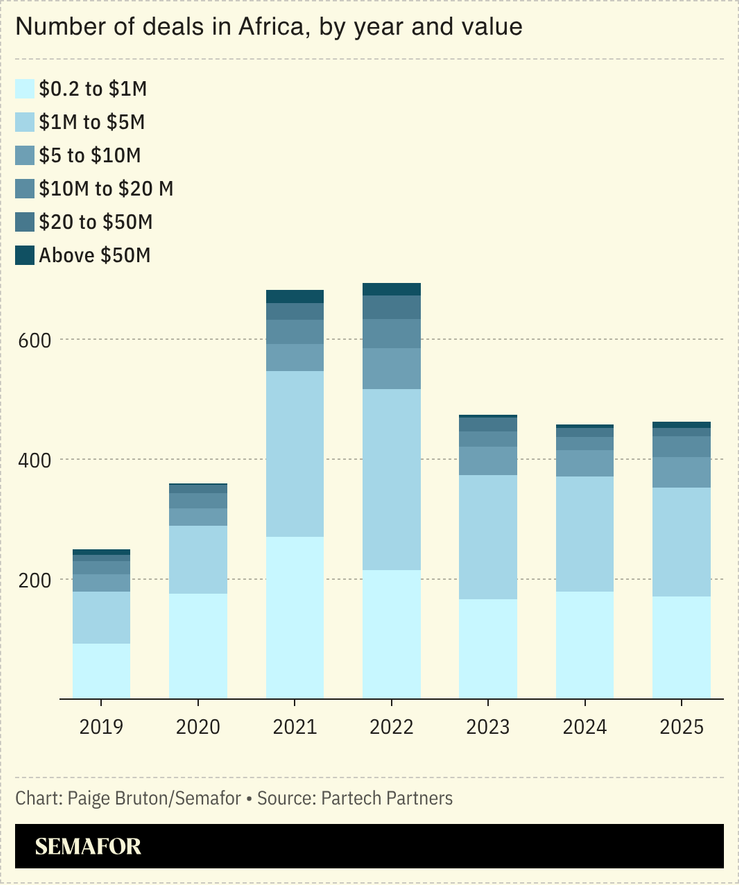
Later stage startups have always attracted more of the available investor money. But in the years following African tech funding’s peak of 2022, the fundraising haul by the more established, larger ventures has become likely to coincide with a drop in what newer startups get from venture capitalists.
Last year marked “a clear shift toward later-stage capital deployment, while early-stage investment remains constrained,” as Senegal-based investor Partech Africa observed in its fundraising report in January. The average investment into a growth-stage startup in 2025 was $50 million due to a 25% annual rise, according to Partech’s data, a far larger increase in average check size than for startups at other stages.
Investors and startup CEOs are keenly studying the variations in how much an African tech startup can hope to raise as a signal for assessing the ecosystem’s health. The sector is aiming to find stability and its new normal, following the much-mourned US investor pullback from the continent with the end of the zero interest rate policy era.

Alexander’s view
It has been clear for a few years that African tech’s ‘hot money’ era is over. What seemed like a low barrier for starting a company and finding investors — spurring viral storylines around 19-year-old blockchain CEOs and other such novelties — has given way to a high sense of precarity for people entering today’s arena.
Startups yet to attain the kind of market stability synonymous with, say, Moniepoint in Nigeria or Tymebank in South Africa, may have to rethink cost structures to be certain that they are operating within positive unit economics. Ambitious entrepreneurs who have modeled their startup on the revered playbook that advises fast growth first and profitability later will have to adapt quickly to the reality that there may not be money in the future to save promising loss makers.
Many fintech companies that are now crucial to African commerce and trade were seeded by venture capital within the last decade. Some are expanding beyond what investors initially backed them for. To back away from today’s class of upstarts suggests a calculated skepticism that they will be as transformative for Africa’s economy within the typical 10-year cycle of VC investments. The Moniepoints and Flutterwaves of the future — if needed — will have to emerge by other financing means.
Investors will ostensibly do what is best for themselves and their backers. Perhaps it is time for African entrepreneurs to do what is best for establishing viable businesses when resources are scarce: profitably making what Africans want and can pay for today, and growing sustainably.

Room for Disagreement
While it is concerning that a newly-founded African startup might struggle to raise money in 2026, that reality is coinciding with an overall “meatier” cohort of startups on the continent, said Eloho Omame, partner at TLCOM, an African startup investor managing over $200 million in assets.
These startups are likely to be run by more experienced entrepreneurs who participated in the highs and lows of the last African startup investment decade, and are equipped to execute better, she said. TLCOM, which has offices in Nairobi and Lagos, still invests about 80% of its funds in early-stage ventures and is prioritizing this class of second-time founders, Omame said. The growing investor bias for the later stage is welcome as it means that exit possibilities for early-stage firms remain available down the line, she said.

The View From Cairo
Mazen Mohamed AL-Morshedy, a Cairo-based associate at startup investor LoftyInc Capital, said an increase in direct startup investments by development finance institutions — most of which target growth stage startups — gives the impression that more mature ventures are attracting greater attention. But “there remains a healthy base of seed focused investors,” he said.
However, VC investments into African early-stage startups is still constrained by a dearth of angel investment networks, syndicates, and high quality accelerators that are necessary to “consistently produce venture-ready companies and replenish the seed pipeline,” Al-Morshedy said.

Notable
- African startups turn inward as the US AI boom drains venture capital on the continent.