




Morgan’s view
President Donald Trump concluded his speech in Beijing today by toasting “the rich and enduring ties between the American and Chinese people” and inviting Chinese leader Xi Jinping to the White House in September.
Xi told American CEOs accompanying Trump that Beijing would “only open wider” to them.
But optimistic talk about deepening the bilateral relationship doesn’t mean that the promises made and deals announced are all real. China watchers should be very skeptical about how much got tangibly agreed to this week.
Take Trump’s announcement that China had agreed to purchase 200 large Boeing planes. News of that purchase saw the company’s stock slide — a sign that the deal fell short of expectations.
On artificial intelligence, Treasury Secretary Scott Bessent told CNBC this morning that the US and China would start a channel to discuss “guardrails” — apparently a resurrection of a channel that former President Joe Biden set up during his own meeting with Xi, which never amounted to much.
Beijing’s commitment to ramp up its purchases of US soybeans may bear more fruit, which would be particularly helpful to farmers walloped by Trump’s tariffs, but its track record on following through there isn’t top-notch.
China only made good on 58% of the overall US goods and services it agreed to as part of Trump’s first-term trade talks, according to analysis from the Peterson Institute for International Economics. Aircraft purchases were among the promises that China evaded then.
When it comes to export controls and rare earths — at the center of global US-China competition — the White House and Chinese readouts suggest Trump and Xi may not have discussed them substantively at all.
Looking beyond deals to geopolitics, the signs of progress aren’t piling up either. Xi warned Trump on the perennially thorny issue of Taiwan, which the US president also vowed to raise, but neither side has pointed to a clear step forward. And despite the White House saying the two leaders “agreed that the Strait of Hormuz must remain open,” China is said to be preparing to surreptitiously send arms to its ally Iran.
When I asked one former US official for their take on Trump’s trip so far, they responded: “Seems like a nothingburger.”
Recent history offers a useful lesson here. Though Trump hates to admit it, his first-term deal with Beijing fizzled. “The Chinese didn’t honor it,” Trump’s former national security adviser, Robert O’Brien, told me during the 2024 campaign.
Even more recently, the multitrillion-dollar deal package that Trump rolled out during his Gulf trip last year ultimately proved smaller in reality, once preexisting and repackaged deals were counted out of the math.
As our Liz Hoffman reported last year, Trump’s claim to $16 trillion in total US investment commitments during his second term so far would pad the entire US economic output by more than half … if it were true.
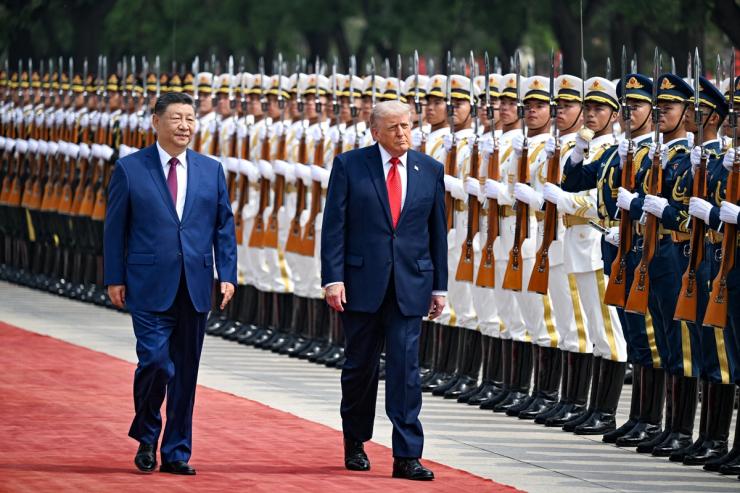
But the main product of this China trip is closer to what we can see: pomp and circumstance.
The White House insists Trump has achieved what he set out to do in Beijing.
“President Trump is the Dealmaker in Chief who means what he says and gets things done,” White House spokesman Kush Desai told Semafor. “His historic visit to China is proof of that, with the President delivering on the Administration’s clear objectives on leveling the playing field on trade and advancing commercial ties.”
In this article:

Room for Disagreement
Trump’s trip isn’t over just yet, and there are still more announcements — not to mention theatrics — that promise to legitimately worry China hawks who are still bruised from last year’s TikTok saga.
Conservatives are panicked about the prospect of increasing Chinese investment in the US, which runs counter to the strategy of “strategic decoupling” set in motion by trade adviser Bob Lighthizer during Trump’s first term. Earlier today, Bessent said that a potential “Board of Investment” being set up would look at “nonstrategic, nonsensitive areas” where China can invest directly in the US.
“We’ve seen Chinese companies weaponize their investments to hollow out American companies in critical industries like healthcare,” the Hudson Institute’s Michael Sobolik told me. “As a general matter, I don’t understand why we’d try and decouple our own exposure to Chinese supply chains, and then turn around and further integrate Beijing into our own economy.”
“We’ll see what specifics emerge,” he said.

Notable
- US Trade Representative Jamieson Greer called for a “pragmatic” approach to China during an interview at Semafor World Economy earlier this year.
- The Justice Department plans to drop charges against an Indian billionaire after his Trump-connected lawyer highlighted his pledge to invest $10 billion in the US economy, The New York Times reported.