



The News
US Trade Representative Jamieson Greer pushed for a “pragmatic” approach to China, a warmer stance than many analysts have expected ahead of a visit by President Donald Trump.
Tensions have been mounting between the US and China ahead of next month’s Beijing summit, though Greer voiced confidence the two superpowers will land on a deal that would set up two boards, with representatives from both governments, managing trade and investment between the world’s two largest economies.
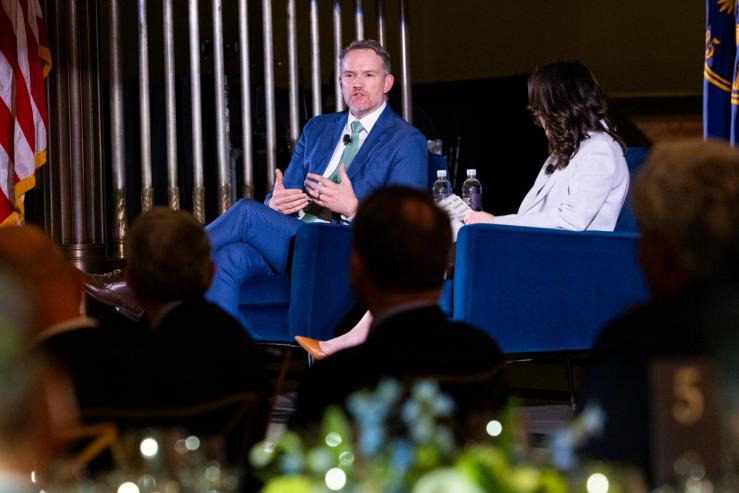
“There’s not going to be a situation where there’s just no trade between the United States and China,” Greer told Semafor’s Liz Hoffman at Semafor World Economy. “Our job is to manage that relationship in a way that protects our national and economic security but also acknowledges reality.
“There are things we need to import from China; there are things China should be buying from us,” he continued. “And China agrees with us on that.”

Step Back
Greer laid out what a US-China board of investment could look like. Treasury Secretary Scott Bessent publicly floated the idea at Semafor World Economy on Monday.
“It’s not some big investment program; that’s not what this is about,” Greer said. “It’s really about having a venue to talk about discrete investment-related issues. There is cross-border investment between the US and China; there are other mechanisms that manage it, like CFIUS. … It doesn’t affect that. It’s really a government forum to talk about investment issues that come up.”
“What’s not going to happen is we’re not going to do what Washington tried to do for 25 years, which is, go to the Chinese and say, ‘We’re going to pretend they’re going to become a market economy,’” Greer added. “They’re not going to put their hand on Mao’s Little Red Book and swear that, ‘We’re not going to be communists.’”

Know More
In a 20-minute interview at the National Archives, Greer offered a broad defense of US trade policy, including:
Whether export controls are on the table during Trump’s China visit: “No. ... I’ll just elaborate just a little bit: Export controls, these are national security decisions made by the United States of America, made by our government. The Chinese always raise these things. They always talk about these things. But it’s something that we decide as a government.”
Critiques that the Trump administration could be reverse-engineering its Section 301 trade investigations: “We don’t prejudge it, right? It’s a legal process. … But the reality is, the president’s tariffs he did on an emergency basis, the temporary [Section 122] tariffs he has now, and the [Section 301] ones we’re doing now, they always have the same basic issue, which is massive imbalances, driven in many cases by unfair trading practices and non-reciprocal terms of trade with the United States.”
Whether he’s concerned by declining manufacturing construction spending: “There’s a strong demand signal for manufacturing labor.” Greer pointed to indicators like rising manufacturing workers’ wages and overtime hours: “We’re really positive about this.” He also called out the pharmaceutical industry, which he said “has been incredibly responsive to the call to reindustrialize.”
Whether the Trump administration anticipated China’s rare earths embargo: “Well, we’ve always known they have that leverage. We’ve always known that.”
How he’ll measure success in a year: “I have three metrics I’m looking at. One of them is, what is the direction in the US trade deficit in goods? … The other one is, we want to see increases in real wages, right? … And then the last metric is the one that I’m quite focused on, and this is having more manufacturing as a share of GDP.”