



The Scene
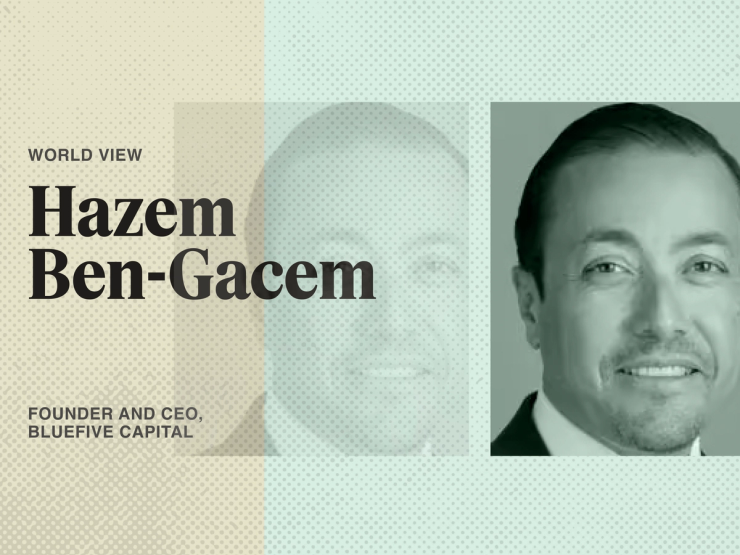
With drones and missiles still being regularly intercepted overhead, BlueFive Capital founder and CEO Hazem Ben-Gacem cooked up a play in the defense industry, over a Ramadan meal with companions with ties to a Gulf sovereign fund.
Six months later, BlueFive is “ready to launch it,” Ben-Gacem told Semafor in an interview in Dubai, while staying coy on further details. At the helm of one of the region’s fastest-growing funds, Abu Dhabi-based BlueFive Capital is not slowing down, even in wartime, and Ben-Gacem says neither are the Gulf’s sovereigns; he counts members of each of the region’s royal families, except Qatar, as founding shareholders.
The 30-year veteran of Investcorp left in 2024 to found BlueFive, which now has $15 billion in assets under management. Among its deals in the last year, it has taken a 30% stake in supercar company Bugatti and backed an Islamic digital bank.
While Ben-Gacem said fundraising isn’t easy — “it’s a pain in the you-know-what,” he said to a group of private capital investors in Dubai last week — BlueFive’s $3 billion Onyx Fund, to back AI, biotech, and advanced computing in the US and Europe, was closed just before the war. Pitchbook called it a “standout” in an otherwise muted year for regional private equity.
The firm’s AI strategy reflects, in part, demographics in the Gulf, which relies on expat labor, especially for its services and tourism industries. “Addressing [that gap] today through automation is an important trend,” he said. “Not much different from what Thailand and China are doing.” BlueFive has opened an office in Beijing and will add another in Indonesia, the world’s most-populous Muslim nation, to seize on growing demand for Islamic products.
“The same way I feel good having a ‘Made in Italy’ label on my suit, when I’m in Jakarta or Kuala Lumpur, and I buy a Sharia-compliant product I want to have a ‘Made in Mecca’ label on it,” he said.
Ben-Gacem is eyeing another, more unusual target: BlueFive could look to do a deal for one of the region’s local stock exchanges, to convert to an exchange for digital assets.

Q&A
Kelsey Warner: We find ourselves sitting in a regional war and facing a lot of uncertainty. What have been the challenges for you this year?
Hazem Ben-Gacem: This is not like World War Z where people are running around and scared and supermarkets are empty. I’m surprised that there’s no difference in the pace and scale of investment, particularly in those strategic sectors that continue to accelerate: technology, agri [and food security], infra.
The bulk of our LPs tend to be entrepreneurial sovereign pockets. Our discussions are not, ‘let’s slow down.’ It’s more like ‘we want to do this, can you do it with us?’ Even the smaller ones, even Bahrain, have a clear agenda where they want to deploy their capital. Obviously, a lot of it is strategic maneuvering to make sure they are prepared for the future, and that’s what our conversations tend to be about, as opposed to more defensive lines.
You’ve opened an office in Beijing and invested in a Chinese AI generative video company. What’s the strategy there?
We have set up quite a substantial team out of Beijing. We deployed about $1.2 billion in China. A lot of those investments are for the purpose of technology transfer to the [Gulf region]. We announced the first such business called CargoX, which is autonomous delivery.
We should be announcing a presence in Jakarta, the world’s most populous Muslim nation. I’m really surprised by this increased appetite for Islamic products. I didn’t expect it. I felt like the world has moved away from that, and that’s getting the biggest traction in Southeast Asia, Indonesia, Malaysia, Bangladesh, India. We took over one of the big Sharia-compliant asset managers, Sidra Capital. Now, why is that? The same way I feel good having a “Made in Italy” label on my suit, when I’m in Jakarta or Kuala Lumpur, and I buy a Sharia-compliant product I want to have a “Made in Mecca” label on it. That’s priceless.
If you had to give advice to your peers in the region about striking out on their own, what would you tell them?
The region is tribal still. Our investors, it’s not like they haven’t seen Blackstone or Goldman Sachs or Accel Partners or Andreessen Horowitz. But they give us money. Because it’s much more than just, I’m an LP and I’m going to give money to this GP to make my returns. I want to do it with a partner I trust.

Notable
- BlueFive Capital is in the mix for a possible take-private of US fast-food chain Wendy’s as Nelson Peltz’s Trian Fund Management works on a deal with backing from a consortium of investors, the Financial Times reported.