




The News
Xenophobic unrest in South Africa has become a painful cost of doing business, executives warned, signalling that companies are bracing for prolonged instability in a country eager to draw fresh investment.
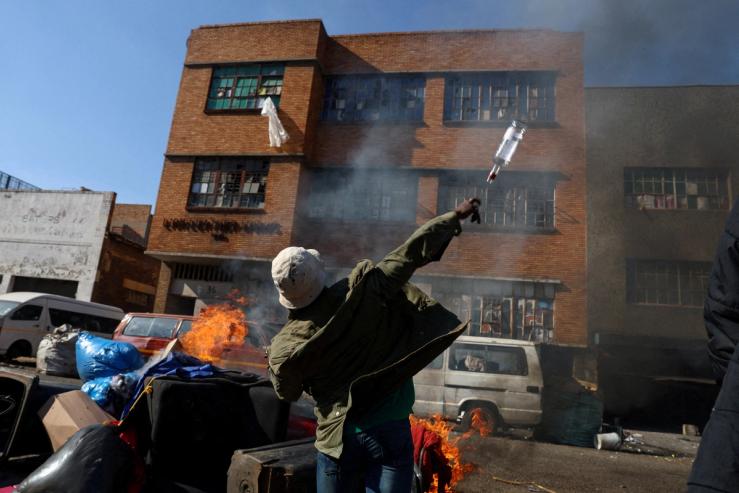
Just over a week after mass protests froze parts of Johannesburg, Durban and Pretoria — shuttering retail districts and triggering emergency security protocols — executives say the threat of renewed disruption has soured boardroom sentiment in an economy already grappling with the world’s highest unemployment rate, collapsing municipal services, and intensifying political agitation.
Economists say an exodus of foreign workers, which anti-migrant protesters are demanding, will trigger labor shortages and economic blowback, ultimately harming local businesses and informal markets that activists say they want to protect.
Sim Tshabalala, chief executive of Standard Bank Group, linked the instability to institutional failures, warning that xenophobia is an economic and geopolitical liability. Stronger border management and a rational migration system would have delivered “significantly faster growth and much lower unemployment,” Tshabalala told reporters last week.
“Our collective folly and ineptitude on migration have lost us the moral high ground in Africa, making it harder for South African businesses to trade in the rest of our continent,” he said.
For companies that move goods along the N3 corridor — the Durban port to Gauteng industrial belt that carries hundreds of millions of dollars in exports and domestic freight each day — contingency planning is already adding millions of dollars to operating budgets and shaving margins in an economy still struggling to regain momentum.
“We are pricing for the possibility that some days will be constrained,” said a senior logistics executive who declined to be named because of contractual sensitivities. “That changes how we run the business.”
Gavin Kelly, chief executive of the Road Freight Association, warned that a promise from organizers to hold weekly marches until their demands are met has left the sector bracing for further disruption. “That is of concern as this can only lead to a heightened risk of violence should the demands/expectations not be met,” he said.
Since last week’s rallies, organizers have begun acting as vigilante labor inspectors — entering factories to check for foreign workers, forcing meetings with managers and shutting down spaza shops, or informal convenience stores, they claim employ migrants. Iqbal Ismail, chairperson of the eThekwini Clothing and Leather Association, said that clothing factories in the garment manufacturing hub of Newcastle are already shutting down operations.
“Our sector will 100% collapse if migrants suddenly disappear from our factories,” said Ismail, who employs 150 workers, only 30 of whom are South African.
In this article:

Know More
Thousands of African migrants have already fled their homes and workplaces in months, with several countries, including Ghana, Malawi, and Nigeria launching state-funded evacuation flights.
South Africa’s history of violent anti-immigration riots stretches back to 2008, peaking again in 2015, 2019, and 2021, fueled by socioeconomic discontent. Unemployment remains above 30%, making migrants easy political targets for frustrated communities and opportunistic actors.
Public distrust of African immigrants in South Africa climbed to more than 73% in 2025, up from 62% four years earlier, according to the Inclusive Society Institute, a Cape Town-based think tank. Outfits like anti-migrant vigilante group March and March have capitalized on this shift, conducting aggressive so-called “citizens’ audits” of small businesses, blockading public health facilities, and setting up unauthorized checkpoints outside schools to vet individuals based on language, accent, and documentation.
But since 2025, the March on March movement has moved away from sporadic skirmishes to a highly organized city-by-city campaign, drawing speculation from senior government leaders such as acting police minister Firoz Cachalia and former president Thabo Mbeki that it is managed by influential political backers rather than shapeless crowds fed up with job losses and poverty.
Analysts warned that the protests also risk straining South Africa’s security sector — which may further dampen business sentiment — considering the deployment required to prevent last week’s demonstrations from spiralling. “Maintaining this level of deployment — including police, intelligence coordination, and aerial support — may prove costly and difficult over the next six months,” the global monitor ACLED said.

Tiisetso’s view
There is a deliberate, almost theatrical evasiveness in how South Africa’s elite talk about this crisis — a language designed to contain diplomatic fallout while leaving the problem to fester. Officials pivot to “vigilantism” and “law and order,” treating targeted intimidation as a policing issue rather than naming the xenophobic sentiment that drives it.
Groups such as March and March cultivate a professional veneer to mask tactics that make life unlivable for migrants. Gatekeeping at clinics and schools, “citizens’ arrests,” and coordinated online campaigns that manufacture panic.
That semantic sleight‑of‑hand matters because words shape policy. If the state refuses to call out the motive, it avoids the hard fixes — humane migration processing, consistent labor enforcement, and accountable political leadership. Tshabalala’s bluntness about the economic cost is the rare honest signal here; business will not be pacified by euphemisms. Pretoria must stop policing symptoms and start rebuilding institutions.

Room for Disagreement
In a televised speech in recent weeks — organized specifically to announce an immigration crackdown — President Cyril Ramaphosa refused to call out deep-seated prejudices driving the campaigns, saying “we know that South Africans are not xenophobic.” He blamed the rallies on “opportunists who are exploiting the legitimate grievances, particularly those of the poor, under the false guise of ‘community activism.’”

Notable
- An Institute for Security Studies’ investigation reveals South Africa’s recent populist shutdown was artificially manufactured by paid online networks.