




The News
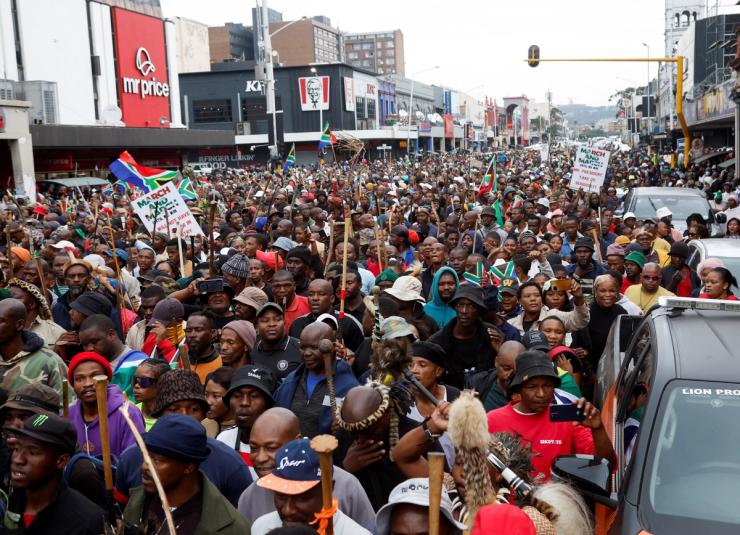
South Africa’s anti-migrant protest leaders vowed a rolling campaign targeting the country’s commercial hubs after tense nationwide protests ended with activists giving the government six months to enforce mass deportations and workplace quotas.
Demonstrations on Tuesday, to mark a deadline set by vigilante groups for undocumented migrants to leave the country, followed months of xenophobic violence in the world’s most unequal society, where one in three is unemployed and municipal services are failing.
“Every Thursday, for the next six months, we are marching until they are gone,” said Jacinata Ngobese-Zuma, leader of civic group March on March, whose grassroots advocacy frequently spills into vigilante-style violence.
The ultimatum puts South Africa on a knife-edge and heaps pressure on President Cyril Ramaphosa to make good on his promises last month to cut off undocumented migrants from Africa’s biggest economy through deportations, workplace inspections, and new penalties for employers who hire undocumented workers.

Know More
Thousands of African migrants had already fled their homes and workplaces in the days leading up to Tuesday’s protest, according to consular officials. Several countries, including Ghana, Nigeria, and Malawi, launched state-funded evacuation flights. In Johannesburg’s inner city, entire blocks fell silent as street vendors cleared out and retail shops pulled steel shutters down, conjuring up memories of the 2020 pandemic lockdowns.
South Africa’s history of violent anti-immigration riots stretches back to 2009, peaking again in 2015, 2019, and 2021, fueled by socioeconomic discontent. Unemployment remains above 30%, making migrants easy political targets for frustrated communities and opportunistic actors.
Public distrust of African immigrants in South Africa climbed to more than 73% in 2025, up from 62% four years earlier, according to the Inclusive Society Institute, a Cape Town-based policy think tank. Outfits like anti-migrant vigilante group March and March have capitalized on this shift, expanding their footprint from the coastal KwaZulu-Natal province directly into economic hubs such as Gauteng. Armed with traditional weapons, whips, and pepper spray, these groups have conducted aggressive so-called “citizens’ audits” of small businesses, blockaded public health facilities, and set up unauthorized checkpoints outside schools to vet individuals based on language, accent, and documentation.
But since 2025, the March on March movement has moved away from sporadic skirmishes to a highly organized city-by-city campaign, drawing speculation from senior government leaders such as acting police minister Firoz Cachalia and former president Thabo Mbeki that it is managed by influential political backers rather than shapeless crowds fed up with job losses and poverty.
Investigative reporting this week by amaBhungane — an influential South African investigative journalism platform — shows that March on March leadership includes figures who move within former president Jacob Zuma’s family orbit. Zuma’s MK Party has publicly signaled support for the demonstrations even as ANC leaders accuse Zuma of “stoking the fires” and reviving the specter of the 2021 unrest.

Step Back
Vanya Gastrow, a researcher at the Institute for Security Studies think tank said the large-scale loss of migrant workers from an economy “often produce displacement, economic disruption, and diplomatic fallouts, sometimes for decades.”
Gastrow cited Ghana and Uganda as historical parallels. Accra’s 1969 migrant expulsion and Uganda’s mass ban three years later both triggered capital flight and supply chain chaos. “South Africa’s government must think carefully about the direction it is taking.”

Tiisetso’s view
South Africa’s political class will spend the week congratulating itself for a peaceful protest. That’s a wrong metric. The country’s economic hubs — Johannesburg, Durban, Cape Town – were partially shut down because a civic movement, not the state, dictated the tempo. That is a warning shot.
South Africa has now demonstrated — twice in five years — that its economic arteries can be shut down when pressure builds. The 2021 unrest, when tens of thousands ran amok, looting and torching shopping malls and trucks, showed what happens when failure to deliver basic services, corruption-driven state paralysis, and criminal opportunism combined to produce the most expensive civil disorder in post-apartheid South Africa. This week’s shutdown was the peaceful sequel. Same vulnerability, different tactics.
Pretoria responded to the threat of violence in June 30 protests with millions of dollars shuffled inside the police budget, tactical units deployed, and soldiers on standby. But none of it touches the underlying problem. Africa’s biggest economy is buckling under a more than 30% unemployment rate, rising food inflation, and an informal retail sector where millions compete for survival. This week’s peaceful marches demonstrated that the squeeze is still there and remains potent. A government that cannot deliver jobs, services or clean governance will continue to face mobilization from citizens who feel abandoned, and opportunists who see weakness as an opening.
The absence of violence this week is not evidence of stability. It is evidence of how easily South Africa’s economic core can be bent — and how little authority the state can project when confronted with organized pressure.
South Africa avoided another 2021. But it also confirmed why 2021 happened. Policymakers should treat it as a reminder that the country’s foundations are still cracking — and if the drift continues, the next rupture will be something darker.

Room for Disagreement
State officials downplayed the threat of a prolonged siege, dismissing the prospect of weekly disruptions as standard white noise. “We’re not worried, because there have been demonstrations every day since the beginning of June and we’ve been making sure they are peaceful,” said Khumbudzo Ntshavheni, a minister in Ramaphosa’s office.
Justice minister Mmamoloko Kubayi said South Africa had learned lessons from the unrest in 2021, which was triggered by the jailing of former president Jacob Zuma. “The message was clear from South Africans that July 2021 must not happen again … we will ensure there’s law and order that happened today.”

Notable
- Tunisia has been gripped by racially motivated violence, arbitrary detentions, and the forceful expulsion of migrants to remote border areas after President Kais Saied accused sub-Saharan migrants of a conspiracy to change the country’s demographics.