


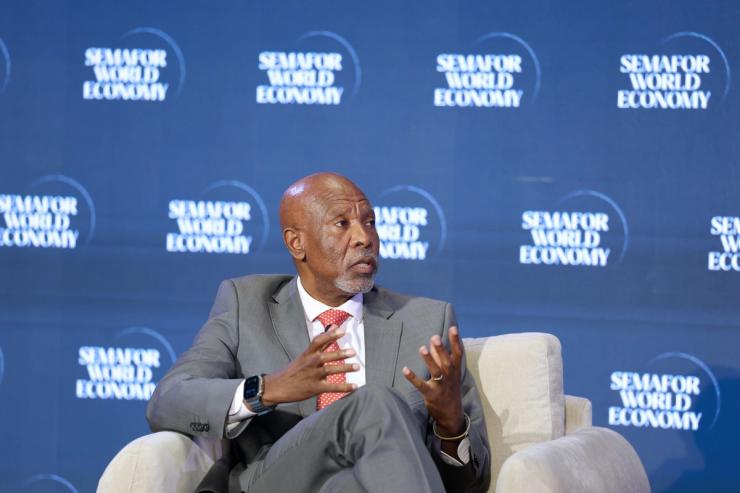

The News
South Africa’s central bank governor broke sharply with the global “wait-and-see” mood about the impact of the Iran war, saying the bank cannot be “complacent” and will not wait for early price shocks to filter through Africa’s biggest economy.
Letsetja Kganyago’s comments at Semafor World Economy in Washington, DC, open up the possibility of interest rate hikes before fuel and fertilizer shocks bleed into wages, transport, and broader price-setting behavior.
“It is important to anticipate any evidence that will start emerging that would suggest that the second-round effects could kick in and you react to that,” Kganyago said. “You don’t wait for the second round effects to arrive; by that time it’s too late.”
His comments make South Africa stand out globally for rejecting the “wait-and-see” approach now common among major central banks following the onset of the Israel-US war against Iran.
Kganyago said the current inflation environment was more complicated than a typical one-off shock, describing it as a sequence of shocks hitting South Africa through fuel and fertilizer markets.
The first impact comes through global fuel prices, which feed directly into transport and logistics, and the second comes via fertilizer, a critical input for South Africa’s agricultural sector. “In both cases, the price effect matters, but what matters even more is whether you have access to the product in the first place,” he said.
He warned that the coming planting season — starting in October and November — will depend heavily on where fertilizer prices settle in the second half of the year. If fertilizer prices remain expensive or scarce, food prices could accelerate even if South African produces a surplus.

Know More
Kganyago’s stance places South Africa outside the dominant global monetary mood. Most major central banks — including the Federal Reserve, the European Central Bank and the Bank of England — have shifted into a wait-and-see posture, meaning they want more evidence before adjusting policy.
The South African Reserve Bank is among the first emerging market central banks to signal that cuts are not guaranteed and hikes remain possible.
The bank left rates unchanged at its last meeting in March, extending a hawkish hold to the second straight meeting, and effectively pushed out the prospect of rate cuts. Its latest projections show interest rates remain unchanged for longer than previously expected, postponing cuts that had been pencilled in earlier this year.
The monetary policy committee laid out two adverse scenarios. In the first, the conflict lasts another two months, oil prices average close to $100 a barrel, and the rand weakens by about 5%.
A more severe scenario assumes the war drags on for more than a year, keeping oil prices above $100 a barrel and weakening the rand by around 10%. Under both conditions, the bank — whose MPC is due to meet again in May — would need to hike rates this year.

Notable
- Kenya’s central bank decided to hold its benchmark rate at its meeting last year, ending an easing cycle that began almost two years ago as policymakers gauge the likely impact of the Middle East conflict.