



The News
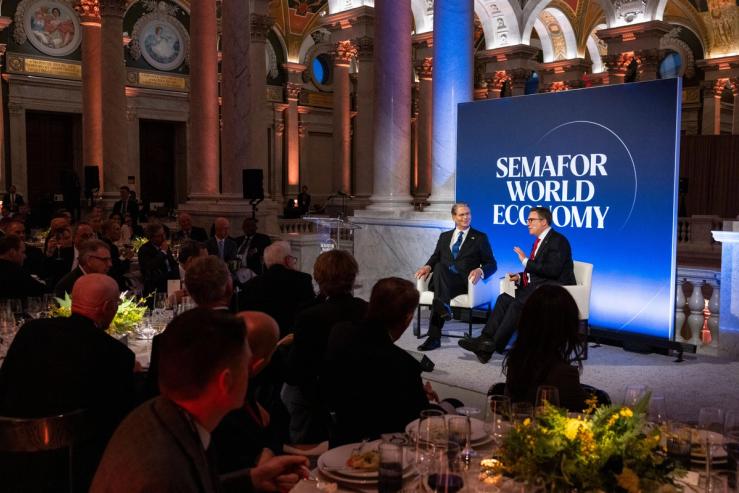
The Federal Reserve should “wait and see” before deciding whether to lower interest rates amid the war in Iran, US Treasury Secretary Scott Bessent said Monday at Semafor World Economy in Washington, DC.
“Do I think rates should be lowered? Eventually. I think now that we have to wait and see,” Bessent told Semafor Editor-in-Chief Ben Smith. “But I think as we went into January [and] came out of January and February — the economy was very strong.”
US President Donald Trump has spent much of his second administration lobbying for the central bank to slash interest rates. For now, “the Fed is doing the right thing by sitting and watching” how the Iran conflict plays out, Bessent said.
Bessent said he’s confident recent price increases won’t permanently alter how consumers view the economy. The US government said Friday that inflation rose three times faster in March than it did in February amid surging oil and gas costs. Inflation excluding food and energy, however, rose slightly less than forecasters had anticipated.
“If ever there was ‘Team Transitory,’ it’s this,” Bessent said. “I don’t believe this is going to get embedded into inflation expectations.”
Asked whether the war in Iran would wind up being good or bad for the US economy, Bessent said: “I think we will look back and say — I don’t know the number of days, whether it’s 50 or 100 or more — for 50 years of stability.”
Bessent also said he thought in February that the economy would have grown more than 4% this year. Asked whether he still thought that, he said: “Obviously, we’re going to have some make-up to do from this quarter.”
“But in theory there will be a big catch-up,” Bessent added.
In this article:

Know More
In a 23-minute interview at the Semafor World Economy’s inaugural Treasury Secretary Dinner at the Library of Congress, Bessent weighed in on a range of other subjects, including:
A forthcoming executive order requiring banks to collect citizenship information on their customers: “It’s in process. And I don’t think it’s unreasonable, because: Why don’t we have information on who’s in our banking system? I have a place in the UK; they want to know who lives in every apartment. And how do we know that it’s not part of a foreign terrorist organization?”
On Kevin Warsh’s pending nomination to the Fed: “My criteria was: Who has an open mind? … With the Fed, you expect a monetary policy guru. But you never think there’s this sprawling organization out there. … He’ll have an open mind on monetary policy, because you have to bring the board along with you, but I think he’s going to do a serious look at how the reserve banks interact, because I think the reserve banks [are] a management disaster, because something like 50% of the people in each reserve bank do not report to the president of that reserve bank.”
On Sen. Thom Tillis, R-N.C., opposing Warsh’s nomination over the Trump administration’s investigation into Fed Chair Jerome Powell: “We will have to see what Senator Tillis needs to do.”
On potential insider trading in prediction markets: “I spoke to the head of the CFTC the other day” and the agency “didn’t notice anything unusual. … I would use them more as a tool, because what eople always forget in markets is what’s priced in and what’s unexpected. So I think the good thing about prediction markets is it tells you where the consensus is.”
On concerns over AI making banks vulnerable to cyberattacks: Bessent called reports of a recent meeting with bank CEOs over Anthropic’s Mythos “overdramatized,” adding: “The CEOs happened to be in town, so it was much more convenient just to bring them in and just talk about the cybersecurity of what’s happening with these large language models and to get their thoughts on the way forward.”
On whether Treasury would work with Anthropic on those concerns: “Of course, of course. They have a very specific issue with DOW. So to the extent that they are widely used in the market, we will work with them.”
On fears the war in Iran could weaken the US dollar: “Well, as you’ve seen during the war, the dollar’s strengthened. So I’m not worried about that.”
On whether the US underestimated China’s rare-earths leverage: “I actually think they miscalculated, because … three times in five years, [they] have proved that they’re not a reliable supplier.” He pointed to Covid, rare earths; and most recently, energy products: “It’s not a great business.”
On whether Trump should entertain allowing Chinese automakers to build US factories ahead of an upcoming visit to Beijing: “I think what we’re thinking of is two boards: a Board of Trade and maybe a Board of Investment. I’m not sure. … There are things; I would think maybe the auto industry isn’t one of them. I have a house out in the country and there are a lot of BYDs. A lot of my neighbors have their small SUV, and I will tell you, it is the best $75,000 car that $35,000 can buy. It is clearly highly subsidized.”

Transcript
Ben Smith: “Thank you all so much for coming, and thank you for joining us, secretary. And I thought I would just start, as you take a sip of water, with the big picture. You have been moving in recent weeks, very kind of quickly and tactically, to try to keep oil prices under control, and they’re lower I think than people thought they would be —”
Scott Bessent: “As of today, the stock market is higher than on Feb. 27 — but nobody’s keeping score.”
Ben Smith: “But nobody is keeping score, so that is why we have brought you here. But what I was going to say is there’s a lot of inflationary pressure. The core inflation was OK, but the numbers last week were pretty bad. There’s — defense spending is going up, reshoring the economy. And I guess I wonder, to start with the big picture, if you could talk about just how you’re thinking about inflation.”
Scott Bessent: “Well, I’m thinking that if ever there was ‘Team Transitory,’ it’s this. I don’t believe this is going to get embedded into inflation expectations. We can see forward inflation expectations; they are well-anchored. And core inflation is coming down. And traditionally, as we’ve seen, the fourth and first quarter actually have been very noisy numbers that tend to err on the high side. I think at a point this war will end and things will normalize – and I think the Fed is doing the right thing by sitting and watching. I would be shocked if, for instance, the [European Central Bank] hiked, although I do have to say that many European countries, [like] the UK, [and] many Asian countries are subsidizing demand, which we haven’t done in the US.”
Ben Smith: “Peter Orszag, the Lazard president, said at our event today that — and I think a lot of people feel this — that there’s a roadrunner effect where the supply shock hasn’t made its way through the system yet, but that we’re out over the cliff.”
Scott Bessent: “Yeah, I think that’s wrong. I mean, that’s what an OMB guy would say. That’s why they split — that’s why I’m not called the finance minister. Because OMB is on one side, Treasury secretary is on the other, and you get to be both if you’re a finance minister.”
Ben Smith: “Fighting words. How do you square this environment with your desire to cut interest rates?”
Scott Bessent: “In terms of: Do I think rates should be lowered? Eventually. I think now that we have to wait and see; we have to wait and see what happens to the economy. But I think as we went into January [and] came out of January and February, the economy was very strong. I know you have a lot of CEOs here; I have a lot of CEOs who come through Treasury. And during my investment career, I always had a saying: ‘The micro drives the macro.’ So what my firm was never good at is trying to calculate the CPI within a tenth or GDP or non-farm payrolls. What we were good at was talking to a lot of CEOs and getting an underlying feel for the economy — and whether it was airlines or trucking or retail, things were very, very strong [before the war]. So I do think that there is quite a bit of momentum in the economy.”
Ben Smith: “Do you think when we look back on this moment, we’ll say the Iran war was bad for the economy; that it was good for the economy; that it was a wash?”
Scott Bessent: “I think that we will look back and say that it was — I don’t know the number of days, whether it’s 50 or 100 or more — for 50 years of stability. To the extent in my investment career [that] I had a strength, that was as a risk manager. And the biggest risk, or the worst risk, is one you don’t know you’re taking. So there was the illusion of security in the Gulf. It is strange when you think that oil coming out of the Gulf, that the shutdown of the Strait was always there, the potential — but it was never at a premium price. It’s abundant. Or the risk management by some of the Asian countries that would get such a large percentage of their energy from the region.”
Ben Smith: “You’ve said that you got into public service to repair the fiscal policy and bring deficits down to 3%. The CBO says we’re on track to double that this year. Has this been harder than you thought it would be, that element of this, from being in government?”
Scott Bessent: “Hearing people talk about the CBO is harder than [I thought].”
Ben Smith: “So where do you think we’ll go this year?”
Scott Bessent: “Well, I don’t know yet, but again, I actually think the important and the number you’re thinking about is deficit to GDP, which is the important number. We have a shocking level of debt, but it is possible to grow your way out of it. And for whatever reason, the CBO maintains growth at a static level of 1.7, 1.8%. So even if the tax bill hadn’t passed and we’d had the largest tax increase in history, they’re projecting 1.7 or 1.8[%] — or we had a very stimulative tax bill, and they’re still at 1.8[%]. So I’m very optimistic on our ability to constrain spending and then grow our way out.”
Ben Smith: “You have a building full of very smart people. What estimates are you seeing for growth this year, for deficit to GDP this year, if you don’t buy the CBO’s [estimate]?”
Scott Bessent: “I would have told you in February that I thought growth was going to be over 4%.”
Ben Smith: “You still think that?”
Scott Bessent: “Obviously, we’re going to have some make-up to do from this quarter, but in theory there’ll be a big catch-up.”
Ben Smith: “Didn’t Lutnick say 6%? I won’t hold you to that.”
Scott Bessent: “I’m not sure whether he meant real or nominal.”
Ben Smith: “That’s where they get you. I think, in your 3-3-3 plan, do you think there is a way to get there without raising taxes?”
Scott Bessent: “Sure. I do think the growth potential in the US was really held back. If I think about when I joined, three of my goals: We needed better or more fiscal rectitude and to be able to bring the deficit down or grow our way out of it. We needed to onshore supply chains. And [we needed to] have more resilience. But what I didn’t realize was the deregulatory part. We always make fun of the Europeans — ‘oh, the Germans want to deindustrialize, they’ve done this, their policies’ — I think until I got in this seat that I didn’t realize the inability of the US, that we layered all these regulations on top and our ability to actually manufacture things here had really been undone just by the administrative state and layers on layers, especially, of environmental policy or just like bureaucrats who had pet projects, and the thought of American business that —whether it was the EPA or Labor or some [other] department — was going to come and get them.”
Ben Smith: “As you were talking, I was just thinking that if we were sitting here a year ago, I would be saying, ‘Elon Musk, DOGE, what do you think? How’s it going?’ And sort of in retrospect: What was that?”
Scott Bessent: “Look, I think it was a much-needed idea and I think a lot of it has gotten done, in terms of bringing down headcount and expenses. I, until recently, was also the acting commissioner of the IRS, but now I serve the duties of the commissioner because it floats up to me as Treasury secretary when there’s not a commissioner, and it was just cr— so, for the misnamed Inflation Reduction Act, Democrats added 20,000 new IRS agents and they got a score for more revenues. And I can tell you: We’ve taken that down and collections are up.”
Ben Smith: “I was just talking to a lawyer who represents, possibly in this room, some very major clients with a lot of tax questions for the government and they said to me, ‘I’m telling my clients: Don’t worry about it. IRS is understaffed, underwater. If it’s a close call, don’t pay the tax.’”
Scott Bessent: “I’m not sure, did that really happen or just at the Wall Street Journal?”
Ben Smith: “I swear to God that happened. Just now.”
Scott Bessent: “If you want to give me his client list —”
Ben Smith: “Is that bad advice?”
Scott Bessent: “It’s going to be a rude awakening.”
Ben Smith: “You have a large portfolio, and China is another part of it, along with meeting with all these global bankers this week, with managing the economics of the Iran conflict. You’re leading preparation for trade talks with China in May. Last April you said that China was playing with a ‘pair of twos.’ They then played this rare earths card. Did you guys miscalculate?”
Scott Bessent: “No, I actually think they miscalculated because they had this device or this system that they’d been putting together for 30 years; Deng Xiaoping used to talk about it. And I think that they actually shocked the world, and unfortunately, once again, I would say three times in five years, have proved that they’re not a reliable supplier. So during Covid, they threw down the gates. If you want to be the manufacturer for the world, you’ve got to deliver products. For rare earths — and what’s important there is that it was not just for the United States, it was for the whole world. And April, it was rare earth magnets, and October, it was this rare earth licensing regime. And then now, during the Iran conflict, they’ve stopped exporting energy products, whether it’s jet fuel or gasoline, to their customers in the Far East. So I think it’s not a great business model over the long run.”
Ben Smith: “There are people in China who would like to have one of the outcomes of these talks be some form of joint-venture, BYD factory setting up in the United States. Is that on the table?”
Scott Bessent: “I think we’re going to maybe end up with two boards, a board of trade and maybe a board of investment. I’m not sure — we have a 100% tariff on Chinese EVs, and there is a rule to do with autonomous-driving cars that they cannot have foreign components or Chinese components.”
Ben Smith: “Just to be clear, you don’t like the idea of a BYD factory in the US: American workers, Chinese investment?”
Scott Bessent: “There are things; I would think maybe the auto-industry isn’t one of them. I have a house out in the country and there are a lot of BYDs. A lot of my neighbors have their small SUV, and I will tell you, it is the best $75,000 car that $35,000 can buy. It is clearly highly subsidized. And the electric battery is 100 times more likely to blow up.”
Ben Smith: “Heard it here first: Park it outdoors. You spent a lot of your career in Japan, East Asia, and East Asian leaders seem to feel abandoned by the US right now. You saw the South Korean president’s very angry comments about Israel. I assume they’re calling you. What are you telling them?”
Scott Bessent: “Well, I don’t think the Japanese feel abandoned. We had a great visit —”
Ben Smith: “Well, the Koreans then.”
Scott Bessent: “We had a great visit with the Prime Minister and I haven’t seen the Koreans say, ‘Here, take your troops home.’”
Ben Smith: “You’ve also led a very aggressive campaign against Iran and the economic campaign that kind of preceded the military campaign: sanctions, SWIFT, currency, asset seizures. Those have strengthened the arguments of nations that make the case for getting off the dollar. There’s this IMF report on the rise of gold-backed assets. Do you worry that this war will affect dollar dominance? Just broadly — you think about this a lot — how do you see that picture?”
Scott Bessent: “Well, as we’ve seen during the war, the dollar’s strengthened. So I’m not worried about that. If we look [at] last year, the share of transactions in US dollars was actually up, it was statistically insignificant, but it was up about a percent.”
Ben Smith: “Do you worry about the incentives, I mean, that you’re sending a signal that the dollar’s a weapon?”
Scott Bessent: “Well, look —”
Ben Smith: “And our friend Saleha Mohsin wrote a book about this.”
Scott Bessent: “But think about this, the Russians went out of dollars into euros because they thought the Europeans would be spineless, and the Europeans actually froze their assets. So if you want to be part of any kind of a global order — I do think this is one of the reasons gold’s going up because you can keep gold in your storehouse — but at the end of the day, the vast majority is in dollars. People want to be part of our capital markets, whether it’s equities or debt. You’re asking me who’s getting it right? I can tell you a lot of people are getting it wrong, because where it says the US demand for Treasuries is down, last time I looked, a Treasury bill was a Treasury. So for long-dated coupons, it’s down slightly — and I would assume that probably has something to do with some of the [Gulf Cooperation Council] countries having to fund an operating budget — but in terms of the overall, we had, I think, the second biggest year last year ever for dollar debt.”
Ben Smith: “I asked the secretary what journalists he felt were getting it right. If you do think of any, we continue to be curious. As I go through this, I’m struck by the breadth of your portfolio. You warned in Dallas a few weeks ago about cyber attacks on financial institutions; you brought bankers into your office on Tuesday I guess to really sound the alarm on that. Can you just as specifically as you can —”
Scott Bessent: “It wasn’t really to sound the alarm, it got overdramatized.”
Ben Smith: “The press again.”
Scott Bessent: “Maybe, I was thinking the other day that when we think about yellow journalism, maybe there’s a golden era, like post-World War II up to, 1990, 2000, where journalism was down the middle — but that was the aberration. So, everything before that was highly biased. Maybe we’ve just gone back to the normal equilibrium. But anyway, I think of you more as an intel leader.”
Ben Smith: “I’ll take it.”
Scott Bessent: “But the CEOs happened to be in town so it was much more convenient just to bring them in and just talk about cybersecurity, what’s happening with these large language models, and to get their thoughts on the way forward.”
Ben Smith: “You warned in Dallas about the cyber incident disrupting banks, payment systems, financial market infrastructure. Just specifically as you can: What worries you?”
Scott Bessent: “Well, it’s everything, because we have to be resilient. I do think one of the things that happened was the earth is flat, and lots of stock buybacks and profits at all costs, that we lost this resiliency, whether it was in supply chains or whether it was something like cyber. When you think, what’s the definition of risk? It’s probability and severity. And I think now in cyber, that the probability and the severity of both got worse.”
Ben Smith: “Will you work with Anthropic on this?”
Scott Bessent: “Of course, of course. They have a very specific issue with [Department of War]. So to the extent that they are widely used in the market, we will work with them.”
Ben Smith: “There have been big trades in the prediction markets and in the underlying markets that some people read as indicating advanced knowledge of administration moves around the war and other forms of insider trading. How concerned are you about that?”
Scott Bessent: “I spoke to the head of the CFTC the other day. Their — SEC would be called ‘stock watch’ — so their ‘commodities watch’ didn’t notice anything unusual.”
Ben Smith: “If you were trading, would you be in the prediction markets? How would you think about them?”
Scott Bessent: “I would use them more as a tool. Because what people always forget in markets is what’s priced in and what’s unexpected. So I think the good thing about the prediction markets is it tells you where the consensus is. George Soros used to say, ‘The crowd’s right 88% of the time, but you lose a lot of money, and it’s the 12% where you can really make a lot.’ So if you could look at the prediction market and think, ‘OK, this will be over in three days,’ and think that’s wrong.”
Ben Smith: “A question on domestic policy: There was a report that there’s a discussion of an executive order that would require banks collect citizenship information on their customers. Where does that stand?”
Scott Bessent: “It’s in process, and I don’t think it’s unreasonable, because: Why don’t we have information on who’s in our banking system? I have a place in the UK; they want to know who lives in every apartment. And how do we know that it’s not part of a foreign terrorist organization? Back to your friend from the IRS who says, ‘Don’t worry about it.’”
Ben Smith: “They’re not at the IRS.”
Scott Bessent: “But we are worried about it.”
Ben Smith: “A final question I’m sure a lot of people would like to know: What does a Trump-Warsh Fed look like?”
Scott Bessent: “I ran the process and we started with 11 great candidates; got it down to four. The president met all of them. The question is, what does a Warsh Fed look like? I think everyone would always ask me, ‘Well, what are you looking for in the Fed chair?’ I said, ‘Well, it’s not my decision.’ But as I talked to them, and as I mentioned to you earlier, I’ve probably written 20,000 words in the Fed in the past 10 years — some complimentary, some not. But my criteria was: Who has an open mind? The first female admiral ever, Grace Hopper, said the most dangerous words in the English language are, ‘Well, we’ve always done it that way.’ I think it’s somebody who has to have an open mind — what’s worked, what hasn’t — because the Fed is this very unusual institution. I used to be a trustee at Rockefeller University in New York — very small school, Upper East Side of New York, and it’s 100% graduate students in medical research. But, by charter, the president of Rockefeller has to be a research scientist. I was on the search committee that hired Rick Lipton, who was an A-plus geneticist from Yale. You hire him, and you know you’ve got a great research scientist, but you don’t know: Can he deal with the alumni? Can he run 2,200 employees? Can he deal with the federal government? Can he find his way to the office? And he’s been a great administrator, too. And it’s very similar with the Fed. With the Fed, you expect a monetary policy guru. But you never think there’s a sprawling organization out there. I just think the sprawl — I talked about it in my article in the International Economist called ‘Gain of Function Monetary Policy’ — but it’s been like gain of function, the administrative policy. So I believe that a Warsh Fed, he’ll have an open mind on monetary policy, because you have to bring the board along with you, but I think he’s going to do a serious look at how did the reserve banks interact because I think the reserve banks, it’s a management disaster, because something like 50% of the people in each reserve bank do not report to the president of that reserve bank.”
Ben Smith: “He has written 10,000 words on this. I commend it to you all. It’s genuinely, totally, no one else is writing about this stuff. Last question, do you have a plan to make that happen before [Sen.] Thom Tillis retires to get Warsh in?”
Scott Bessent: “We will have to see what Senator Tillis wants to do.”
Ben Smith: “All right. Well, thank you so much for taking all this time.”
Scott Bessent: “Pleasure.”