




The News
South Africa’s mining minister criticized DR Congo for signing a minerals deal with the US, saying it threatened the sovereignty of the continent’s states by intensifying the scramble for Africa’s natural resources.
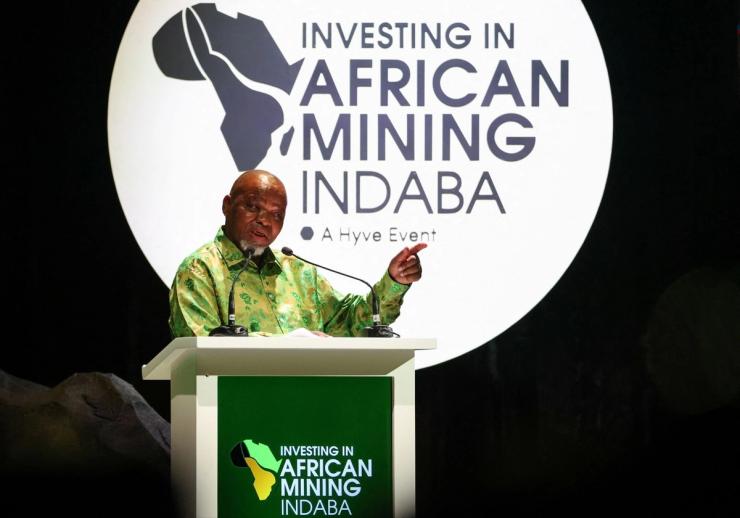
Gwede Mantashe, speaking at the Mining Indaba conference in Cape Town, instead urged African states to “deepen collaboration” with each other. “It can’t be about you. It should be about us all in the region,” said Mantashe. He told reporters on Monday that he clashed with his counterpart from DR Congo at a ministerial meeting a day earlier due to the deal Kinshasa signed with Washington in December.
Mantashe’s remarks came days after the US announced plans to create a trade zone for critical minerals — with price floors intended to stabilize markets — to counter China’s dominance of the sector.
In a separate address at the continent’s largest annual mining summit, Zambian President Hakainde Hichilema called on African countries to build regional value chains around mining logistics alongside the processing and refinement of minerals. “Whether it’s the Tazara Railway or the Lobito Corridor, we need to focus not just on transport, but on what we are transporting,” he told delegates. “We need a shared vision [for mineral processing] that moves beyond the port-to-pit approach.”

Know More
The US government unveiled its plans to launch a critical minerals trade zone last week after holding a summit in Washington that brought together officials from 54 countries including several from Africa.
US Secretary of State Marco Rubio said supply chains had become “heavily concentrated,” with decades of outsourcing leaving advanced economies without the materials needed for green energy and defense. Although he did not mention China, Beijing has developed strong supply chains over several years. The International Energy Agency estimates that China is the leading refiner of 19 of what it says are the 20 most important “strategic minerals,” with an average market share of 70%.
Congolese President Félix Tshisekedi was among the attendees at the White House event, where there were no South African representatives. Relations between Pretoria and Washington have deteriorated under the Trump administration.
Tshisekedi’s presence was in line with DR Congo’s deals with Washington in recent months to provide access to its minerals. Swiss commodities giant Glencore this month also agreed to sell 40% of its stake in its DR Congo copper and cobalt mines to the Washington-backed Orion Critical Mineral Consortium.
Mantashe, speaking to reporters, said a failure for African countries to work together would result in a “race to the bottom.” He did not provide details of what collaboration might look like, but analysts have said regional cooperation could involve pooling mineral supplies for shared processing and developing cross-border infrastructure to expand downstream markets.

Step Back
Global competition for battery metals and rare minerals has intensified in recent years. Yet only a small fraction of these natural resources are processed in Africa, despite large deposits across the continent.
Some estimates suggest Africa holds as much as 30% of known key minerals reserves — processing only a small fraction. Others have argued that Africa’s share of global “critical minerals” production and reserves is much lower: Bright Simons, an analyst at the Accra-based think tank Imani, said it was actually less than 5% in a Semafor column last year.
Looking at the definition of critical minerals more broadly, Mantashe said what is deemed “critical” relies on Western nations’ priorities around defense and renewable energy. But he argued that all minerals are critically important in some way.
In addition to its planned critical minerals trading zone, the US last week also launched a $12 billion critical minerals stockpile as part of its efforts to counter Chinese dominance over key metals and support domestic manufacturers during shortages and emergencies.
The top US State Department official responsible for Africa policy recently told Semafor that Washington need not match Beijing “dollar for dollar” in Africa, but should instead ensure it is “actively competing” in priority supply chains.

Notable
- The deals between the US and DR Congo pose a direct challenge to China’s mineral domination in Africa, according to analysts cited by the China Global South Project.