

The News
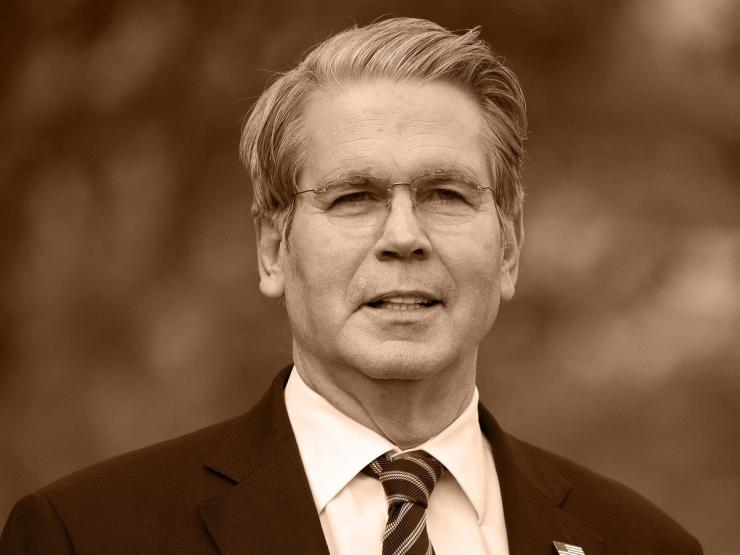
The day after Politico reported that Scott Bessent had threatened to punch a bumptious housing official in the face, the secretary of the Treasury addressed Republican luminaries gathered to celebrate the 50th anniversary of the Laffer curve under the big chandelier in his department’s Cash Room.
Bessent drew laughs with a remark that he’d been “fighting” for the American people every day, a guest recalled. Then Jamieson Greer, the US trade representative, took it a little further, quipping that he’d overheard Bessent helping to pass the White House’s tax cut package with joking threats to punch members of Congress in the face.
Some members of the audience laughed so hard they spilled their drinks, an attendee recounted.
And they may have wondered: How exactly did this guy, a courtly 63-year-old hedge fund manager, alpha his way past figures like Elon Musk and Howard Lutnick to emerge as the MAGA Bob Rubin?
After ushering the GOP’s megabill through Congress, he’s leading the search for the next Federal Reserve chair; playing point on Trump’s trade agenda; pulling new regulatory powers into his department, most recently as he finalizes a host of new capital requirements; and overseeing new retirement investments known as “Trump Accounts.”

Know More
I spent the last few weeks talking to financiers who knew Bessent during his New York rise and to the Republicans who now run Washington.
What emerged was a clear view of a rare path to success among Trump’s circle of old friends and cowed former critics: a man who chose his path to Washington, and willed himself there with unusual discipline and focus.
He is the only one of the ambitious men in Trump’s inner circle who is neither running for president himself nor seeing eye-popping returns for a family business.
Bessent came up in the cold-blooded world of macro trading, betting big on swings in currencies that are driven by a mixture of economic and political factors. It’s a field that requires, among other things, a strong stomach: Traders place long-term bets and may look like fools for months or even years, as they try to persuade nervous investors to hang with them until a position pays off.
His defining role was at Soros Fund Management. Bessent was a protege of Stan Druckenmiller, who pushed him into the high-profile job of chief investment officer in 2011. His tenure there was bracketed by the firm’s legendary currency bets — against the British pound in 1992, and against the yen in 2013.
Peers said Bessent was well-regarded (including, a couple noted, by himself).
“Scott was as professorial as any trader I knew and he had deep knowledge of most things in the economic ecosystem. But his strength was his ability to do principal component analysis on the fly — i.e., get straight to the heart of the matter in any decision,” legendary macro trader Paul Tudor Jones told me in an email. “That is why he has been the standout in the Trump administration — because he gets it before everyone else does.”
Bessent was not particularly seen as a future Treasury secretary, as rising stars at places like Goldman Sachs sometimes are. Jones told me that “I wasn’t surprised that he got it. I was surprised he wanted to do it. But he’s a great American.”
People close to Bessent said they weren’t quite sure when he decided he wanted to go into politics. His friends said his motives are basically intellectual: Though he’d backed Vice President Al Gore in 2000, he’d grown alarmed that expanding government debt and a mounting trade imbalance would destroy the US economy. He worried that the kind of rural conservatives he’d known in his youth in South Carolina had become alienated from American capitalism.
It is clear when Bessent started positioning himself in earnest for a run at a top political role in a second Trump term. In September 2017, Steve Bannon, recently booted from his job as White House adviser, was giving a paid speech at a conference in Hong Kong when the Southerner introduced himself.
Bannon recalls being struck by a “hedge fund manager who had a drive to understand populism, economic nationalism, America First, MAGA — and I realized he was also somewhat of a ‘cracker’ — that Yale had not smoothed off all of the South Carolinian Gamecock in him.”
Bessent told associates he’d been urged to run for Congress against Rep. Tom Rice in his childhood district.
But when much of Wall Street abandoned Trump and its populist posturing after Jan. 6, 2021, Bessent stayed committed. (He once described Trump as the sort of stock that rises on bad news.)
He also spread money around the movement. In the summer of 2021, he financed a conservative publishing outfit, All Seasons Press, which bought a book from the anti-trade Trump adviser Peter Navarro and a sympathetic biography of Tucker Carlson, among others. (Details of the business emerged in a messy lawsuit triggered by the ultimate rookie mistake in publishing: trying to reclaim an advance from a writer.)
Bessent made the case to his investors in long, academic letters that the 2024 markets were in a “Trump rally” anticipating his election, and predicted (wrongly) that Trump would weaken the dollar rather than impose tariffs.
And when Trump started running for a second term, Bessent made himself useful: He raised money and worked to persuade some on Wall Street not to join a rush to support Florida Gov. Ron DeSantis.
Bessent is not a natural public figure. He gives the impression of being carved into the marble of any chair he sits in. But he worked hard to repair his biggest political deficit: the wooden discomfort on television of a man who used to tell friends your name should only appear in the newspaper to announce your birth, marriage, and death.
By 2024, he was a regular political commentator on Bannon’s War Room; he appeared on the show five times that May, growing visibly more comfortable on air and sharing his view that any apparent uptick in the markets was simply anticipation of a Trump victory. He appeared to relish the opportunity to trade jabs with House Democrats during a committee hearing earlier this year, even while visibly sleep-deprived after returning from a trip abroad.
In the 2024 transition, Lutnick’s allies campaigned against Bessent by arguing that his fund had underperformed. But Bessent outmaneuvered his rival with the help of an unusual coalition that included MAGA figures like Bannon and Navarro and Wall Street elites who had a history of tension with Lutnick.
Even during the nomination process, Bessent was pulled into another Trumpworld knife fight, a complicated, failed plot against Trump’s loyalist lawyer, Boris Epshteyn, whose enemies accused him of trying to broker top jobs for figures including Bessent.
Trump brushed off the allegations, and Epshteyn weathered them. But Bessent got an early glimpse of the Washington snake pit, friends said, and a sense that he had to remain on offense.
Still, it wasn’t clear in the administration’s early days that he would be first among equals. Lutnick and Trump were close friends. Musk was a planetary force who seemed at times to eclipse the president.
Bessent distinguished himself in a pair of crises in April. He soldiered through a Liberation Day tariff announcement — and then, when 10-year Treasury note yields rose alarmingly, scrambled to market US government debt to key institutional investors. Then he resolved the Oval Office Ukraine blowup by quickly drafting an investment deal.
Meanwhile Musk’s power, in retrospect, may have reached its peak that month, when he and Bessent reportedly had a physical confrontation outside the Oval Office over control of the Internal Revenue Service.
Bessent stood up to Musk — and then cheerfully played up the fight, just as he did with a housing official close to Lutnick, Bill Pulte, later in the year.
“I think Elon probably fancies himself more of a Viking,” he told the New York Post’s podcast. “I’m more a ninja. Sort of: The submarine surfaces, fires, goes back under.”

Ben’s view
Bessent is, so far, the defining economic figure of Trump’s dramatic, zig-zag second term. More than anyone else, he has given an intellectual scaffolding to Trump’s longstanding drive to reshape the global economic order to favor American exports.
Bessent also appears to have figured out more clearly than any other Washington newcomer how to operate in Trump’s orbit. He has developed the sometimes bombastic television persona required for an administration spokesperson, but also the deferential professionalism in the West Wing favored by Chief of Staff Susie Wiles, and common to other successful inside players like crypto and AI czar David Sacks and Deputy Secretary of Defense Stephen Feinberg.
Bessent has at times had to clean up after the president. The Treasury secretary acknowledged last week that he’d opposed the Liberation Day tariff assault — but said he’d “evolved” on the issue, after seeing how eager trading partners were to do deals.
The real test for Treasury secretaries comes in extremis. Trump’s first Treasury secretary, Stephen Mnuchin, surprised even his critics with his deft handling of the job and his reaction to the COVID-19 pandemic. The financial crises of Trump’s second term have so far been self-inflicted. But investors are increasingly wary of a crash — whether from a dark corner of private credit, the overheated AI bubble, or some other unanticipated source.
Bessent has built the credibility inside the White House, on Wall Street, and around the world that he’ll need if and when the crisis comes. Now his reputation, and the endurance of his ideas, will depend on how he handles it.

Room for Disagreement
The economist Paul Krugman took violent exception to Bessent’s role in Trump’s campaign against the Federal Reserve: “Unlike virtually all other Trump cabinet members, Bessent isn’t a fool. He’s highly intelligent and well-versed in his area of operation. He understands financial markets. Hence the fact that he willingly smears the Fed by invoking conspiracy-laden tropes and re-writing facts is a window into his character, showing that he isn’t, and never was, worthy of Americans’ trust.”

Notable
- Bessent had a combative exchange with the New York Times’s Andrew Ross Sorkin last week.
- Breitbart’s John Carney offered Cliffs Notes on a major Bessent speech this spring, arguing that his goal is to “re-privatize” the American economy.
- Bessent offered his views on China talks in an interview with the FT.
- Bessent is the “most powerful” of the alpha gay men who play big roles in Trump’s Washington, The New York Times wrote.
Correction: A previous version of this article incorrectly listed the lawmaker Treasury Secretary Scott Bessent had been urged to run against, and overstated his association with the Democratic Party.

Architects of the New Economy