




The News
African countries could lean into nuclear energy to supply nearly a third of national electricity needs by the middle of this century with the right systems and financing incentives in place, a new report argued.
Ghana, Nigeria, and South Africa could each see nuclear energy account for up to 30% of total electricity supply by 2050, while nuclear energy could represent 24% of Rwanda’s power generation mix by the same year, said the report by The Rockefeller Foundation. The philanthropic group surveyed eight emerging economies including Brazil, India, Indonesia, and the Philippines. More investments in nuclear power could see each country’s electricity generation costs fall by at least 13%, compared with only relying on renewable sources, the report said.
More than half a billion Africans lack access to electricity. Nigeria — the continent’s most populous nation — is home to the largest number of people without electricity globally. The crisis has spurred ambitious interventions such as the World Bank and African Development Bank’s Mission 300 initiative: Around $90 billion is sought to meet Mission 300’s target of connecting 300 million people in Africa to electricity by 2030. But only about $50 billion has been pledged so far.
As with solar, wind, and hydropower, nuclear energy can “significantly contribute to scaling clean power for abundant energy” and so must be considered a key source for fixing the electricity gap in emerging economies broadly and Africa specifically, The Rockefeller Foundation, which is also a partner of the Mission 300 initiative, said.
In this article:

Know More
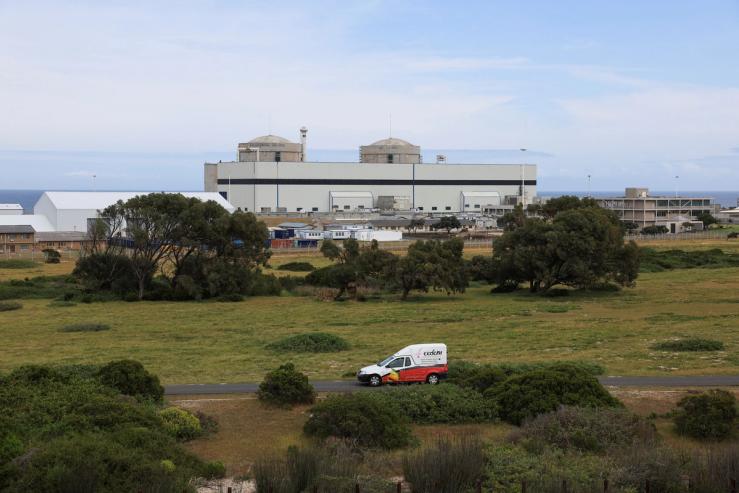
South Africa is the only country in Africa with an operational nuclear power plant. Operated by the state-owned power company Eskom, the Koeberg plant in Cape Town accounts for 5% of the country’s total electricity generation. A new 4 gigawatt plant also to be based in Cape Town is in the works.
The country is “well positioned to develop a diversified and reliable generation mix,” with its nuclear power generation capacity growing from 2 gigawatts to potentially reaching 22 gigawatts by 2025, according to The Rockefeller report. South Africa announced in October that it will revive the Pebble Bed Modular Reactor — an original nuclear energy project on which it spent more than $500 million before it stalled a decade ago — by the first quarter of 2026.
Nuclear energy projects are also underway in other African countries such as Ghana and Rwanda, which are notably ahead in the continental race to develop small modular reactors — a category of nuclear power facilities that are easier to build, ship, and install in remote areas. Ghana’s plans have invited interest from China, France, Russia, South Korea, and the US. An International Atomic Energy Agency inspection team assessed the proposed site of the country’s first nuclear power plant in February.

Room for Disagreement
The path to more nuclear energy in Africa’s power mix will not be easy, the Rockefeller report noted. One difficulty is the perceived risk associated with investing in infrastructure projects, but there are also government efficacy and public engagement challenges.
Executives and officials at the recent World Nuclear Symposium in London went further in identifying a litany of obstacles that threaten to derail a pledge from dozens of countries to triple nuclear power capacity by 2050: Attendees said financing challenges, supply chain disruptions, an uncertain talent pipeline, and a growing shortfall of the uranium required to run nuclear power facilities all posed major challenges.

Step Back
In Ghana, political parties across the spectrum have long supported nuclear energy development, but the fiscal tightening required to comply with debt restructuring obligations have constrained the government’s ability to finance nuclear infrastructure.
Nigeria may be stymied in its nuclear ambitions by its focus on reviving the economy, which could limit fiscal experimentation for nuclear power financing. In Rwanda, meanwhile, longstanding government support for clear nuclear power has failed to galvanize public support for nuclear energy due to safety concerns, the report noted.

Notable
- Africa needs about $100 billion in investments to triple its nuclear capacity by 2030, the International Atomic Energy Agency said.
- Ethiopia and Niger are both courting Russia as the main partner for their nuclear energy development ambitions.