



The Scene
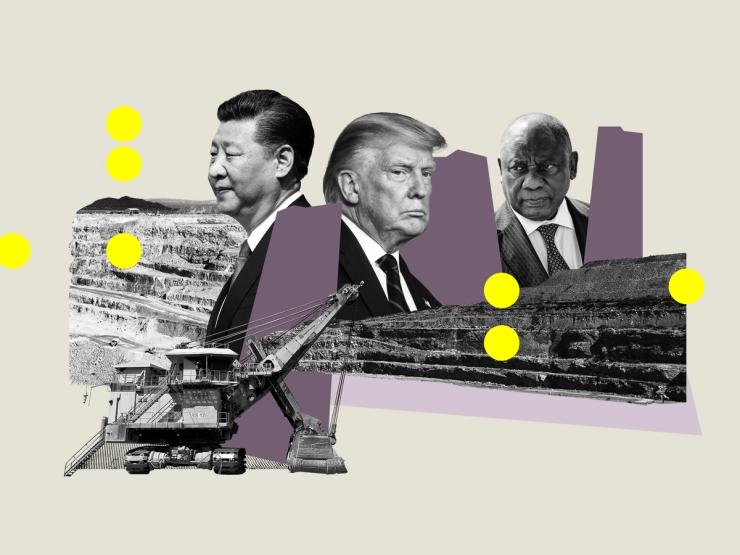
MOKOPANE, South Africa — In South Africa’s northernmost province, under a cavernous expanse of jagged gray rock, lies a mineral treasure trove that could play a pivotal role in the country’s relationship with global superpowers.
It is from here that South Africa has sought to rebuild a humiliating relationship with Donald Trump’s Washington and bolster a budding one with Beijing, pitching itself as a critical minerals supplier to the rival powers. According to South African government documents and market data reviewed by Semafor, as well as interviews with senior officials and executives, Pretoria is seeking to leverage its role as the world’s dominant supplier of platinum to ingratiate itself with Washington and Beijing at the same time.
The US and China are both seeking to secure access to platinum group metals — prized for withstanding extreme heat, conducting electricity, and resisting corrosion. The US needs platinum for catalytic converters, as it looks to grow its automotive industry based on internal-combustion engines and hybrids, and defense equipment; Beijing to develop green hydrogen as a form of sustainable energy. And both need the metals to build the data centers that will power their AI buildouts.
Yet the superpowers have taken sharply different approaches to trade policy with Pretoria. Washington slapped a 30% import duty on South African goods last year as part of a wider strategy of trade pressure: Since returning to office last year, US President Donald Trump has accused Pretoria of presiding over a “white genocide” — a discredited claim he repeated during a fractious Oval Office meeting with his South African counterpart. His administration has also demanded the rollback of land expropriation policies and Black Economic Empowerment laws, which were established to redress the legacy of apartheid. Tensions over these issues, exacerbated by Pretoria’s criticism of Israel over its conduct in Gaza, have become a major sticking point.
That has helped push Africa’s largest economy closer to China. South Africa hosted China and Iran in Beijing-led naval drills this year, a public show of devotion to the BRICS bloc that further fueled Washington’s ire. Beijing, for its part, scrapped levies on South African imports entirely as part of its move this year to extend its zero-tariff policy across the continent.
At the core of South Africa’s push to reset its ties with the US while maintaining strong relations with China are mines like the giant Mogalakwena site, 150 miles north of Johannesburg and operated by Valterra Platinum. The world’s largest open-pit platinum mine, dotted with yellow tipper trucks carving out boulders and overlooked by the rose-tinged peaks of Limpopo province’s Waterberg mountains, sits on top of the Bushveld Igneous Complex, a mineral deposit formed around two billion years ago which is now roughly the size of Sri Lanka. The deposit is a geological anomaly, home to around 80% of the world’s known PGM reserves.
“If you check all over the world,” Sello Mashabela, a Valterra geologist said as he gazed at the huge pit, “you won’t really find anything like this.”
In this article:

Know More
 A chart showing US platinum imports by country.
Pretoria has pushed its dominant position in the PGM space — the second-largest reserves of the metals are found in Russia, and therefore functionally off-limits to Western firms because of sanctions over the Ukraine war — to the core of its trade policy.
In a document published in May and reviewed by Semafor, full details of which have not been previously reported, South Africa’s trade ministry emphasized the importance of PGMs to US industry when making the case for the African Growth and Opportunity Act, a trade agreement, to be extended by 15 years.
“South Africa supplies the United States with 12 of the 50 minerals identified by the United States Geological Survey as critical for United States interests,” the ministry wrote in a submission to the Office of the US Trade Representative, arguing that materials such as PGM metals “are important to United States production and technological advancement, and South Africa has maintained reliable supply.” It urged the US to pursue an “investment-led trade strategy” that included local processing in Africa. In a separate document dated May 15, 2026, also seeking an AGOA extension, Business Unity South Africa, the country’s largest trade body, stressed PGMs were “essential to US manufacturing, defence, technology, and the energy transition.”
That push fell short: US lawmakers this month voted to extend the AGOA pact, but by just two years. Yet officials are not giving up. South Africa’s ministry of trade, industry, and competition told Semafor that critical minerals were a central part of the country’s trade negotiations with Washington. Kaamil Alli, spokesman for the country’s trade minister, said South African officials were holding discussions with US companies interested in securing critical mineral supplies.
Pretoria wants American investors to build smelters, factories, and processing facilities in South Africa, rather than relying principally on conventional offtake agreements with local mines. “We understand you want these minerals for particular reasons, but this is our goal,” Alli said, describing Pretoria’s pitch. “Come and let’s have a mutually beneficial relationship where you undertake processing in South Africa.”
Alli said talks on this issue were expected to continue in New York during the United Nations General Assembly this week. Senior South African trade officials plan to meet US business representatives, while Trade Minister Parks Tau is also likely to hold talks with US Trade Representative Jamieson Greer.

Alexis’s view
 A chart showing imports of unwrought platinum by country.
 The differing approaches between the US and China to court South Africa speaks volumes about Pretoria’s relationship with the world’s two largest economies — and the strategic priorities of all three.
Both superpowers use PGMs — a group of metals that include platinum and which are typically found in the same deposits — to build data centers: Platinum and ruthenium are used in the electronic components inside AI-training hardware, while iridium plays a key role in advanced chipmaking processes. China has calculated that it needs these elements to meet its strategic goal of building a network of state-run data centers to integrate AI into 90% of its economy by 2030.
But Washington and Beijing differ starkly in how and why they use platinum in their energy strategies.
The Trump administration’s cuts to subsidies for electric vehicles has driven imports of platinum and palladium for catalytic converters needed for gasoline-powered cars.
China, by contrast, values platinum for green hydrogen technology, a form of clean energy that it identified as a “future industry” in its most recent five-year plan. Beijing is making a big bet on green hydrogen, more than tripling its annual operational capacity since the end of 2024, Bloomberg reported. Valterra — which was spun out of Anglo American last year — forecast that an expanded push to green hydrogen could add 6 million ounces of demand a year, more than enough to offset shrinking auto-catalyst vehicle sales.
Indeed, Chinese customs data shows a sharp rise in imports of unprocessed platinum and palladium over the past five years, an approach in keeping with a playbook that involves importing raw materials for local processing. Analysts at research firm Trivium and think tank ODI Global said the surge points to Beijing stockpiling to protect its economy against market vicissitudes, given the global scarcity of PGMs.
 Oupa Nkosi/Semafor
The Bushveld Igneous Complex, thus, is South Africa’s ace card.
Beijing has shown a strong appetite for metals needed to realize its economic vision and Washington needs PGMs to drive the Trump administration’s automotive and defense policies.
Pretoria, mindful of Washington’s transactional approach to foreign policy under Trump, is trying to use its mineral advantage to attract investment from US companies to develop local processing. Adding value to raw materials, which South Africa already does to a greater extent than its African peers, is the goal of countries across the continent. The hope for South African officials is that it could boost the nation’s stuttering economy and create jobs in a labor market grappling with unemployment that recently hit a four-year high.
The appeal for South Africa’s government is clear in Mokopane, the nearest town to Mogalakwena. Driving through the town at daybreak, the groups of men in protective uniforms and convoys of long haul trucks point to the massive economic contribution of the mine to a community Valterra estimates supplies 70% of the plant’s workforce.
Still, privately, government officials and business leaders told Semafor that South Africa would not overplay its hand by making any attempt to withhold access to these metals; PGMs make up more than a third of its exports to the US. Pretoria will also be aware that diplomacy can yield positive results with the Trump administration: Frank Garcia, US assistant secretary of state for Africa, this month said the US will help Kenya to develop a critical minerals processing industry. And DR Congo is setting up a task force to speed up the implementation of a strategic mining partnership with Washington.
But Washington’s criticism of South Africa shows no sign of abating, despite Pretoria’s overtures: Only last week, the US imposed new visa restrictions on South African officials that the Trump administration accuses of “government-sponsored discrimination” against the white minority Afrikaner community. Yet the episode also offered evidence of how natural resources provide a bulwark against an adversarial White House. Despite threatening to unleash “escalatory measures” to punish Pretoria for what it deems to be unfair treatment of Afrikaners, Washington’s need for PGMs means those key trade ties are likely to remain intact.
For the US, rebuffing Pretoria’s appeal to forge commercial ties risks losing further ground to Beijing in the race to secure access to Africa’s natural resources. China’s trade with Africa last year was four times larger than Washington’s with the continent, and that gap looks set to widen after Beijing extended its zero-tariff policy across Africa. The US, meanwhile, has wielded tariffs as weapons.
 Oupa Nkosi/Semafor
Room for Disagreement
China’s bet on hydrogen may not pay off. Hydrogen has so far failed to take hold because it relies on expensive material like platinum and the process of making green hydrogen via electrolysis is less straightforward than other renewable energy sources. As a result, the future of green hydrogen remains uncertain. Richard Stewart, CEO of South Africa’s Sibanye-Stillwater, which runs the only source of PGMs in the US, told Semafor he was betting on buoyant American demand for the metals for at least another decade because “we don’t see internal combustion engines or hybrid vehicles falling off the cliff.” He said Sibanye, the world’s third largest PGM producer, could ramp up output if hydrogen fuel cells began to scale, in line with Beijing’s five-year plan, but voiced skepticism. “Does the technology work? Yes. Is it going to be enough to offset the vehicle demand? I have a big question mark around that.”

Notable
- The energy transition and technological advances are “creating unusual tension” in PGM markets, wrote Shane Lasley in Metal Tech News.
Additional reporting by Adrian Elimian.