




The News
What are the stakes of today’s election for America’s progressive movement? What do they mean for the Democratic Party? Let the Incredible Hulk explain.
“This is what we started in 2016,” Mark Ruffalo said on a Sunday night call organized by supporters of the left-wing candidates in Michigan’s primaries. “They have to spend more and more money each time to beat us, and it’s just a matter of time until they flop. And this could be it.”
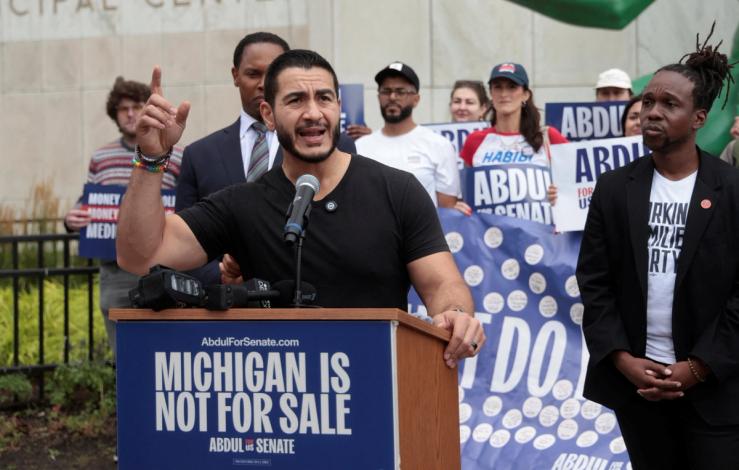
The primary for Michigan’s open Senate seat, between Abdul El-Sayed and Rep. Haley Stevens, D-Mich., is clearly the story of the day. Their fight was nearly a decade in the making. In 2018, when El-Sayed lost a race for governor and Stevens won her House seat, the Sen. Bernie Sanders, I-Vt., wing of the party was weaker. In 2022, when Stevens clobbered a left-wing Jewish colleague with the support of AIPAC, the pro-Israel lobby was not yet toxic among rank-and-file Democrats. Republicans are now expecting an El-Sayed victory, which they’ll slot into their 2026 message that “communism” is on the ballot, and a choice between “crazy and common sense.”
Democrats are bracing for an El-Sayed win and new questions about whether their party committees will invest in a candidate who ran against his party. A loss for Stevens will be shared by Michigan’s Democratic Gov. Gretchen Whitmer and retiring Sen. Gary Peters, D-Mich., who endorsed her as El-Sayed built his momentum.

David’s view
That’s the big race to watch on a day when Missouri, Virginia, and Washington are also voting. Here are ten other races to watch.
Michigan’s 7th District: Another progressive target on Tuesday: The mid-Michigan seat that covers Lansing, where progressive activist Will Lawrence has run against data centers and taken advantage of a split in the moderate Democratic vote. Sen. Elissa Slotkin, D-Mich., endorsed veteran Matt Maasdam for the seat, which she won three times; that angered some supporters of former Ukraine Amb. Bridget Brink, including Emily’s List, the Democratic group whose mandate to elect women helped both Slotkin and Stevens get to Congress. President Donald Trump carried the seat by one point, but the groups opposing Lawrence believe a Sunrise Movement co-founder would lose the seat to Rep. Tom Barrett, R-Mich. (The pop-up GOP PAC helping Lawrence, a tactic Republicans have used in several races this year, is cheekily called Sunrise Michigan.)
Michigan’s 11th District: Stevens is leaving this safe Democratic seat in the Detroit suburbs to run for Senate, and state Sen. Jeremy Moss has been the favorite to win the primary since he entered it. That makes this a test of how much anti-incumbent and anti-Israel sentiment is driving Democratic votes; Moss has two opponents, former auto engineer Don Ufford and attorney Aisha Farooqi, running to his left and accusing him of being a vote for more war weapons if he gets elected.
Michigan’s 13th District. For four years, since Rep. Shri Thanedar won the crowded primary for this Detroit-based seat in 2022, Michigan has sent no black Democrats to Congress. That’s always been a problem for Thanedar, who only took 55% of the vote in 2024 against two candidates who barely campaigned – and after an AIPAC affiliate spent more than $2 million to help him. State Rep. Donavan McKinney, a member of Democratic Socialists of America, is getting the first one-on-one race against Thandedar, after one of his weak 2024 challengers missed the ballot. Democrats expect Stevens to run strong in this district in her Senate race, but are skeptical that Thanedar can hold on. It’s also a safe seat.
Michigan governor: Trump’s endorsement of Rep. John James seemed to settle the GOP primary, and national Democrats have lined up behind Secretary of State Jocelyn Benson, assuming that she’ll win the nomination to succeed Gov. Gretchen Whitmer. But the margins and regional vote patterns could be interesting. Benson lost a pile of labor endorsements to Genesee County Sheriff Chris Swanson, and James couldn’t convince Perry Johnson, a wealthy businessman who ran for president in 2024, to drop out after the Trump endorsement. A closing message for Johnson: James has already lost two statewide races, for all the support he gets from national Republicans.
Kansas governor: Very early in this race, Democratic incumbent Laura Kelly, who’s term-limited, endorsed state Sen. Ethan Corson to succeed her. Kelly’s support is a sizable part of Corson’s campaign: “She believes I’m the only Democrat who can win in November,” he told the Kansas Reflector. This didn’t dissuade state Sen. Cindy Holscher from entering the race with a more progressive agenda, including a moratorium on data centers (after voting for a data center developer tax break), and didn’t stop Overland Park Mayor Curt Skoog from jumping in, skeptical that Corson could beat Holscher. This could be another race where Democratic voters opt against the advice of their governor. The president has endorsed state Senate President Ty Masterson, who sometimes overrode Kelly’s vetoes, for the GOP nomination.
Missouri’s 1st District: This is a rematch between Rep. Wesley Bell and former Rep. Cori Bush, who he unseated in 2024 with the help of millions of dollars from AIPAC’s super PAC. Bush announced in October that she’d fight for her old seat, after Bell faced protests from Gaza activists at his public events, and as her stance against funding Israel captured the Democratic mainstream. Bell has benefited from incumbency this time, with the New Democrats complementing the AIPAC spending for his campaign. But his 2024 win was narrow, with Bush winning the city of St. Louis and Bell winning the suburbs. After this last year’s GOP redistricting, it’s the only safe Democratic seat in Missouri.
Missouri’s 5th District: For the first time, Democrats are unlikely to represent Kansas City in Congress; Republicans sliced it up to heed the president’s demand for more safe GOP seats. Democrat Rep. Emanuel Cleaver is still running for what’s now a seat the president won by 18 points. The Club for Growth is spending more than $1 million to help the candidate it sees as the most conservative: state Sen. Rick Brattin, a leader of the Freedom Caucus in Jefferson City. This will be a preview of what sort of Republicans are winning in this seats drawn away from Democrats; Tennessee Republicans will test that on their new map two days later, after splitting up the city of Memphis.
Virginia’s 2nd District: After the GOP sued to block a new voter-passed map, former Rep. Elaine Luria stuck to her rematch against Rep. Jen Kiggins, the Republican who beat her four years ago. Trump carried the Tidewater seat by just one-fifth of a percentage point, and three other Democrats stayed in the primary, so the primary will test both how much enthusiasm there is for Luria’s comeback, and how strong Democratic turnout is after a 2025 wave followed by anger at their setbacks in Richmond.
Washington’s 3rd District: Democrat Rep. Marie Gluesenkamp Perez is seeking a third term in her first election without Joe Kent, the right-wing veteran she defeated twice. She hasn’t escaped the progressive backlash: Brent Hennrich, a progressive cinema equipment installer, has picked up some local endorsements from Democrats angry at the incumbent’s occasional votes with Republicans. The GOP is targeting the seat with John Braun, the state Senate minority leader, with none of Kent’s baggage. Two years ago, Gluesenkamp Perez won 46% of the vote and easily advanced to the top two; Republican candidates combined for 52% of the vote. Her vote total and the support for GOP challengers will hint at how competitive a seat Kamala Harris won by three points really is.
Washington’s 9th District: Nobody thinks Republicans can win this stretch of Puget Sound, which Harris carried by 42 points. The challenge for Rep. Adam Smith, D-Wa. is coming from Kshama Sawant, a socialist former Seattle city councillor, who’s raised almost $650,000 to challenge a “pro-genocide” supporter of Israel. A left-wing Smith challenger got to the November election in 2018, losing 2-1; a DSA candidate fell short to a Republican in 2022. This is another gut check of how far anti-incumbent sentiment is spreading in safely Democratic seats; Smith went on Breaking Points last month to defend himself and accuse Israel critics of being abusive.