




David’s view
GRAND LEDGE, Mich. — On his way to the Yankee Doodle Day parade, Democrat Matt Maasdam tried to explain why his party had lost Michigan’s 7th Congressional District.
Sen. Elissa Slotkin, a former CIA analyst, had won the seat three times on the strength of her national security experience, serving presidents of both parties. But even as she ascended to the Senate, Rep. Tom Barrett picked it up for the GOP by touting his experience fighting in Iraq and Afghanistan while President Donald Trump carried the district on pledges to end wars in Ukraine and Israel.
“People voted for no foreign wars and lower prices,” said Maasdam, a Navy SEAL turned candidate who has carried the nuclear football for then-President Barack Obama. But when Trump and Barrett took office, he added, “they got the opposite” of what Republicans were selling, as the US upped defense spending while choosing new wars.
Now Maasdam is trying to stand for a break from Trump — but not a return to the world before 2016: “Restoring things to the way they were, I don’t think that’s necessarily the goal.”
To retake the House, Democrats will need to succeed in districts like his, where they had a breakthrough in 2018 with national security-focused candidates only to backslide in 2024. This year’s crop of Democratic candidates with security experience is both more war-weary and confident than their 2018 and 2006 predecessors, though.
They talk about America’s place in the world with no hand-wringing about looking weak; they opposed the Iran war from the jump. More daringly, today’s Democrats don’t talk about restoring the pre-Trump order of the world — or, as Joe Biden once did, making MAGA an “aberration” in history.
In fact, they don’t want to hear much from Biden’s team at all.
“I want us to admit that the Biden administration made some pretty big mistakes,” Sen. Chris Murphy, D-Conn., told me recently, describing the former president’s call for a return to the old ways as fundamentally unsuited to the electorate Trump managed to capture.
“When Biden showed up and announced that America was back, it was deeply unsatisfying to Americans who thought the world order that we’ve lived in for years has protected billionaires and corporations and hurt workers and has dragged us into a whole bunch of unnecessary, costly, and deadly wars,” Murphy added.
The party’s anti-interventionists feel particularly vindicated by the move away from Biden, who didn’t hire many of their ilk when he took office, but Murphy isn’t necessarily in that camp. And Biden’s handling of the war in Gaza has hurt his legacy even in the Democratic mainstream.
Last month, at the Center for American Progress Ideas summit, Biden’s Secretary of State Antony Blinken was left off the public schedule before appearing on a panel where he advised Democrats to keep “making ourselves as strong as possible around the world” with international alliances.
His words didn’t travel far from the room.
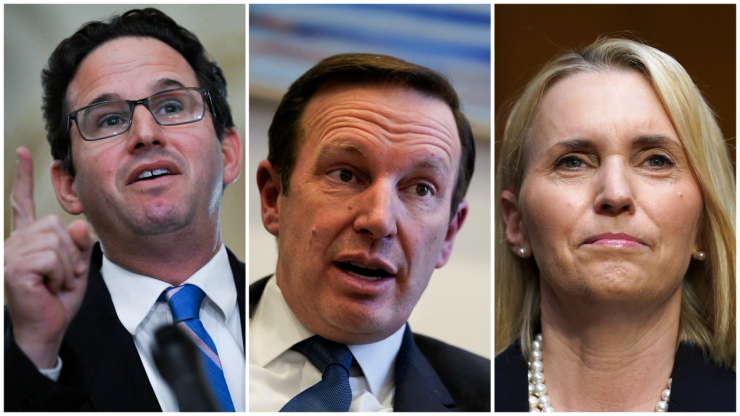
“I’m not into blacklisting anyone from future work in their area of expertise,” Sen. Brian Schatz, D-Hawaii, wrote last month, five days after that conference. “But I do think it’s fair to want a whole new crop of foreign policy staffers in the next democratic administration.”
Murphy, a friend and Foreign Relations Committee ally of Schatz, elaborated on his vision for Democratic reformist foreign policy: “Yes, we as Democrats want to be in a world of alliances. We want to be a force for good in the world, but we should admit that the UN is not working well. We should admit that NATO can be better, and that our European partners can do more.”
In the words of Matt Duss, a former Bernie Sanders adviser who’s now vice president at the Center for International Policy: “I’ve been pleasantly surprised at how many members of Congress have reached out to me, and said: ‘We cannot go back, not just to the policy but to the personnel.’”
Before any of that, Democrats have to win this November. And in Michigan’s 8th, despite two candidates leading with their national security credentials, foreign policy hasn’t become a major issue in the primary.
The best-known Democrat in the race is Bridget Brink, a diplomat who served as Biden’s ambassador to Ukraine from the first months of Russia’s 2022 invasion and quit when she saw the Trump administration walking away from Kyiv. That’s not what her campaign is about now; like others in the party, she’s building a message around “affordability,” which includes avoiding wars like Iran.
“The international component of that is stopping wars of choice, which put at risk our service members, which put at risk global economic security, which is raising prices for gas, fertilizer, diesel, and all goods,” Brink said.
She had less to say about Biden, her former boss who doesn’t appear in her campaign ads.
“I’m really proud of my service to our country over 28 years in the foreign service under five presidents,” she said when I asked about the last administration she worked in.
I wouldn’t expect Biden to campaign in the district, as he once did for Slotkin, celebrating her foreign policy experience — and her promise, back then, to restore the old order.
In this article:

Room for Disagreement
For all their pro-reformist energy when it comes to global affairs, Democrats are far from a consensus on their post-Trump, post-Biden vision of the world. Duss expected that to be figured out once Democrats begin their 2028 primary, toward the end of this year.
It was important, he said, that Sen. Chris Van Hollen, D-Md. had rejected the Biden legacy on Gaza and Israel, writing that “primary voters won’t trust any Democratic presidential candidate who does not have a record of moral and strategic clarity on these issues.”
But there was a lot more to discuss, he said, even though the last Democratic administration wasn’t very useful in that discussion.

Notable
- In New York Magazine, Ben Terris checked in on the Biden family and its effort to rescue a legacy.
- Matt Duss talked with Ezra Klein at length about the changes he wanted to make in Democratic foreign policy.
Correction: An earlier version of this story incorrectly named the number of the district Maasdam and Brink are running in.