



The News
After toppling establishment-backed candidates in three New York City primaries, Zohran Mamdani-backed challengers are already on to their next act: upending the lives of congressional Democratic leaders.
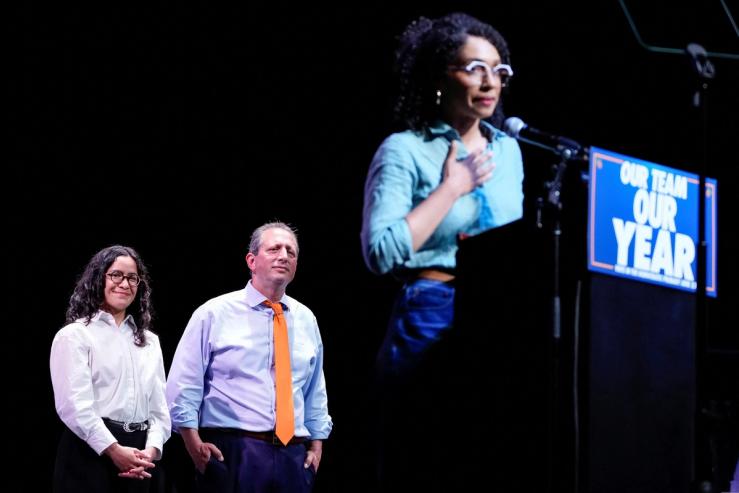
The victories of Brad Lander, Claire Valdez, and Darializa Avila Chevalier show the growing power of a progressive bloc that risks stealing the party’s megaphone during a campaign that Democrats had hoped to center on affordability, not aid to Israel. There’s already angst in the party, and glee among Republicans, that the trio will use their new clout to spotlight issues that divide Democrats.
Top House Democrats brushed off the results, with House Minority Leader Hakeem Jeffries urging reporters to “look at the totality of all 215 members of the House Democratic caucus.” But the party’s leaders don’t have to look far to reckon with their increasingly left-wing electorate — both Jeffries and Senate Majority Leader Chuck Schumer live in New York City.
Valdez and Avila Chevalier are democratic socialists, like Mamdani, while Lander is not. That means Republicans are especially keen to make the two far-left women into the faces of the opposition. After redistricting shrank the House battlefield, some Democrats worry that their party is growing more vulnerable to those attacks.
“Nationally, it’s a huge concern,” said purple-district lawmaker Rep. Vicente Gonzalez, D-Texas. He pointed to “how they push the policies within the Democratic caucus that we’re going to have to defend … policies that obviously I don’t agree with, and would be very difficult for me to sell to people in South Texas — and I don’t intend to sell them, because I don’t believe in most of them myself.”
Republicans’ House campaign arm is already trying to tie swing-seat Democrats’ to Valdez and Avila Chevalier, who both have been critical of Israel and have called for abolishing ICE.
The GOP has “got a f*ckton of money, more than us and more than they did in 2018,” one Democratic strategist working on swing-district races told Semafor. “And the far-left primary wins do help the Republicans portray all Democrats as unacceptable.”
Outside the deep-blue bastion of the five boroughs, there was plenty for the mainstream of the Democratic Party to feel good about on Tuesday night. Even in the New York suburbs, a former Palantir employee won the Democratic nod to take on battleground-seat GOP Rep. Mike Lawler.
But intraparty tension pulled focus from that on Wednesday — including the specific strain on Mamdani’s relationship with New York lawmakers. Jeffries, who backed two of the three candidates the mayor helped defeat, didn’t exactly quell that storyline.
“The mayor and I agreed to strongly disagree about some of his endorsements,” Jeffries said. “And he’s got work to do in terms of the conversations that he’s going to have with members of Congress moving forward.”

Know More
Congressional Democratic leaders’ endorsement power will be tested further in upcoming primaries in Colorado, Minnesota and Michigan, where candidates from the centrist wing of the party are fighting insurgent progressives.
Among them is Michigan Rep. Haley Stevens — backed by Schumer but trailing in some polls to a progressive who’s openly dismissing the leader’s power.
“At the end of the day, my job is to win this seat in Michigan. He can either help me or get out of the way,” Democratic Senate hopeful Abdul El-Sayed told Semafor recently.
Jeffries, who waited until just days before the 2025 election to endorse Mamdani, nearly faced his own primary challenge on Tuesday.
Chi Ossé, a left-wing city council member, launched and then quickly scrapped a campaign against Jeffries after it became clear that neither the mayor nor New York Rep. Alexandria Ocasio-Cortez — who stayed out of Tuesday’s clashes — would support him.
At the victory party for Valdez, Democratic Socialists of America members booed when Jeffries appeared onscreen for an interview with NY1, then chanted: “You’re next!”
Some Democrats aired frustration that coverage of progressives was overwhelming their own local politics, which showcase a more ideologically diverse party.
For instance, Pennsylvania Gov. Josh Shapiro, who helped several of his preferred House candidates win primaries last month, faced more questions about Chris Rabb’s victory in Philadelphia. Shapiro stayed neutral in that race, but polling suggests he’s the most popular member of the party in the state.
And in Maryland, Gov. Wes Moore’s endorsements in downballot races paid off — including an endorsement of Adrian Boafo, who will succeed his mentor Rep. Steny Hoyer, after progressive challengers failed to turn voters against Boafo’s support from AIPAC.
Progressives were perhaps the only Democrats in the Capitol to celebrate what they saw as a fresh sign that the party was shifting leftward on US aid to Israel.
“Clearly voters have moved significantly on issues as it relates to Israel, and I think that has been clear across the country,” Rep. Greg Casar, chair of the Progressive Caucus, told reporters.

Room for Disagreement
Other top Democratic lawmakers brushed aside concerns that the progressive wing would speak for the rest of the party. Republicans would have tried to lump Democrats in with their most progressive elements regardless of the candidates’ primary wins, they argued.
“It’s a primary in New York City,” said Rep. Susie Lee, D-Nev. “I think that most frontliners know how to win frontline districts, and I don’t think that formula has drastically changed.”
“In Florida, we think socialism sucks, so I’m not worried about distinguishing myself,” agreed Rep. Darren Soto, D-Fla., whose district was targeted by the GOP’s Florida gerrymander.

Nicholas, Lauren, and David’s View
For all of the palpable unease on the Hill right now, Democratic candidates have generally shown they can differentiate themselves from the left wing.
Eight years ago, Republicans welcomed the victories of “Squad” members like Ocasio-Cortez, dispatching their video trackers to ask if swing-state nominees wanted to abolish ICE and end private health insurance. They generally said “no” and neutralized the question.
And Trump already helped rescue Democrats from themselves on Wednesday. The president’s cancellation of a signing ceremony for a bipartisan housing bill promptly created new problems for the GOP.

Notable
- Hours before polls closed on Tuesday, we took an in-depth look at the bet Mamdani was making on his own influence.