




Andy’s view
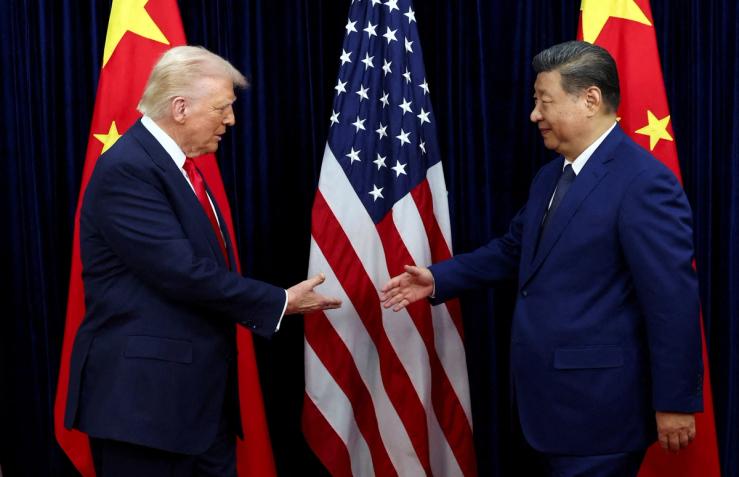
With only a month to go before US President Donald Trump’s visit to China — the first by an American leader in a decade — there’s little sign he’ll get the “big deal” on trade he so badly craves, or even the “big, fat hug” from Chinese leader Xi Jinping that he apparently expects.
In Washington, DC, the mood of top White House policymakers responsible for negotiating summit outcomes seems subdued. So far, they report nothing more exciting than establishing a “Board of Trade” and a “Board of Investment” staffed by officials from both countries to solidify a tariff truce forged last year. Jamieson Greer, the US trade representative, acknowledged at the annual Semafor World Economy gathering last week that managed trade was the best Washington could hope for given that Chinese leaders were “not going to put their hand on Mao’s Little Red Book and swear that, ‘We’re not going to be communists’.” Commerce Secretary Howard Lutnick was similarly blunt in shutting down any talk of Chinese EV makers investing in the US.
The Chinese government is in no mood to compromise, either: In quick succession, Beijing has rolled out three separate pieces of legislation to give itself the tools to punish foreign companies operating in China that drop Chinese suppliers. Penalties include “exit bans” on staff and asset seizures. In effect, international executives in China are on notice that they may become hostages, depending on the actions of their headquarters.
The upshot of all this is that the leadup to next month’s Trump-Xi summit points to more, rather than less, tension on the horizon. Although the superpowers’ tariff conflict is ending, a potentially far more damaging supply chain fight is just getting going.
JPMorgan CEO Jamie Dimon — who recently declared that shifting critical supply chains to China was a “huge mistake” that should be reversed right away — has put the balance sheet of America’s largest financial institution behind Trump’s “America First” mission to reshore manufacturing, announcing $1.5 trillion in financing over 10 years to boost domestic sectors including critical minerals, pharmaceutical precursors, and robotics — all areas dominated by China. Tim Cook, the outgoing Apple chief, went to the White House last year to announce $600 billion in manufacturing investments in the US. General Motors has directed several thousand suppliers to scrub their supply chains of parts from China, according to Reuters, setting a deadline of 2027 for some of them.
At the same time, US Defense Secretary Pete Hegseth has put the country’s military industrial base, now highly dependent on Chinese rare earth magnets and other key industrial inputs, onto a “wartime footing.” That has led to talks between Trump administration officials and leaders of major US automakers and other domestic manufacturers aimed at getting them to play a larger role in weapons production, according to The Wall Street Journal.
Overseas, the Journal reports an unprecedented legal arrangement for the US to take out a two-year lease renewable for 99 years on a 4,000-acre site in the Philippines, a key ally, and turn it into a high-tech manufacturing hub to draw on the country’s rich reserves of cobalt, copper, and nickel.
US manufacturers with operations in China face tough choices. Many have been diversifying production to places like Vietnam and India — a “China+1″ strategy — but that option now represents a clear regulatory risk and, potentially, a staff safety issue. (They can’t do this quietly, either: The co-founder and CEO of Altana, an AI-powered global supply chain management platform, told me that Beijing has “unparalleled visibility” into the pathways of international trade through its ownership of logistics networks.) On the other hand, pulling out of China at short notice is impossible; it can take years to build supply chains free of Chinese inputs, if it can be done at all.
Staying for now and hoping for the best may be the most realistic option, although that leaves companies at the mercy of an opaque legal system. “Don’t say you haven’t been warned,” said Jorge Guajardo, the former Mexican ambassador to China and now a partner at DGA Group, a business consultancy. “China can knee-cap you in a second.”
In this article:

Room for Disagreement
Quietly but purposefully, Trump has set the US on a less ideological and confrontational path in relations with China, writes Ryan Hass, a Brookings Institution scholar on China, noting that the American leader’s proponents credit him with delivering pragmatic results: Progress on curbing the flow of fentanyl from China, promises to buy US agricultural goods, and a reduction in the risk of major power war. Hass offers three scenarios for US-China relations: “Soft landing,” “Hard split,” and “Buy time and build insulation.” For now, he writes, both Trump and Xi seem fine with buying time. That would suggest a summit filled more with ceremony than substance, delivering solid if unspectacular outcomes.

Notable
- The China scholar Wu Xinbo says “the chemistry exists for a productive bond between Trump and Xi.”