




Ben’s view
Every January, the world’s business and political leaders descend from the Swiss mountains with a Davos Consensus — relentlessly optimistic and deeply influential if, notoriously, often wrong.
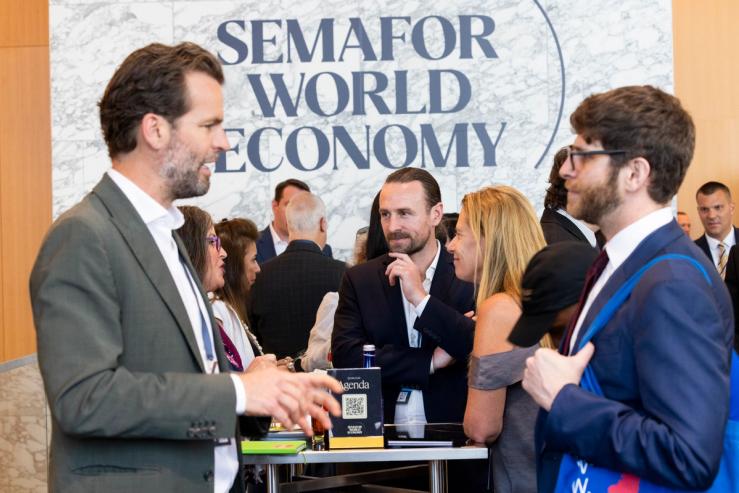
Semafor World Economy brought together hundreds of those political and industry figures in Washington last week in America’s biggest gathering of major CEOs. So since it ended Friday, I’ve been asking colleagues and chatbots alike for a preliminary sense of the consensus among the 500 CEOs, dozens of Cabinet officials, lawmakers, and finance ministers who assembled at Washington, DC’s Conrad Hotel.
Unlike similar global gatherings, Semafor World Economy is first of all a festival of news, rooted in the revelatory power of good journalism, so our reporters and guest moderators asked challenging questions and hard follow-ups in the hope of understanding how leaders see this confounding moment.
The bottom line, for investors and business leaders in particular: There is a growing belief in the resilience of the US economy — and of flexible globalized business more broadly — in the face of whatever gets thrown at it. A year ago, AI felt like a threat to that resilience; now, business leaders increasingly think that AI-driven productivity gains may counterbalance growing worries about domestic inflation and the global economy.
After all, a year bookended by the “Liberation Day” tariff onslaught and the messy, unresolved Iran war left markets at record highs last week. New AI platforms appear more and more capable of genuinely astonishing breakthroughs. And CEOs appear more and more confident that they can pick a zigzag path through the chaos.
There was, more than I’ve ever felt in Washington, a gap between on-record and Chatham House Rule conversations. Much of what you could read between the lines in public emerged behind closed doors. There’s a second consensus: that the Trump administration is doing long-term damage to the global political system that will make the world more dangerous for citizens and more expensive for consumers in the long term. Others quietly lament the new atmosphere of self-dealing in Washington. Some believe there’s oil market manipulation, though Treasury Secretary Scott Bessent told me in our interview that regulators haven’t found that.
But there’s little point saying any of that out loud when it might jeopardize the thing business leaders love most about Trump and his top aides: that you can call them and they’ll try to fix your problems.
Hyundai’s José Muñoz had a particularly emblematic year. He told my colleague Shelly Banjo that after a shocking immigration raid last September, White House chief of staff Susie Wiles called to apologize. Many of the Korean workers returned to Georgia, and the company hired locals to run the plant once it opened, on time, in April.
Then, Hyundai — which has, unlike some carmakers, kept apace with EV production after an oil-friendly Republican Party pushed for the end of federal tax credits — suddenly saw a 40% spike in demand for those cars driven by the energy shock that followed the Iran war. This dangerous, unpredictable country is full of opportunity. Muñoz says his three priorities remain: “U, S, A.”
Meanwhile, optimism about the AI transformation has replaced something closer to panic. Big global enterprises may be a year or two behind the Silicon Valley pioneers, but, as our technology editor Reed Albergotti notes, “they’re all moving in the same direction, toward the token-centric economy. There’s no need to freak out.”
There, too, are surprises: For instance, AI tools have increased by a factor of 10 the productivity of call center workers dealing with credit card fraud, I was told, but those workers have kept their jobs because the same AI tools are increasing the productivity of the fraudsters.
The consensus, as our CEO editor Andrew Edgecliffe-Johnson put it, is that “resilience is not complacency.” Global CEOs now believe they’ve “survived enough shocks to the system that whatever this conflict throws up won’t be any worse.”

Room for Disagreement
If you’re looking for dissenters on this belief in resilience, turn to Wall Street, which on measure was far more pessimistic (or realistic) about the coming economic shocks.
Citadel Securities President Jim Esposito told Semafor Business editor Liz Hoffman he’s worried about a “breakdown in discipline,” saying we’ve raised “a generation of investors that really never learned the price of being wrong.” Lazard’s Peter Orszag warned that the economy is in a “Road Runner moment,” out over the cliff with the legs still pumping. And LSEG’s David Schwimmer warned of “irrational complacency.”