



The News
South Africa could lift its medium-term growth rate to between 3-4% if the state sustains the faster execution of structural reforms now underway, Standard Bank’s CEO told Semafor, arguing that the biggest remaining obstacle was restoring the rule of law.
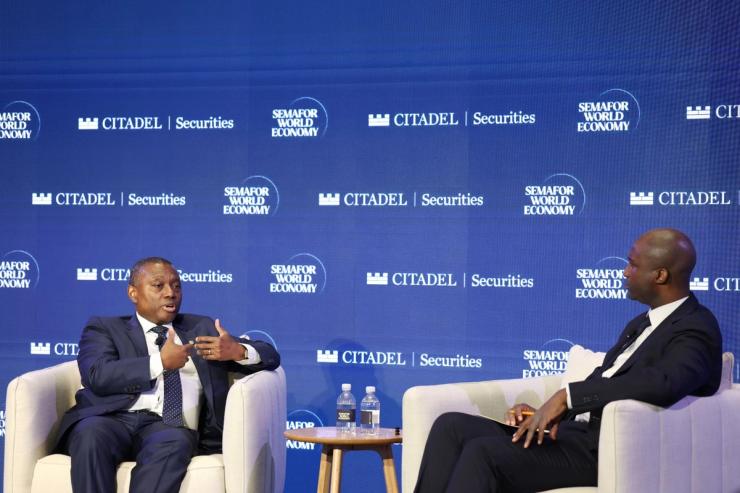
Sim Tshabalala’s comments at Semafor World Economy in Washington, DC add weight to a growing view in business cycles that the country’s reform cycle is finally beginning to translate into measurable economic gains.
Tshabalala said the reforms driving early gains in energy, logistics, and water infrastructure were designed under the reform acceleration unit set up by the then African National Congress government in 2020 — but that the current coalition government had accelerated their execution.
He described the coalition anchored by the ANC, the Democratic Alliance, IFP, and Freedom Front Plus — as a centrist formation that maintained policy orthodoxy while speeding up delivery. “The faster [reforms] are executed, the faster the country will grow,” he said.
Tshabalala identified the rule of law as the most urgent and politically sensitive reform frontier. “There’s a direct correlation between the rule of law and GDP growth,” he said.

Know More
Tshabalala’s remarks land at a moment when South Africa’s law enforcement architecture is under intense public scrutiny. The Madlanga Commission — set up to investigate systemic procurement failures and corruption in the police department — has highlighted widespread corruption that has undermined the rule of law.
The public hearings have led to the suspension of Police Minister Senzo Mchunu, and resulted in criminal charges against National Police Commissioner Fannie Masemola, who is accused of obstructing investigations and enabling corrupt procurement schemes.
Meanwhile, the Constitutional Court is expected to deliver its ruling on whether lawmakers acted lawfully when they rejected an independent panel finding that South African President Cyril Ramaphosa may have a case to answer over the 2020 theft of foreign currency from his Phala Phala game farm.
Tshabalala said Standard Bank, Africa’s largest bank by assets, had not revised its baseline outlook for South Africa despite the Middle East war, which is weighing on global energy markets and exposing fiscal constraints across sub-Saharan Africa. The bank is still working on the assumption that South Africa will grow by about 1.5% this year.
South African Finance Minister Enoch Godongwana has already cut fuel taxes to blunt the impact of surging oil prices, foregoing millions of dollars in revenue, and warned that his budget assumptions are under threat because of the US-Israel war against Iran.

Notable
- Sub-Saharan Africa is bracing for a fresh growth downgrade after the IMF warned that the Middle East conflict is driving an energy price shock, higher inflation, and tighter fiscal conditions across the region.