




The News
The nine potential Democratic presidential candidates set to speak to Rev. Al Sharpton’s National Action Network this week will face pointed questions about a topic that’s tricky for the party — how to restore Biden-era racial equity policies that Donald Trump erased.
“I want to know how they will deal with issues like DEI, which has been a major template of Trump 2.0,” Sharpton told Semafor. “How will they deal with hate crimes? How will they deal with the fact that we’re seeing, in the military, people not promoted based on gender and on race?”
Sharpton, who unsuccessfully sought the party’s presidential nomination in 2004, has ever since invited influential Democrats to address his group. Amid a flourishing of liberal and Democratic organizing under Trump, he said that he wanted — at least for a few days — to refocus that energy on civil rights and Black Americans.
Held over four days, his group’s conference will be the largest single gathering of potential Democratic candidates since their party lost the White House. They’ll face a host and audience that view the Biden-Harris administration favorably, and fear an irreversible rollback of civil rights policies that helped Black voters.
“I helped out on the front line of the No Kings March in New York, right?” Sharpton said. “I’m all for [a] coalition, but we need to also address the entire coalition and the concerns that we have in different parts, different silos of the coalition.”
Heeding Sharpton’s call to defend DEI policies could prove a challenge for Democrats who have worried that they’re playing into conservatives’ hands by sounding “woke” without gaining anything for it, from white or non-white voters.
Sharpton is also concerned about last week’s arguments before the Supreme Court on the administration’s bid to dismantle birthright citizenship. He warned that conservative justices might dismantle Section II of the Voting Rights Act, a move that would pave the way for the redistricting of some Black lawmakers’ House seats, while using a ruling against the Trump administration’s birthright position as cover.
“How will they try and relitigate that?” Sharpton said he would ask the presidential contenders-in-waiting who are coming to New York. “Do you have a plan for that?”
In his second term, Sharpton argued, Trump embodied “the bigotry that he demonstrated in New York” when he called for the death penalty to be used against young Black men who were later exonerated of rape charges. Dismantling affirmative action in federal contracting and laying off Black federal workers, as Sharpton saw it, necessitated a response.
And Sharpton will get a response this week from nearly every Democrat he invited. California Gov. Gavin Newsom, he said, had a scheduling conflict that proved impossible to get around. (Rep. Alexandria Ocasio-Cortez, D-N.Y. was also unable to make it.)
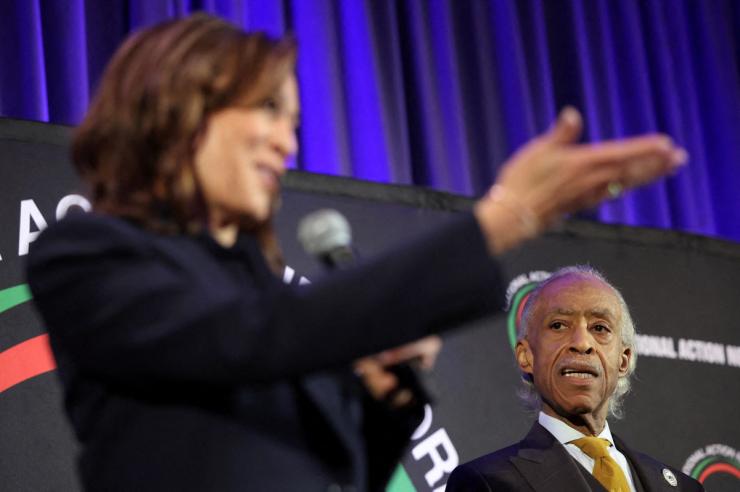
He said he expects Harris to talk about what would be happening differently under “a Harris presidency,” while the other Democrats, who’d mostly impressed him with their work over the last year, would get other questions.
“I think being at a civil rights organization, they should discuss civil rights issues,” he said. Trump’s eager use of executive powers could also inspire some questions: “Will you be willing to make executive orders to bring back balance where he’s brought an imbalance?”
In this article:

Know More
Harris and former Transportation Secretary Pete Buttigieg spoke to the Sharpton group’s conference during their 2020 presidential campaigns, and both returned as members of the Biden administration. Days before leaving office, Harris appeared at a Sharpton-hosted breakfast and pledged to “stay in the fight,” while Sharpton continued to praise her.
Maryland Gov. Wes Moore, who’ll speak on Thursday, attended last year’s conference, recounting his battle to find jobs for fired federal workers. The country’s only Black governor contrasted Democrats’ struggles with the hurdles overcome by Harriet Tubman and Frederick Douglass.
“We’ve seen this before, and still I rise,” Moore said, quoting Maya Angelou.
A few Democrats will be speaking to the group for the first time: Pennsylvania Gov. Josh Shapiro, Illinois Gov. JB Pritzker, Kentucky Gov. Andy Beshear, California Rep. Ro Khanna, and Arizona Sen. Ruben Gallego. Like Buttigieg, they’ve spent some time since Harris’ 2024 defeat speaking to non-traditional media sources and podcasters who’d supported Trump.
The Sharpton-hosted conference is more of a home game, full of Democrats who’ve stuck with the party and saw progress on their issues under Biden. House Minority Leader Hakeem Jeffries will address the crowd on Thursday morning, between multiple sessions on racial economic gaps, misinformation, and the Black church.

David’s view
Why did the Democratic share of the Black vote decline in 2024, even as the party put the first female Black vice president atop the ticket? It’s a puzzle that’s gotten less attention in political media than the party’s struggle to win over young people (a surprise in 2024) and white men (an ongoing trend).
Eight years ago, at what ended up being the zenith of the Black Lives Matter movement, Democrats talked plenty about what they’d do for Black America. Harris used her 2019 speech to Sharpton’s group to talk about how the places with the “highest needs” required new investments. Biden used his final address there, in 2024, to celebrate building “the most diverse administration” in history, creating jobs for Black workers, and cutting their health care bills.
After the Biden-Harris loss, strategists from the left and center fretted that the party had grown too “woke,” and too close to activists, as they drifted away from working-class voters. Buttigieg went from recanting his use of the term “all lives matter” at the Sharpton-led conference to being ridiculed by conservatives for saying there was “racism physically built in” to American highways.
A strategist might look at Buttigieg and see Goldilocks trying the porridge that was too hot and then too cold, finally on his way to finding the bowl at the right temperature. But Black Democrats have suffered more economic blowback in the last year than they did in Trump’s first term, and they will want to hear a Democratic response to that this week.

Notable
- Last year, after the president nixed federal affirmative action rules with a penstroke, I explored why Democrats didn’t want to talk much about it.
- In Politico, Adam Wren talked with Sharpton about why Harris deserved more respect from a party that tried to wish her away in 2024, and is doing so again.