



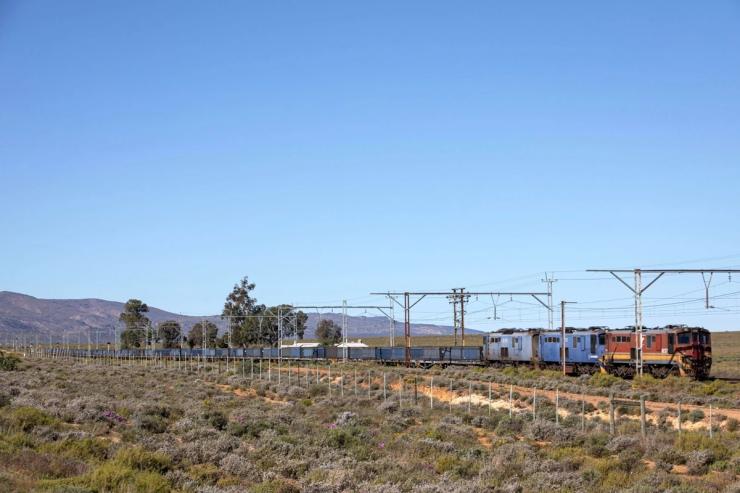

The Scoop
South Africa’s state-owned freight company Transnet is asking lenders to relax financial tests on loans as it prepares to roll over $200 million-plus in debt in planned refinancing this year, it told Semafor.
The move would offer government sovereign guarantees to replace some commercial safeguards — “loan covenants” in corporate finance parlance — jacking up fiscal exposure and raising fresh questions about whether the company’s liquidity squeeze could force state support.
Transnet, which moves bulk exports in Africa’s most industrialized economy and runs key ports and pipelines, is contending with a nearly $2.6 billion debt pile. It is another wildcard in the national budget announced by Finance Minister Enoch Godongwana late last month that is already strained after the US and Israel launched strikes against Iran which tightened markets and pushed up fuel costs.
The company, the backbone of mining exports in the resource-rich country thanks to its sprawling rail, port, and pipeline network, confirmed Semafor’s reporting based on a source with knowledge of the matter, saying it was revising the rules on loans, and how these loans are priced.
It argued that lenders should look to the government’s sovereign guarantees rather than the company’s finances, which are strained by ageing rail infrastructure, rolling stock shortages, and theft.
As part of efforts to keep interest payments contained, which swallow about half of its core earnings, or EBITDA, Transnet told Semafor that it was preparing to roll over borrowings worth as much as $230 million this year.
Transnet must move more freight to stabilize its finances, but operational problems are holding it back, Songezo Zibi, chair of the South African parliament’s public finances committee, told Semafor. A dispute with a Chinese locomotive supplier has left many trains idle, and Zibi said the company could remain “stuck in the same place for a long time.”
“Transnet has a liquidity problem,” he added. “Meeting its obligations will require some form of capital injection.”
His comments put a spotlight on Godongwana. Since 2023, the government guarantees for Transnet have risen more than fourfold with the hope that the company will turn its fortunes around.
In this article:

Know More
Transnet has been a choke point on South Africa’s economy for over a decade, hollowed out by a corruption frenzy during the administration of President Jacob Zuma. It depends on roughly $3.4 billion in government guarantees after racking up $2.6 billion in borrowings to buy hundreds of locomotives, which have since sat idle as a standoff with the Chinese supplier, CRRC-E-Loco, drags on. A series of locomotive contracts that Transnet awarded to CRRC were later ruled unlawful and overpriced.
The impasse has boxed South Africa into an uncomfortable corner because CRRC is owned by the Chinese government, and Beijing is a key BRICS partner. South Africa previously dispatched senior political officials to Beijing in an attempt to resolve the issue.
Transnet’s operational failures have pushed freight off the rails and onto the roads, raising logistics costs across the economy and entrenching a truck-heavy system ill-suited to bulk exports. That breakdown has opened space for private players such as Dubai’s DP World, but triggered higher congestion and public spending and reduced export competitiveness.

Tiisetso’s view
If Transnet’s lenders accept Treasury guarantees in place of hard performance tests, they securing certainty for themselves while potentially sending the bill to the public
The company’s self-help measures remain unproven, and projections underpinning its recovery look like rough estimates, but the state is being asked to underwrite the same operational turnaround. That is a textbook moral hazard.
If Godongwana wants to stabilize logistics without mortgaging the budget, he must insist on paperwork that provides verifiable self-help measures — not hope.

Room for Disagreement
Transnet has argued that the sovereign guarantees and covenant relief are necessary to stabilize operations while it works through deep-seated constraints that limit its financial performance.
“The credit enhancement of government guarantees allows Transnet flexibility to improve the overall conditions of the affected facilities,” it said in an emailed response to Semafor questions.
Some analysts argue that Transnet’s rail volumes — the company’s core revenue engine — -are showing early signs of recovery, rising just over 4% to more than 80 million tons in the six months to the end of September. Management is projecting a full-year uplift to 170 million tons, up from their three decade-low of 149 million tonnes in 2022. Transnet’s historical peak was around 230 million tons in 2017.
Observers have also blamed the government for Transnet’s operational failures, arguing that the company is trapped by structural constraints that management alone cannot resolve.
One of the most glaring is the slow pace at which the government has opened the rail network to private operators. Allowing third-party operators to run trains on Transnet’s network, paying annuity-style access and operating licenses that could lift volumes.

Notable
- India’s railways and power utilities are undergoing aggressive reform and receiving heavy state support, with the government doubling down on capital spending.