




Yinka’s view
Four years after Russia’s full-scale invasion of Ukraine, a war many African officials once viewed as distant and European is now uncomfortably close to home.
What began as a geopolitical rupture in Eastern Europe is now a domestic political headache in Kenya, Nigeria, and South Africa. Ukraine has said roughly 1,400 Africans from nearly 40 countries are fighting on the Russian side, though experts believe the numbers are higher. Many of them were recruited online, lured by promises of steady pay, legal residency, or educational opportunities — offers that often disappear upon arrival at the front.
Research from the Atlantic Council shows Russian-linked recruiters ramping up digital campaigns across African social media as battlefield losses — there are reportedly more than 1 million Russian casualties — mount. The pitch mixes selective truths with outright deception, targeting young men facing joblessness, inflation, and creeping poverty, as well as young women lured by promises of factory jobs, including in drone production tied to the war effort. Social media has since carried horror stories of recruits subjected to abuse and sent to the front line with minimal training.
The uncomfortable truth for African governments is that this phenomenon mirrors another crisis many on the continent have struggled to contain: The steady flow of migrants risking their lives by crossing the Mediterranean to Europe. In both cases, desperation meets disinformation. The same economic frustrations that drive perilous journeys north are now being weaponized to fill foreign trenches east.
A year into the conflict, African leaders sought to chart a different course. A delegation of seven countries led by South Africa’s President Cyril Ramaphosa attempted to position the continent as a neutral peace broker. They were politely received and largely ignored by Russian President Vladimir Putin and Western leaders.
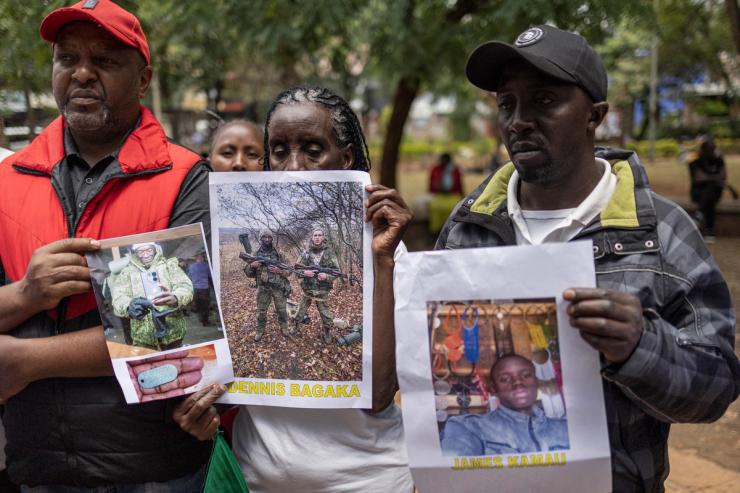
Now, as families in Nairobi, Johannesburg, and beyond demand the return of sons recruited into a distant war, the political and human costs are landing squarely at home.
The war was never Africa’s to fight. But four years on, its consequences are unmistakably African.

Notable
- While the EU has mostly closed its doors to economic migrants from the continent, Russia has welcomed them with promises of citizenship, the Danish Institute for International Studies wrote in an EU policy brief.