




The News
Prediction markets have won over the Trump administration. The rest of the Republican Party might prove more of a challenge.
Kalshi, Polymarket, and their cohorts won big this week when Commodity Futures Trading Commission Chair Mike Selig asserted power over them, wading into multiple legal fights with state and local regulators who say that prediction markets violate gambling laws.
By endorsing prediction markets’ argument that regulators should treat them more like derivatives exchanges than like casinos, however, Selig also laid bare the messy political dynamics behind the ongoing fight.
Republicans split on the CFTC announcement; Sens. Bill Hagerty, R-La., and Dave McCormick, R-Pa., voiced their support while Utah Gov. Spencer Cox panned the move. Other GOP lawmakers, including Sens. Mike Lee, R-Utah, and Cindy Hyde-Smith, R-Miss., have previously raised concerns about federal regulation of prediction markets; Sen. John Curtis, R-Utah, joined Democrats on a September letter to the CFTC.
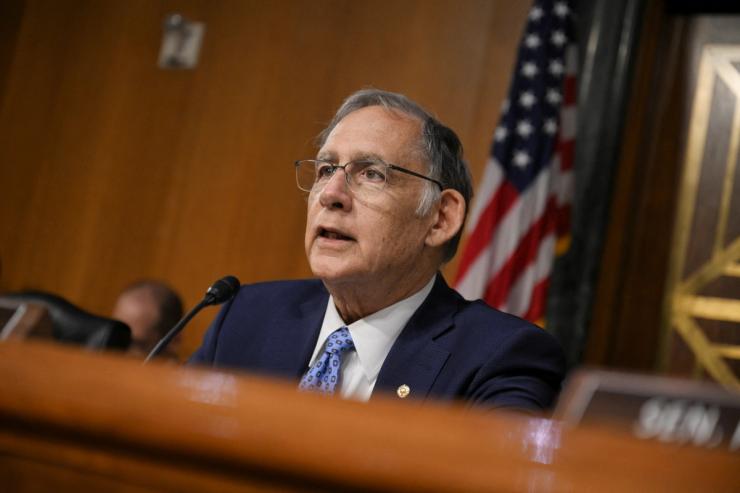
Senate Agriculture Chair John Boozman, R-Ark., whose committee has jurisdiction over the CFTC, told Semafor before the chair’s announcement that his panel “will be visiting with Selig” as Congress tries “to figure out what the path forward is.”
“This is an area that just caught fire; I don’t think anybody expected it to grow at the rate that it has,” Boozman said. “But there is concern; it’s the Wild West. There’s not much regulation.”
“Probably at some point, either from a regulatory standpoint or Congress stepping in and passing some sort of law, it does need to be cleaned up,” Boozman added.
Selig’s announcement of federal supervision for prediction markets, notably, described the “Wild West” label as unfairly attached to the betting companies by “some critics.”
But Boozman made clear that lawmakers aren’t just listening to Kalshi and Polymarket, saying they’ve talked “to everyone involved — the tribes, the rest of the gambling world.”
Those critics of prediction markets have yet to coalesce behind a single legislative response, even as some trade groups push lawmakers to include language in a pending cryptocurrency bill that “reenforces existing law and prohibits gaming through CFTC-registered platforms.”
Lawmakers looking to rein in the rising betting operations won’t necessarily find an easy path either. Between the multiple pending lawsuits and the tricky state-by-state alignment on the issue, Democrats don’t have a unified position beyond the belief that Selig’s actions are already “at odds” with the law, as they reiterated in a letter Friday.
“The CFTC needs to follow its own rules, not make up new ones,” Sen. Catherine Cortez Masto, D-Nev., said.
That could take a while. Selig last month struck down a Biden-era rule that would have explicitly banned the markets from offering wagers on sports or politics. He said he’d also directed staff to “move forward with drafting an event contracts rulemaking.”
For now, the industry is thinking short-term — and hiring Democratic advocates.
“Washington is trying to figure out how it feels,” Center for Prediction Markets CEO Sean Patrick Maloney, a former House Democratic campaigns chief, told Semafor.
“Our job is to make sure that people in the Democratic Party understand that these markets are regulated effectively by a good federal regulator. There’s nothing to be afraid of here.”
In this article:

Know More
Maloney said his group is “very eager” to engage on narrower proposals like New York Democratic Rep. Ritchie Torres’ that target specific issues like insider trading, which its prediction-market members have already banned.
Boozman said lawmakers were also interested in examining underage betting, which he called “a real problem,” as well as sports betting, which accounts for most of the markets’ trading volume.
The latter is the focus of most states’ and tribes’ legal arguments that prediction markets fall under state and local jurisdiction per the Supreme Court’s 2018 ruling that allowed states to permit sports gambling.
States and tribes say that prediction markets offer gambling rather than events contracts — which the CFTC may prohibit on illegal activity, assassinations, terrorism, war, or games, according to federal law. (Prediction markets counter that their sports contracts should remain permitted.)
“This is a states’ rights issue, and that’s why it’s been such a polarizing type of thing, because there’s so much money and so much debate and so much consumer protectionism,” Macquarie senior analyst Chad Beynon said.
The Republicans who have withheld their support from prediction markets so far hail from states that have legalized gambling operated by casinos or tribes, as well as from states that have banned gambling.
And as with crypto legislation, the Trump family’s dealmaking is also poised to complicate any potential bipartisan compromise. Its social media company, Truth Social, last year launched its own prediction market with Crypto.com, which Selig defended Tuesday. Donald Trump Jr. has invested in Polymarket and advises Kalshi.
Meanwhile, the CFTC is grappling with staffing cuts at every level. Four out of five seats on the commission itself remain empty: “It’s a lot for one person to handle,” Maloney said.
Like Selig, Maloney’s group wants to keep the focus on prediction markets’ potential benefits. He suggested small businesses could use them to plan around tariffs; young people could treat them as a side hustle; and politicians could use them to replace polls.
The possibilities extend beyond retail: Wall Street is exploring ways it can use prediction markets to make better investments.

Room for Disagreement
Consumer-protection advocates see the fight as far more straightforward than blurry partisan lines.
They’re betting that the courts will eventually shut down Selig’s attempt to claim federal jurisdiction, making legislation not only unlikely but unnecessary.
“Congress is either gridlocked or responding to its campaign paymasters,” Better Markets’ Dennis Kelleher said. “But the industry’s argument here to stretch the language of the law beyond any reasonable interpretation has already run into judicial roadblocks, and probably will continue.”

Eleanor’s view
It’s tempting to draw parallels between prediction markets and crypto, which share some of the same political dynamics and even some of the same private-sector players. But they’re asking for very different things and dealing with very different coalitions.
Take Cortez Masto, who voted for stablecoin legislation earlier this Congress and is now leading the charge against Selig.
A better comparison to prediction markets’ current situation might be AI, which is also seeking federal preemption of state regulation.
Perhaps the biggest difference between prediction markets and crypto is the lack of a long-term game plan. Like prediction markets’ fight for CFTC jurisdiction, crypto exchanges’ fight for market structure legislation is existential.
But the latter goal guarantees crypto regulatory certainty long after Trump leaves office. It’s unclear how prediction markets might achieve that.
Online sportsbooks “that are pushing forward with an offering in prediction markets, they’re looking at it as, ‘We need to make our money back in three years,’” Beynon said. “The amount that they’re spending is with that view … that this would not go beyond” 2028.

Notable
- Selig elaborated on his rationale in an editorial in The Wall Street Journal.
- One former CFTC chair told Politico that the agency doesn’t “have the expertise or staff that they need to police these markets.”