



The News
Nearly six weeks after the Trump administration ousted Venezuela’s leader with plans to effectively run the country, its manner of doing so is increasingly opaque.
The first US sale of Venezuelan oil took place 11 days after President Donald Trump’s declaration that the US would rely on Caracas’ oil revenues to control its future. But one month after Semafor reported that proceeds from an initial $500 million sale were held in a Qatari account, there is no sign of a second successful sale.
There’s also no clarity on when future proceeds will shift to a US-based Treasury Department account from the Qatari account, which was used to help shield the oil proceeds from Venezuela’s creditors.
Secretary of State Marco Rubio said on Jan. 28 that the Treasury account would “ultimately” be used, and an administration official told Semafor that there is one set up to hold “future revenues derived from the sale of Venezuela natural resources.” Asked about further oil sales under what Trump billed as a multi-billion-dollar deal with Venezuela, the official said there were “no new announcements to preview at this time.”
It’s the latest sign of slowing progress in Venezuela, as lawmakers and private-sector players raise questions about how Trump’s advisers plan to build momentum for what will inevitably be a years-long transition on the ground. The lack of public detail emerging from Venezuela stands in stark contrast to the organized communications around other Trump global priorities, like Russia-Ukraine negotiations and the Gaza peace agreement.
“What I worry about is: We’ve got a lot of plates spinning. And it is very difficult to keep them all going at the same time,” said Sen. Thom Tillis, R-N.C. Venezuela is “a classic example” of the limits of Trump-era multitasking, he added, because “taking Maduro out of the country was a great move. But I’m not seeing a lot of immediate progress.”
“Obviously, the business community would have to be brain-dead to make major capital investments without some certainty,” Tillis said.
Some people close to the White House speculate that the lack of details it’s sharing about Venezuela may be intentional. One person close to the administration said that there may be an attempt to “avoid a ‘mission accomplished’ moment,” referring to then-President George W. Bush’s widely mocked premature victory lap in Iraq after the toppling of Saddam Hussein.
“This is a years-long process,” the person added, emphasizing that Trump’s efforts to convince more oil companies to invest in Venezuela likely involve behind-the-scenes maneuvering. “In the words of Kenny Rogers: Don’t count your chips at the table.”
The Treasury Department on Tuesday issued another general license for Venezuelan oil this week, potentially helping shake loose new investments. But there are still “a lot of questions,” Winston & Strawn’s Cari Stinebower, a former Office of Foreign Assets Control counsel who advises clients on the licensing process, said last week.
“I keep hearing unofficially that we just need to be patient,” added Stinebower. Meanwhile, she said, “everyone’s calling and asking for information, and we’re all sort of combing the press and every other source we possibly can.”
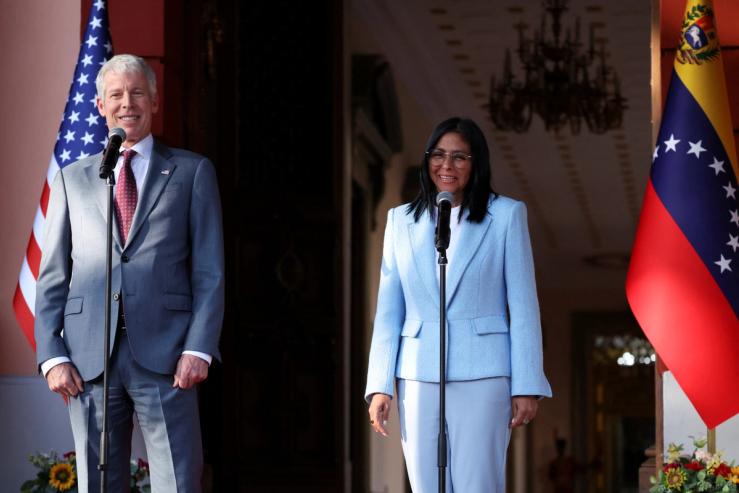
Energy Secretary Chris Wright, a longtime oil-industry executive himself, is playing a leading role in Venezuela. He traveled there this week for meetings with both its interim President Delcy Rodríguez and its state-run oil company.
But Wright has made no firm promises about how quickly production or sales might ramp up. Senior White House economic adviser Kevin Hassett told Semafor on Wednesday that Wright “is working really hard on getting the sales amped up … but I don’t have a hard number.”

Know More
A few things are clear about Trump’s approach in Venezuela: His advisers feel they can work with Rodríguez, despite her occasionally combative public rhetoric and ongoing uncertainty among some Florida Republicans.
And new elections in the country will likely not be held on the shorter timeline that opposition leader Maria Corina Machado has pushed for.
Still more remains uncertain. Treasury Secretary Scott Bessent told lawmakers last week that the administration would use “outside auditors” to oversee how Rodríguez’s team spends oil revenue — a top concern for Florida Republicans. But Bessent added that there’s currently no agreement for such a system.
Legal confusion also surrounds the Treasury-based account for oil revenue. Administration officials have cited the International Emergency Economic Powers Act when talking about it, but lawmakers have raised repeated questions about whether that provides sufficient authority for the US.
That law would also allow Venezuela’s opposition party, as well as creditors with terrorism-related claims, to try to tap the funds as soon as the money enters the US.
Neither Treasury nor State provided on-the-record comment for this story.

Step Back
Iraq offers another clear warning to the Trump administration on the legal risks it has to avoid. When an Iraqi regional government tried to sell the nation’s oil a decade ago, the country’s central government sued participating buyers and sellers.
And when the Biden administration began spending seized funds from Afghanistan’s central bank, “we had a little bit clearer roadmap of the legal justifications,” said Alex Zerden, a former senior government adviser on international finance who ran the Treasury’s Kabul embassy office.
“The Venezuela raid itself was closely held … and so now they’re just being incredibly reactive,” added Zerden, now founder of Capitol Peak Strategies.
“This is a … stopgap measure that they’re claiming to be ‘temporary,’ and they’re not going to be particularly verbose or profligate in their legal justifications.”

The View From The White House
The clear message from White House aides: Be patient and, as spokeswoman Taylor Rogers put it, “Trust in President Trump.”
Rogers added that “this historic US-Venezuela energy agreement is one of the many great deals that the president has brokered on behalf of the American people. President Trump’s team is working with the interim authorities and oil companies to help restore prosperity, safety, and security in the United States and Venezuela.”

Room for Disagreement
The majority of congressional Republicans are taking the White House’s advice.
Rep. Mario Diaz-Balart, R-Fla., told Semafor he has “zero complaints” about communication so far. Others ascribe any uncertainty to the early stages of an inevitably lengthy process.
“You’ve got to remember we took it from a completely broken, sanctioned, basically black-oil situation where it was an underground market, to try and bring it to the legitimacy of the world — and all that’s taking a little bit of time,” Sen. Bernie Moreno, R-Ohio, said after a meeting with Citgo representatives. “But we’re going to be in good shape.”
For others on the ground in Venezuela, the existing signs of change and potential growth are also more than enough. Stinebower said she’s spoken with Venezuelan lawyers who are “ecstatic” over the private-sector interest so far.
“It’s hard to say that this is a problem when the people in Venezuela are celebrating,” she added.

Eleanor and Shelby’s View
A big portion of the haziness surrounding the US approach to Venezuela can credibly be attributed to how much work is required to open up its economy, particularly its oil industry.
But one thing is true about Trump: When he sees clear success, he trumpets it from the rooftops. (Exhibit A: Gaza.) So his administration’s relative silence sends its own political message.
And while Trump can get away with divulging less for as long as Republicans are in charge of Congress, that may change quickly after November.

Notable
- A US flag is hanging outside the Venezuelan presidential palace, reports Bloomberg’s Annmarie Hordern on the ground with Wright.
- Lawfare has an in-depth primer on the legal issues with the administration’s planning.