



The News
Congressional Republicans from Florida are expressing pointed skepticism about the Trump administration’s plans for Venezuelan oil sales while Caracas’ interim president Delcy Rodríguez remains in power.
President Donald Trump, who plans to sell up to 50 million barrels of Venezuelan crude, signed an order this month directing Secretary of State Marco Rubio to spend the revenue on “public, governmental or diplomatic purposes” to benefit Venezuelans. The administration’s initial Venezuelan oil deal, first reported by Semafor, earned $500 million; according to Reuters, $300 million of that was injected back into Venezuela’s economy last week.
But on Capitol Hill, Republicans from the powerful Florida delegation — dominated by supporters of opposition leader Maria Corina Machado — are concerned that Rodríguez’s government will inevitably find a way to misuse the oil revenue. They point out Rodríguez worked hand-in-hand with former President Nicolás Maduro, and worry that her current cooperation with the US belies a patronage system that’s changed little since his capture.
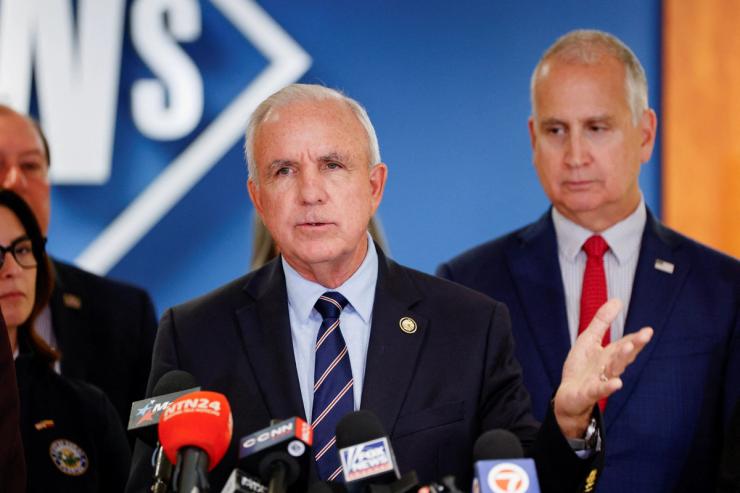
“She’s doing what the Trump administration is requiring of her — but I think everybody understands that if they could, [Rodríguez’s government] would go back to their usual ways,” said Rep. Mario Díaz-Balart, R-Fla.
“Delcy is not just a person that was Maduro’s vice president; she’s a person who has a very extensive record of corruption,” he added. “I mean, frankly, she’s done horrific things.”
The State Department has a “limited” team working to restore US-Venezuela relations, as Fox News reported, and officials have visited the country after Maduro’s capture.
But it’s unclear whether that will be enough to address questions from Florida Republicans about how, exactly, the US will be able to ensure the money truly is used to “stabilize the market” and “protect [Venezuelan] workers,” as Rodríguez said last week.
Rep. María Salazar, R-Fla., told Semafor that she wants to see ongoing oversight of how the revenue is spent.
Rubio said “he was going to make sure that those monies are administered by the United States forces … and I’m going to believe him,” she said. “Now, we’re going to go and investigate what’s going to happen. We’re definitely going to say, ‘That has to fall in American hands.’”
“We know what those people do with that money, ” Salazar added. “They’re not going to give it to the hospitals in Caracas.”
As Rep. Carlos Giménez, R-Fla., put it: “Maybe some public servants need to be paid, maybe there’s some things that need to be bought, etc., for the people — but it’s not to put in the regime’s pocket.”
The Trump administration continues to argue that the US has “established leverage over Venezuela” through the sanctions relief process and selling Venezuelan oil, as an administration official told Semafor. The official added that the interim Venezuelan government has been fully cooperative since Maduro’s ouster.
“Trust in President Trump — he is the ultimate Dealmaker-in-Chief who has brokered many great deals on behalf of the American people,” White House spokeswoman Taylor Rogers said, vowing that energy sales would “restore prosperity and security in Venezuela, safeguarding the economic and national security interests of the United States.”
The State Department “has made tremendous progress over the past three weeks and continues to work with the interim authorities to stabilize Venezuela,” a spokesperson said.

Know More
Legal experts said that the Florida Republican lawmakers are justified in their concern.
Ferrari & Associates’ Aydin Akgün, who worked on Venezuela issues during his two decades at the Treasury Department, pointed to the Oil-for-Food Programme the United Nations set up for Iraq after the 2003 removal from power of Saddam Hussein.
People “can’t help but think about the abuse that took place under that, or misuse of funds, and the lack of accountability,” Akgün said. “So here we are, trying to supposedly create another system like that … and how do you build in those safeguards, those barriers, to make sure the money does go to who we think it should go to?
“What happens when the money hits the ground in Venezuela?” he added. “It’s still going to go through the same bureaucratic process that is right now controlled by Maduro’s former colleagues.”
After Trump’s executive order sought to “safeguard” Venezuelan oil revenue “from attachment or judicial process,” his administration deposited proceeds from its first sale in a Qatari bank account in an effort to avoid its seizure, as Semafor first reported.
Rubio had already told lawmakers that keeping the cash out of the hands of Caracas’ many creditors would be a top priority, a House Republican told Semafor.
“There are so many liens against Venezuela,” this GOP lawmaker said. “They have been shipping all over the world on credit … just trying to basically beg, borrow, and steal to keep the country and the economy limping along.”
The money is “for the Venezuelan people,” the Republican added. “Now, it doesn’t mean that they don’t necessarily have to pay off their debts — but if they’re debts to Russia and Cuba, I’m a little less concerned about that.”
It’s not an airtight strategy, per some legal experts.
Winston & Strawn’s Cari Stinebower, who previously served in the Treasury Department’s Office of Foreign Assets Control, said the use of offshore bank accounts makes it more difficult, but likely not impossible, for Venezuela’s creditors to get access to oil revenue from US sales.

Eleanor and Shelby’s View
It’s been only about three weeks since Trump toppled Maduro, and already a long line of other flashpoints — from immigration enforcement to Greenland — are distracting attention from what his administration is doing in Caracas.
But the fact that Republican lawmakers from a swing state are already voicing doubts doesn’t bode well. If the administration doesn’t start providing answers, and taking steps toward the regime change sought by many in Congress, the problem will continue to snowball.
(It also doesn’t bode well for private-sector investors, who are already skeptical about putting money into Venezuela.)

Room for Disagreement
Rodriguez is certainly putting in effort to please the Trump administration and foreign companies eyeing investment opportunities in Venezuela: She’s pushing a revamp of Venezuelan law that is expected to allow companies to operate on their own, Reuters reported last week.
The move might quiet some concerns from Republicans, especially if Rodriguez continues making efforts to open up the country for US businesses.

Notable
- The US is discussing ways to increase production of Venezuelan oil at lower costs with crude producers, Bloomberg reported.
- Rodriguez is working to consolidate power in the country, even as the Trump administration maintains that it plans to hold elections at some point, Semafor reported.