




The News
It’s been clear since the early days of xAI that Elon Musk’s empire of companies would soon become one big conglomerate (we wrote about that inevitability in 2024).
But Musk’s announcement that SpaceX would buy xAI isn’t just a story about Musk and his wild ambition of making humanity interplanetary. When SpaceX and Tesla finally merge (which won’t happen until SpaceX goes public), we’ll be witnessing the natural evolution of Big Tech, from primarily software-based companies to extraterrestrial industrial giants. Call them EIGs.
Already, being a player in Big Tech means pushing the limits of AI while overseeing the world’s most ambitious energy production projects. Inevitably, the biggest energy, mining, and manufacturing projects will move off the earth’s surface, where solar energy is available 24/7.
The big question is how long this transition will take.
A good rule of thumb when it comes to Musk is right call, wrong clock: He tends to be right on monumental shifts in technology — solar panels, electric vehicles, reusable rockets, big AI models — just wrong on when they manifest. And by laying out his next big bet, Musk is essentially daring every other big tech company to call his bluff.
In this article:

Know More
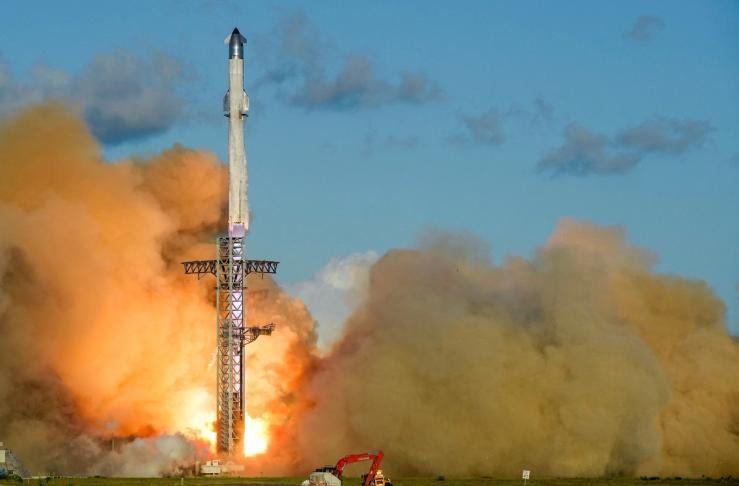
The EIG evolution is made possible by a bunch of complementary technologies. The cost of space flight is plummeting, from NASA’s space shuttle at $54,000 per kg now down to the Falcon Heavy’s $1,400. That’s a big drop. The cost of traveling by car, by comparison, has risen 150% over the same period. At an estimated launch cost of $200 per kg, it will be feasible to begin manufacturing data centers in space. (See our scoop from November).
In space, there is unlimited solar energy. Data centers can be built to always face the sun, so there’s no need for battery storage at night. No winter shade.
There are challenges, like cooling, but there are plenty of ideas for how to make that work. Maintenance is where Tesla comes in. Data centers don’t operate like ‘set it and forget it’ facilities. GPUs frequently get fried and need replacing. Humanoid robots, like the ones Tesla is building, will be essential.
The more significant thing data centers in space do is create a flywheel: Once there’s enough equipment in orbit, the moon becomes a refueling station, leading to mining operations, possibly on asteroids, that create rocket fuel for more far-flung operations and more tasks for robots in space.
Discoveries from quantum computers and AI make space-based mining operations even more valuable. That leads to an extraterrestrial supply chain that upends the one on Earth.
All of this may sound a little far-fetched, and some of the hyperbolic language in the SpaceX acquisition announcement (or viewing it financially as some kind of bailout scam) is humorous. Regardless of whether it happens on Musk’s timeline, it’s going to happen.

Step Back
There are a few more questions worth exploring.
First, why would Musk give away his product roadmap unless he was ready to build a space data center imminently? You might recall when Apple tried to build its own satellite constellation. Or maybe you don’t, because it was never publicly announced. It was a secret project. And then Apple gave up.
Musk often makes public proclamations of ambitious goals to attract the necessary talent and reorient companies around the top priorities. That’s what happened with the company’s autonomous driving program. In 2019, Musk claimed the company would have 1 million robotaxis on the road by 2020. Waves of ambitious employees burned themselves out trying to reach that goal. The first robotaxi was deployed in 2025 (and only last month got rid of the safety drivers).
It also sends a warning shot to competitors that timelines don’t really matter in the Musk empire. Speed matters. SpaceX clearly wanted to acquire xAI before going public, avoiding more regulatory scrutiny. And a Tesla-SpaceX merger doesn’t, on its face, bring up monopoly concerns. They are very different companies. But what they form will be an extremely powerful company without any real competitors, at least in the near term.
I would expect Google, Meta, and Microsoft to look seriously at space industry acquisitions. Google is already an investor in SpaceX, but it doesn’t want to be reliant on Musk’s empire. It’s possible Amazon and Blue Origin will officially merge.Another question to seriously consider is national sovereignty. Once companies leave Earth, it’s harder to subject them to any one nation’s laws. The 1967 Outer Space Treaty makes space subject to international law. But a more recent US law allows companies to keep what they mine out there. Eventually, it will mean a borderless internet and an industrial supply chain that is beyond the reach or control of any country.
Science fiction has plenty of warnings for what these companies might look like. Remember the Weyland-Yutani Corporation in Alien?
Time to start thinking about that, because the era of the EIG is about to begin.

Room for Disagreement
In reality, there is plenty of energy on Earth to build data centers. We can burn coal, natural gas and oil, ramp up solar, and start pumping out nuclear fission plants.
And there are plenty of minerals, too. We can strip mine every mineral we want without ever sending another rocket into space.
People might complain about climate change and pollution from mining, but that’s never stopped humanity before.
Even with the rapidly decreasing price of launching things into space, there are incredible technological and financial hurdles that stand in the way of exploiting resources in orbit.