




The News
The leader of the second-largest party in South Africa’s coalition government announced he will not seek another term, raising fresh questions about the durability of the country’s multi-party administration.
South Africa’s business-friendly Democratic Alliance, which entered national government for the first time nearly 20 months ago, was expected to act as a stabilizing force — providing policy discipline, investor confidence, and institutional ballast. Instead, the party has been increasingly consumed by internal leadership battles and strategic disagreements, often overshadowing its role within government.
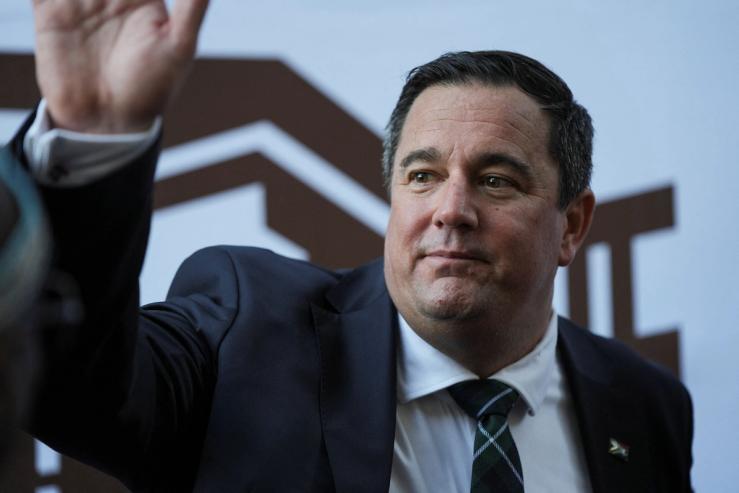
John Steenhuisen said on Wednesday that he will not stand for a third term when the DA holds its leadership elections in April — a decision that follows months of mounting pressure and now risks reopening debates inside the party about its continued participation in the coalition.
Steenhuisen said he had accomplished his political goals, including the establishment of a coalition government in which he serves as agriculture minister. “My work in government now requires me to similarly pour my heart and soul and all of my energy into defeating the foot and mouth disease,” he said at a press conference, referring to a fast-spreading livestock virus currently ravaging South Africa’s beef industry and one of his ministry’s main responsibilities.
His decision is expected to clear the way for Geordin Hill-Lewis, the 39-year-old mayor of Cape Town, to emerge as a leading contender to succeed him. Hill-Lewis, a rising star in the party, has secured strong support from key DA figures since becoming the city’s mayor five years ago.
The DA’s participation in government has helped reassure markets that economic policies will be anchored in a broadly pro-market, rules-based orientation, despite the African National Congress’s uneven delivery record over the past three decades.

Know More
The announcement follows months of mounting internal pressure on Steenhuisen, including public allegations that he used a party credit card to run up a large bill for Uber Eats orders — allegations he has consistently denied. An internal DA investigation cleared him of wrongdoing, but the episode nonetheless deepened factional tensions and further weakened his authority at a time when the party was already divided over its role in government.
Internal divisions in the DA have widened since late last year, when Steenhuisen demoted Dion George, the party’s then environment minister, in a cabinet reshuffle. George, who has since resigned as a member of the DA, previously chaired the party’s finance committee.
After his demotion, he filed a complaint with the graft ombudsman about Steenhuisen’s alleged misuse of the party credit card. George also took the extraordinary step of reporting Steenhuisen to the Public Protector, the country’s top anti-corruption watchdog. In an 84-page affidavit, he alleged that the DA leader orchestrated his removal from the cabinet under false pretences.

Sam’s view
Steenhuisen’s departure paves the way for one of South Africa’s most likeable politicians to take the helm of a key pillar of the coalition government. Hill-Lewis has risen steadily through the party ranks, earning early respect as the DA’s finance spokesperson before becoming mayor of Cape Town.
With a sharp feel for political arithmetic and a slightly geeky approach to strategy, Hill-Lewis has cultivated constructive relationships with key figures in the ANC leadership, helped along by a personable, pragmatic style that plays well across party lines.
That said, it is unlikely to be an easy ride. Steenhuisen’s exit may mark a rupture moment inside the DA, opening long-suppressed ideological, strategic, and leadership debates. It could also prompt an explicit reexamination of the party’s participation in the Government of National Unity — including whether continued participation serves the DA’s electoral interests, or whether a recalibrated or more conditional role is required.
Leadership succession, therefore, is not merely a contest of personalities, but a debate about the DA’s theory of power in a coalition-era political system. While a complete withdrawal from the GNU may be unlikely, the resurgence of internal debate alone risks unsettling a government whose stability rests, in part, on the DA’s role as a moderating force.
The timing could scarcely be worse. The party is attempting to establish itself as the responsible anchor of a fragile coalition — a role that demands ethical clarity, internal coherence, and strategic restraint. Instead, those very qualities are now under strain.
Senior figures within the DA have accused one another of abusing power and manipulating state institutions, drawing South Africa’s anti-corruption watchdog into what is, in effect, an internal leadership battle. For voters and markets alike, the fine distinctions between party processes and state mandates matter less than the optics.The danger is that the internecine warfare could dent investor confidence in the government at a time when Africa’s most industrialized economy is expected to record solid growth on the back of surging commodity prices, increasingly stable electricity, and policy harmonization in the fight against inflation.
The DA entered government promising to bring stability to a fragmented political landscape. Instead, it now risks exporting its own internal civil war into the very institutions meant to steady the country.

Notable
- South African President Cyril Ramaphosa last month told the ANC it must improve its poor record on delivering services ahead of this year’s municipal elections.

Room for Disagreement
“There’s always going to be a difference of opinion” in any healthy political party, former DA leader Tony Leon told South Africa’s Eyewitness News, when asked about schisms within the party.
South Africa is due to hold municipal elections before November. The polls will decide who controls some of the country’s main cities that are vital for economic growth. “Voters punish parties who appear more interested in themselves than in governing,” Leon said.

The View From Johannesburg
Claude de Baissac, CEO of Eunomix, said “petty internal battles” were the main reason the DA “has not delivered on the expectation that it would significantly shape policy direction.”
Joining the coalition government had been seen as “a golden opportunity,” he said. “But the fact that the party appears divided and consumed by internal disputes reflects a deeper problem — a lack of a bold, unifying purpose.”