





The News
Tech companies are swapping concrete bunkers for designer data centers. In response to community pushback over the buildout, they’re tapping architects to make over the facilities powering the AI boom.
For its part, Gensler, the design firm tagged to help with JPMorgan’s splashy new Manhattan headquarters, says the number of its employees who work on data centers jumped by 40% in the last year.
Gensler is designing a data center in the Netherlands with vertical gardens. Another one in Phoenix, Arizona, has a rust-orange facade that looks more like a modern art museum than metal warehouse — and comes with a two-acre community park. Facilities planned for Alberta, Canada, will use wood-colored exteriors to blend more seamlessly into the heavily wooded area.
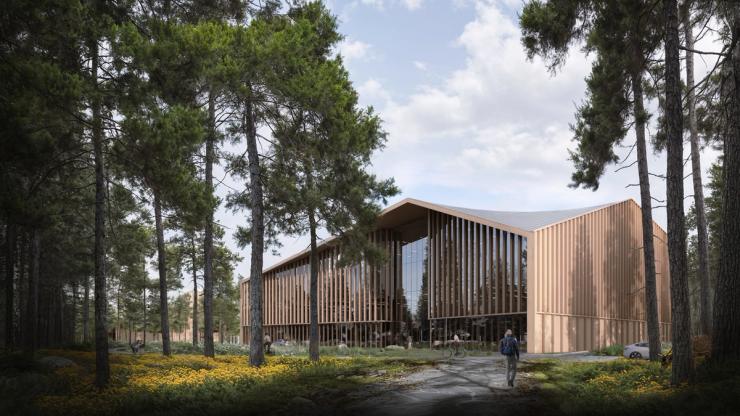 Rendering of data center in Alberta, Canada. Courtesy of Gensler.
Traditionally, data centers are large, rectangular buildings with little architectural flair. And while the outrage around them has mostly centered on energy and water usage, local protests have flared up by people who don’t want to look at what some neighbors refer to as “ugly” eyesores.
That image has contributed to the fury around data center expansion across political lines. And municipalities have begun making demands regarding their appearances. “When we’ve seen municipalities push back, the clients are very, very willing to do what they ask,” said Gensler’s head of its data center practice, Jackson Metcalf.
By investing in optics, tech companies may blunt some of that backlash.
“Many of our clients are finally coming to terms with [the fact that] they’re going to have to do a little more, but they’ve also realized that architecture is like the lowest cost of all the different disciplines of data centers,” Metcalf said.
In this article:

Know More
The rollout is happening relatively quietly. According to Metcalf, data center developers worry fancier structures might send the wrong message to investors that they’re wasting money. “What you really need is a forward-thinking billionaire to demonstrate that this is all feasible by example,” he said.
Since 2023, Gensler says it has tripled its revenue in this business — most of which comes from the US market — to $127 million. And it isn’t the only architecture firm seeing this demand.
Neil Sheehan, who directs Woolpert’s data center design team, said public scrutiny isn’t the only factor in clients’ new attention to aesthetics. There are a limited number of sites these facilities can go, giving local governments an upper hand in negotiations. It has “led to more stringent approval processes” that require buildings to blend into their surroundings, he said.

Rachyl’s view
Local opposition hasn’t stopped the trillion-dollar machine behind the data center buildout, but it has caused delays. The costs to fight lawsuits and relocate facilities adds up, especially considering how fast AI companies are burning through cash already.
Solving the energy and water issues, and then convincing the public, are thorny problems. Sprucing up buildings to make them easier on the eyes is a much simpler lift.
Designers are already envisioning a world in which data centers can double as community spaces, and we expect them to incorporate gardens, playgrounds, parking garages, and other amenities, as we wrote in our 2026 tech predictions (facilities handling sensitive information or government data will likely remain walled off from public use). Building a data center alongside a daycare or gym will help with the PR push around the economic value they bring cities. Tax dollars and donations from companies that run data centers already fund parks, schools, and libraries, but companies will be more vocal about the investments to counter increased political backlash.

Room for Disagreement
There’s evidence that data centers face more serious dissent that fresh paint won’t be able to fix, prompting some localities to issue moratoriums on new builds. Energy generation and transmission demand by data centers have been tied to increases on residents’ electricity bills — upwards of $450 per year by 2040. And the buildout is putting stress on local water resources that communities worry will cause shortages, with 160 new facilities located in areas with scarce supply, according to Bloomberg.

Notable
- In a completely different approach, Meta has started erecting tent-like structures to house servers to get their data centers online faster. They lack the visual appeal of some of these new facilities, indicating Meta has chosen speed over aesthetics.