



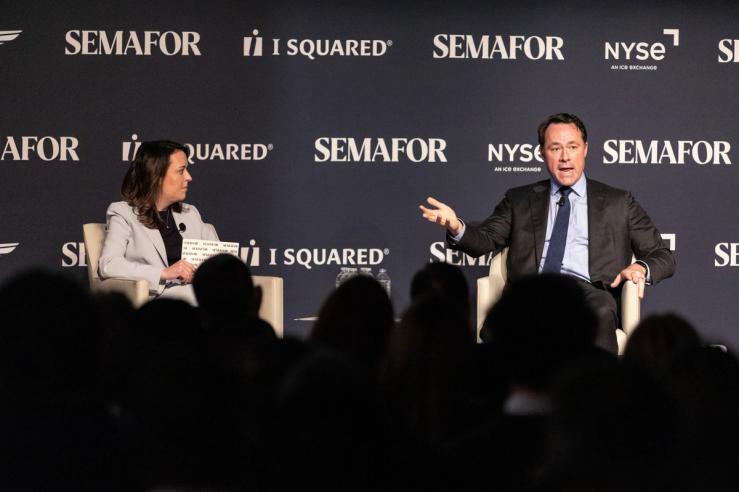

The Scene
Loan defaults in the fast-growing world of private credit are coming, but won’t be catastrophic and are a healthy rebalancing after a decade of easy money and few consequences, said a BlackRock senior executive.
“Coming from an incredibly benign period in the credit markets, the existence of defaults feels like a signal that there’s a problem. And that’s what I reject,” Michael Patterson said at Semafor’s The Ledger live event Tuesday. “There will be people that do this job better and people that do this job worse.”
The collapses this fall of several highly indebted companies has unnerved investors and drawn told-you-so wagging from private credit firms’ bank rivals. The trailing 12-month default rate for private loans — a roughly $2 trillion market — hit 1.3% this summer, up from less than 0.5% three years earlier but well short of the 15% in 2009, according to S&P Global.
Patterson was a co-founder of HPS Investment Partners, a pioneer in private credit that BlackRock bought earlier this year for $12 billion.
“The promise of private credit is not the ability to avoid every single problem,” he added. “It’s that when those surprises happen, you’ve put yourself in a better position to recover as much as possible for your investors.”
He said he expects private credit companies whose borrowers do default to recover “60, 70 cents on average” on the dollar, adding that “by the way, ours are a lot higher than that.” In comparison, banks generally recover between 40 and 60% of their money.
Patterson isn’t a neutral observer; BlackRock paid a huge price for HPS and now manages more than $140 billion of private credit. But he got some backup from Jay Clayton, a former Securities and Exchange Commission chairman who is now the top federal prosecutor in Manhattan.
“All of the pearl-clutching over private credit writ large is a little overblown,” Clayton told Semafor at the event. “There are areas of the private credit markets where there’s been recent trouble and we should continue to look,” he said, singling out loans that are backed by soft collateral like future cash flows and licensing agreements rather than hard assets that could be seized in a default.
HPS lent hundreds of millions of dollars to a company, Carriox, that purported to have contracts with big telecom companies that were allegedly faked. Two accounting firms failed to uncover the fraud, and the company went bankrupt this fall, leaving HPS with losses.
“Do auditors know how to audit things that are not as tangible as they once were?” Clayton wondered. “It happens all the time whenever we have upswings in markets and a whole new set of auditors need to learn all over again.”
Responding broadly to the question of whether Wall Street is lending too much to companies without hard assets that could be repossessed, Patterson said: “Software is a bigger part of all of our lives, and surprise, surprise, software is a much bigger part of the investment portfolios of private equity and private credit firms.”
In this article:

Liz’s view
The era of free money did a lot of suboptimal things to the economy: negative interest-rate bonds, underfunded pensions, vans with robot pizza chefs. One we still haven’t shaken is the sense that loans should never go bad.
Interest rates were so low for so long that bad businesses were able to borrow and refinance rather than admit they were never going to be able to repay. Patterson is right that the market lost its tolerance for occasional failure, and we should view the default numbers now — still fairly now and rising from a base of essentially zero — through that lens.
“We don’t know how to have a cycle anymore,” Jon Pruzan, the former chief financial officer of Morgan Stanley, now co-president of real-estate investment firm Pretium, told me last year.
Remembering how to do that is healthy. Some loans should default, leaving lenders and (as Clayton notes, auditors) to self-examine. Otherwise one of two things is going on: the economy is falling short of maximum credit creation, or a warped monetary policy is protecting the weakest in the corporate herd, and probably doing other weird things, too, like encouraging robot-made pizzas that nobody asked for and venture capitalists inexplicably threw $440 million at.

Notable
- Another not-disinterested observer, Apollo CEO Marc Rowan, poked holes in private-credit criticisms in a lengthy op-ed in Bloomberg Monday
- Britain wants to subject private-credit portfolios to stress-test scenarios similar to those banks must undergo, the FT reported.