



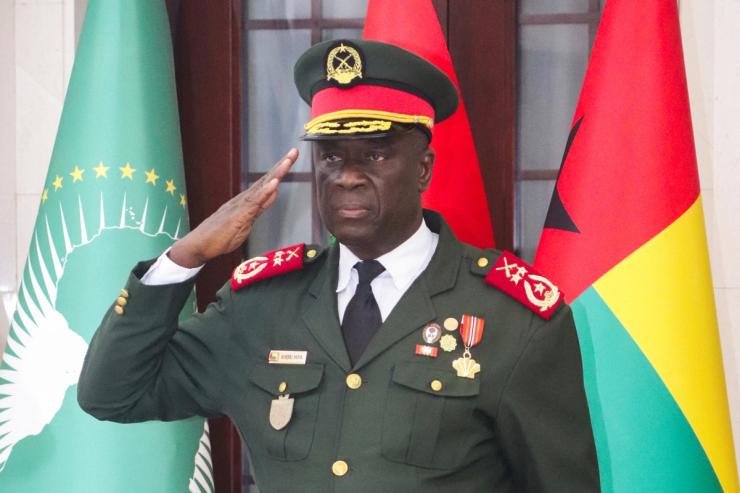
Last week saw yet another military takeover in West Africa — this time in Guinea-Bissau, where soldiers dissolved state institutions days after a presidential election. But everything about Guinea-Bissau’s coup is off. First, the timing: It came after the election but a day before the results were due to be announced. Both the main candidates — incumbent President Umaro Sissoco Embaló and his main challenger Fernando Dias — had already declared victory following a 65% voter turnout. The soldiers said they seized power to counter a plan by some politicians and drug lords to destabilize the country. Why couldn’t they cooperate with the existing government?Guinea-Bissau’s longstanding reputation as a narco-state — with entrenched corruption involving the military and political elite — provided both the conditions and the excuse for this military takeover. Newly installed president General Horta N’Tam put the fight against corruption center-stage at his swearing-in ceremony last week, and could use this argument to shield himself and the other coupmakers from criticism and potential international sanctions.
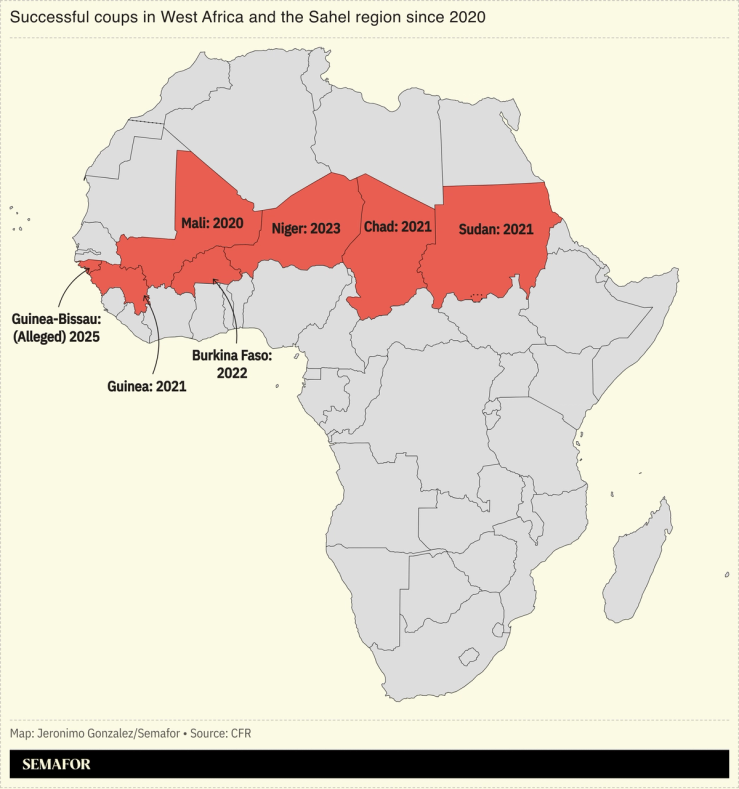
Guinea-Bissau’s latest coup — the fifth successful one since independence from Portugal in 1974 — also doesn’t follow the regional script led by Burkina Faso, Mali, and Niger. It lacks a populist narrative: There’s no jihadist insurgency to rally against, no Western military bases to expel, no anti-colonial sentiment to weaponize. There were no street celebrations to greet the news of the takeover, so the coupists can’t present this as a people-driven revolution.
The absence of election results also raises questions about whose interest the coup serves. Former Nigerian President Goodluck Jonathan, who led the West African Elders Forum observer mission to the elections, described it as a “ceremonial coup,” noting that Embaló’s conduct suggested he had colluded with the junta, which would imply he was likely to lose at the polls. N’Tam is the former head of the presidential guard.
Under Embaló’s five year-presidency, Guinea-Bissau’s political and governance institutions were considerably weakened. Ecowas, the West African bloc, unanimously voted him its chair in 2022, not long after he dissolved Parliament. He did it again in 2023. There were no consequences either time. Now, following this military takeover, both Ecowas and the African Union have suspended Guinea-Bissau.Both regional bodies treat coups like earthquakes: only responding after the ground splits open on democracy, but ignoring the years of tremors weakening its foundations. They send election observers but have no mechanism to monitor what happens in the years between votes, when there is a build-up of constitutional manipulation, autocracy, or erosion of the rule of law. Many of the leaders who should be sounding alarms are eroding democracy in their own countries — from term-limit changes in Togo and Côte d’Ivoire, to brutal suppression of dissent in Tanzania and Kenya. They won’t act collectively against the very behavior they practice individually.
Economically, the coup threatens modest progress. The economy relies overwhelmingly on cashew exports, which provide income for most households. The country had been showing signs of life — growth for 2025 was projected at 5.1% — with offshore oil exploration underway. Political instability can disrupt the crop trading seasons, push down local earnings, and heighten caution from investors. Any international sanctions or isolation would hit ordinary citizens long before they inconvenience the elites.
The junta in Guinea-Bissau promises a one-year transition. The track record of other military governments nearby suggests a much longer timeline ahead. So with no external oversight, and both its political class and military implicated, Guinea-Bissau now faces an implausible path back to constitutional rule.
Tomi Oladipo is an award-winning journalist based in Berlin. He covers global affairs with a focus on African security, geopolitics, and digital media. He has reported for the BBC and Deutsche Welle, among other international outlets, over nearly two decades.