




David’s view
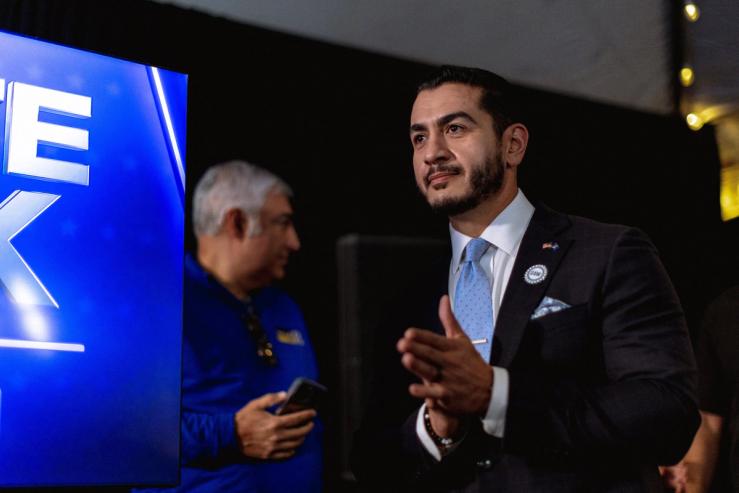
If Abdul El-Sayed wins Michigan’s Senate race next month, the Saturday clip of him admonishing a GOP activist about freedom of religion will achieve legendary status in his party.
“It’s you who need to understand the Constitution, not me,” El-Sayed told Thomas Teepell during an appearance in the small Michigan city of Caro. The candidate accepted Teepell’s challenge to “disavow the Muslim Brotherhood,” then denounced the “dual loyalty” smear it seemed like the activist wanted to make.
If El-Sayed wins, I’d expect Republicans to study that clip, too. That’s because the lesson conservatives can take isn’t that the topic of El-Sayed’s religion is too hot to touch. Teepell struggled to follow up because he couldn’t handle the moment.
From President Donald Trump on down, Republicans are very comfortable contending that Muslim immigration threatens America and that the liberal crusade for diversity is national suicide. They love running against El-Sayed, even in the 49 states where he’s not on the ballot. And they don’t hold their tongues anymore for fear of political backlash.
“What excites him is this prospect of wielding the power of a country he hates,” Vice President JD Vance told Michigan Republicans about El-Sayed this month. “He wants to litigate ancient grievances with your tax dollars, and he wants to use the grievances of faraway lands to punish you.”
This isn’t a swerve away from the GOP’s midterm message. It is the message: Foreigners are undermining America from within, and Democrats won’t stop them. (Never mind that El-Sayed was born in Rochester Hills.)
Teepell was very much in line with the Trump-era Republican rhetorical strategy to demonize the “other.” Where he went wrong was, in part, failing to go toe to toe with one of the most skillful extemporaneous talkers in Democratic politics.
He was also working against a new reality: The Trump administration’s border closure and shutdown of most asylum claims has made “immigration” less critical to most voters. Casting El-Sayed as the enemy simply wasn’t as easy as he might have hoped.
But the bigger context is more favorable to MAGA conservatives: With no Democrat running on a return to pre-Trump border policies, they see that topics once considered forbidden or offensive by media gatekeepers can win elections. The El-Sayed-Teepell moment happened as Paris was gripped by riots; Trump, his White House, and supportive media outlets warned that Democrats would bring the same migration-driven chaos across the Atlantic.
Those media gates of the past might not even be standing anymore.
They were sturdy in 2008, when Republicans campaigned more cautiously around questions of race and immigration. El-Sayed has indulged comparisons to Barack Obama, whose 2008 campaign convinced the young Muslim that he could one day run for office.
In his 2020 memoir, El-Sayed wrote that after he graduated from the University of Michigan, he brushed off the idea (floated by Bill Clinton, his commencement speaker) that he might have a future in politics. Of course not: His name was Abdulrahman Muhammad El-Sayed. But one year later, “someone whose father had immigrated from eastern Africa — someone who was marked by a funny name and dark skin,” won Michigan by 16 points.
The idea that something had changed, and that attacking Islam or a foreign name didn’t work anymore, ran through El-Sayed’s 2018 campaign. At one stop, he was buttonholed by Laura Loomer, then a semi-cancelled independent muckraker, who asked how he could “reconcile your own personal practice of Islamic law with your Marxist, socialist political platform.”
Loomer was fairly easy for that campaign to brush off. She’s now one of the most influential conservative activists in America, with a direct line to the president.
Republicans in the Bush years, who briefly hoped to build a lasting multiracial coalition, were hesitant to attack Obama over his pastor, or to elevate rumors that he was a Muslim. (“No, ma’am.“) On the right, it’s widely believed now that this was a loser’s strategy.
That’s why Teepell’s biggest error, in the eyes of the right, was simply lacking a clapback. If Republicans lose big next month, there’ll be a brawl to assign blame — which consultants blew it, which ads wasted money, which issues didn’t work.
The party’s margins with non-white voters and first generation Americans, which improved in 2024, will get a harder look. But I wouldn’t expect them to ditch tactics like the El-Sayed confrontation, tactics that the new media environment is built for.

Notable
- In Slow Boring, Matthew Yglesias wrote about the edgy conservative debate over “the Indian question,” and whether Republican rhetoric about immigrants was hurting them. “You either need to be willing to bite the bullet and say you’re eager to keep good people out or else you need to redefine good behavior as bad.”