




The News
Control of the US Senate for the next two years could come down to how much the news media chooses to focus in the final weeks of the midterms on a tweet sent years ago by the younger half-sister of Michigan’s Democratic Senate candidate.
In 2012, Abdul El-Sayed’s half-sister, Eman Abdelhadi, described “an amazing talk with my mom about her activism in the Muslim Brotherhood during the early ’70s.” Republicans and members of the media have since pressed El-Sayed, an American of Egyptian descent, to answer whether he has ties to the Islamist movement, which was founded in Egypt and whose offshoots include US-designated terrorist groups.
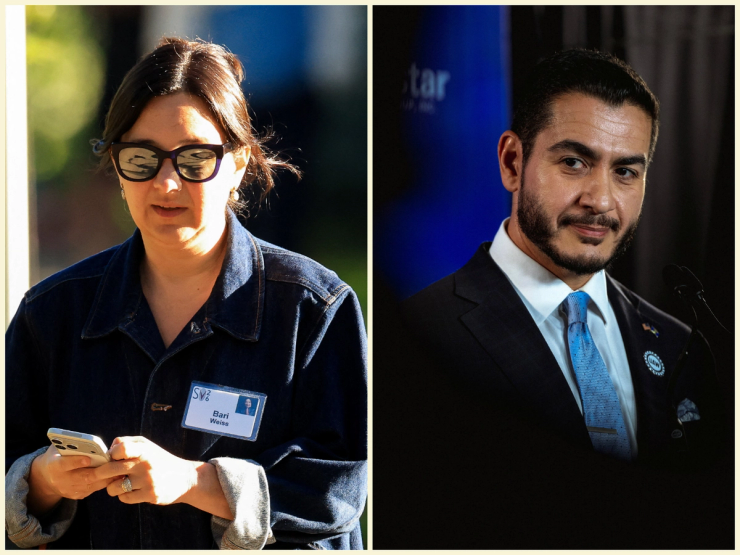
The subject is of particular interest at CBS News, where Editor-in-Chief Bari Weiss has repeatedly encouraged the network’s journalists to dedicate serious resources to finding a potential link.
In recent weeks, Weiss has personally advocated for CBS News journalists to pursue numerous story angles related to El-Sayed’s supposed sympathy towards the Muslim Brotherhood, and was directly involved in a controversial story about his previous posts comparing the COVID-19 death toll to 9/11. She has discussed the topic on editorial calls, and tasked CBS News’ investigative unit with combing through El-Sayed’s background for a potential link to the organization. The network’s investigative team is set to publish a story in the coming days on the subject, though two people familiar with the reporting said that as of Sunday afternoon, it was unclear whether the story will include new revelations.
A year into a new regime at CBS News, some of the daily controversies over Weiss’ management style and relations with the White House that defined the first few months have eased. But the politics of the Middle East and the conflict in Israel and Gaza — and its echoes in American domestic politics — remain red-hot inside the company, as a network leader with strong views on the region’s dynamics has attempted to shape its coverage of stories touching its spiraling conflicts. Rank-and-file staff have clashed with editors installed by Weiss over Gaza, leaking embarrassing internal network discussions about coverage — such as last week, when the media-focused news startup Status and Guardian media reporter Jeremy Barr reported on a clash between CBS News’ London bureau and foreign editor Shayndi Raice.
Weiss has taken a particularly hands-on approach to the Michigan Senate race, where campaign rhetoric has revolved around El-Sayed’s Muslim faith, and whether he can win over Jewish voters in the state. The Hollywood Reporter reported last month that Weiss faced criticism internally for “overseeing an article that critics say falsely insinuated Michigan’s Democratic Senate candidate Abdul El-Sayed had ties to the September 11 attacks.”
Some CBS News staff have privately grumbled that Weiss is particularly focused on pursuing theories about high-profile progressive candidates that bubble up on X or in right-leaning news outlets. Weiss also tasked staff with pursuing the theory that Democratic Texas Senate candidate James Talarico was in a mental health facility after he disappeared from the campaign trail for over a week in October. He was at home with the flu, journalists from The New York Times confirmed, citing images from Talarico’s home security cameras. (CBS News never gave public credence to the theories and matched the Times’ reporting.)
Two CBS News staffers complained that the network has focused on pursuing thin theories about progressive candidates but hasn’t treated conservatives the same way.
“Bari’s ideas routinely come from social media influencers or from opposition research that’s been placed in conservative outlets, and those stories usually leave out important context and facts,” one CBS News staffer in New York told Semafor. “She seems more suited to editing at publications like City Journal, The Free Press, or The [Washington] Free Beacon, which take a clear side on the Israeli-Palestinian conflict and match her views.”
It’s unclear whether the network’s pursuit of the Muslim Brotherhood story will impact its ability to engage with El-Sayed. The candidate, whose relishing of combative interviews and debates verges occasionally on smugness, was slated to potentially appear on 60 Minutes before the November election, people familiar with the planning said.
In this article:

Know More
The purported relationship between El-Sayed and the Muslim Brotherhood has been the subject of political interest since his unsuccessful bid for Michigan governor in 2018. He has disavowed and strenuously denied any ties to the group, and his campaign and its allies say the attacks are thinly veiled Islamophobia; El-Sayed has grown visibly irritated in public when pressed on it.
“Judge me by my actions and my work, but please do not assume that because I might pray differently than anybody who’s ever held this office, that somehow I am not deeply committed to this Constitution,” El-Sayed said in response to a question about it from Semafor. He said it was “insane” to extrapolate a connection and said he didn’t “know what my mother was doing in Egypt in the 1970s.”
“My parents got divorced when I was very young — 3,” El-Sayed said. “I didn’t see my mom for years after I was raised by my dad and my stepmom, and when I asked, [to] the best of my knowledge, nobody in my family’s been a member of this organization.”

Max’s view
When Weiss took over CBS News, her history as The New York Times’ anti-woke columnist, combined with owner David Ellison’s overt suggestions to President Donald Trump that he would change the network if federal regulators approved his corporate deals, stoked fear that the network would be refashioned in an aggressively pro-Trump direction.
The network has not become a mouthpiece for Trump. Without apparent incident, CBS News has regularly published information critical of the Trump administration and its policies. Major reports about its immigration actions and pay-for-play operations have gotten significant airtime on the network and praise from Weiss. The network does appear to have a more friendly relationship with the White House than it did, and has occasionally used that for access. But Vice President JD Vance faced his most challenging media appearance in months during a CBS News town hall last week where he was asked about the shaky US economy, the war in Iran, and self-dealing and corruption within the Trump administration.
Still, if the new CBS is managing to hold the center in Washington, there’s been a far more dramatic shift in coverage of Israel and Gaza.
Weiss has personally been involved in stories about Israeli settler violence. Claire Day, CBS News’ London bureau chief, was reportedly forced out over friction with Weiss regarding Middle East coverage. And to run foreign coverage, Weiss brought on Raice, an editor from The Wall Street Journal that Semafor previously reported had clashed with some Middle East staff over Israel, who described the Palestinian death toll as a “magic number” — and whose claim that no Israelis cared about whether Prime Minister Benjamin Netanyahu knew about the October 7 attacks in advance irked Axios’ Barak Ravid, a close observer of Israeli politics.
The friction over editorial decisions, particularly around Israel, has trapped CBS in its own Middle East media war. When Weiss and her aides shift coverage closer to Israel’s point of view, their actions promptly leak to outlets like the Guardian and Status, the daily media newsletter that has relentlessly chronicled Weiss’ real and perceived missteps. That dustup is typically followed by a defense in Puck’s media newsletter, the reflexively anti-rank-and-file outlet where some media bosses and spokespeople go to air grievances about their unruly staff. (Puck was recently purchased by one of the major investors in CBS’ parent company, Gerry Cardinale.) The problem for Weiss and the new leadership is that the US’ relationship with Israel and Israel’s military actions in the Middle East seems increasingly poised to dominate electoral politics in the coming years.
As I was finishing this piece on Sunday, critics of the network blasted a tweet from CBS News legal correspondent Jan Crawford, who praised a Republican operative who pressed El-Sayed during a town hall to disavow the Muslim Brotherhood. Following backlash, Crawford removed the post from her X timeline on Sunday afternoon and apologized for violating the network’s standards, amid complaints from internal and external critics about the post to CBS News leadership.

Room for Disagreement
Weiss is not alone among the major network figures in her interest in El-Sayed’s supposed ties to the Muslim Brotherhood. NBC News journalists have also pressed El-Sayed on alleged familial connections.
Likewise, CBS News argues it is not an outlier, and is reporting as aggressively on El-Sayed as on contenders in other competitive Senate races, such as Maine’s. The network’s coverage has also not been unilaterally flattering to Israel.
“CBS News has been delivering best-in-class breaking news and exclusive, impactful reporting on immigration, Cornell, the Iran War, the Russia-Ukraine war, and much more,” a network spokesperson told Semafor. “Our Middle East reporting and coverage of the midterms has been just as rigorous. We’ll let our journalism — not baseless accusations — speak for itself.”