



China’s competitor to the dollar-denominated system that zips money between global banks saw record daily volume in August. A spike last spring, as the Iran war sent sanctioned companies looking for a way around Washington, now looks less like a blip and more like a permanent, if small, leg-up for Beijing’s efforts to build a parallel system of financial plumbing.
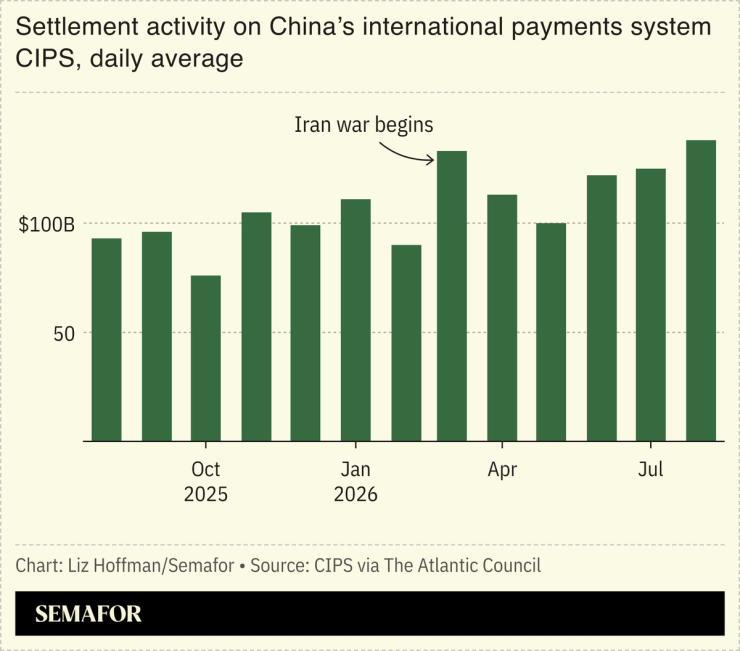
This isn’t the death of the dollar. New data from Atlantic Council researchers Jessie Yin and Lize de Kruijf shared first with Semafor, shows the greenback still underpins most global trade and foreign-exchange transactions. (Try converting Turkish lira to Indian rupees without going through the greenback.)
“The top line numbers all remain stable,” said Josh Lipsky, the Atlantic Council’s chair of international economics. “But look underneath the hood and there’s some worrying signs.”
China’s efforts to dethrone the dollar have so far mostly been a curiosity. Renminbi’s place in global central-bank reserve coffers has actually fallen since 2022, despite Beijing shoveling its currency into developing economies through central-bank swap lines. But crises can reset the board: The number of direct participants in Beijing’s cross-border interbank payment system has more than doubled since Russia’s invasion of Ukraine, and the resulting weaponization of Western financial networks to freeze Russian assets.