





Liz’s view
The keys to succeeding on Wall Street are to a) make money and b) make money differently than others. Performance is table stakes; outperformance gets you the glory.
AI is messing with that logic. Nvidia’s $500 billion consortium includes the four largest alternative-asset managers in the world and six of the top eight. Blackstone and Apollo are jointly providing billions of dollars for Anthropic to buy compute. Anthropic’s AI-for-the-real-world consultancy offshoot raised $1.5 billion from Blackstone, Hellman & Friedman, Goldman Sachs, General Atlantic, Leonard Green, and Apollo. Nearly every big private-equity firm not on that list is backing OpenAI’s competing version. (Goldman, being Goldman, is in both.) Here is a handy chart.
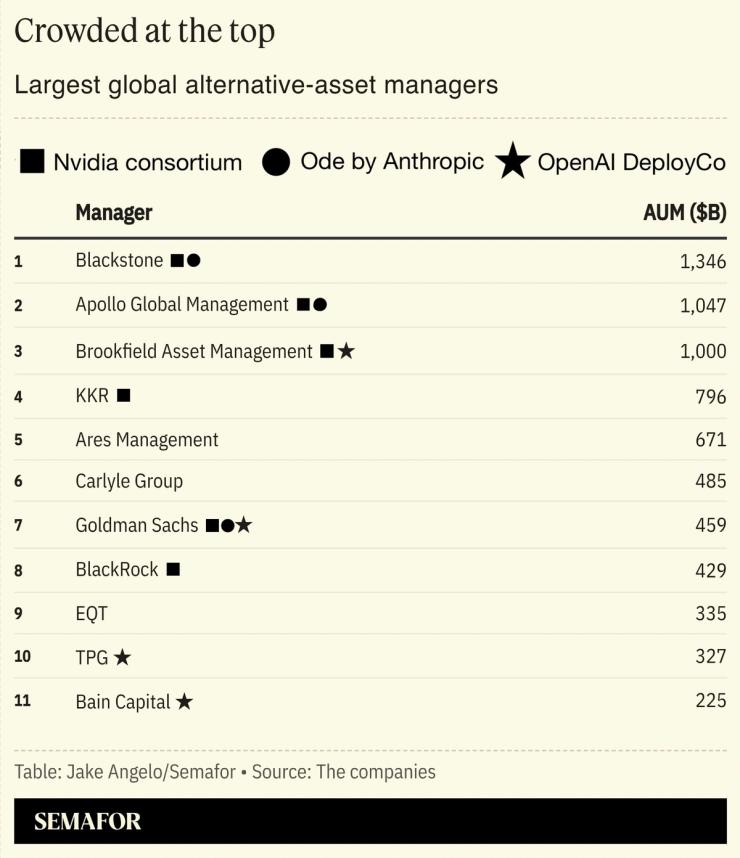
This is not how things usually work on Wall Street, where the goal is to snake investments away from rivals, not share them. The last time private equity clubbed up on deals too big for any one of them to handle solo, we got some of the worst buyouts in history.
Some of the crowding can be explained by the sheer amount of money needed. “Why can you get five or six of the leading players at one table? Because there’s enough to go around,” Brookfield Asset Management CEO Connor Teskey told me last week. He thinks there will still be winners and losers in the AI trade as investors stake out corners within it; Brookfield has made bets on sovereign AI in Europe, Blue Owl is an AI landlord, Apollo is a lender willing to take on chip risk.
But whether those are different bets or marketing gloss for the same big bet is less clear to me. AI is starting to look like an “IBGYBG” trade, a Wall Street phrase that made it into the US government’s postmortem report on the 2008 subprime crash: “I’ll be gone, you’ll be gone.” Everyone wins if it works, even if nobody looks like a standout genius. Everyone loses if it doesn’t, but nobody looks like a standout moron.
The irony is that the investing world was just returning to a place where outperformance seemed possible again when AI arrived. Two decades of easy money had made everyone look like undifferentiated geniuses. A more fractured, risky, and dynamic world of wars, inflation, and tariffs might have encouraged investors to zig where others zagged. “I think we’ll start to see the pull of groupthink become a little weaker, and contrarianism start to pay off,” I wrote in early 2024. Oops.

Notable
- A recent PwC study estimates global spending on data centers alone could top $30 trillion through 2050, a buildout the firm says would surpass infrastructure booms such as railroads, the internet and electrification.