




The Scoop
Amputees in developing nations may hold the key to giving humanoid robots hands that actually work.
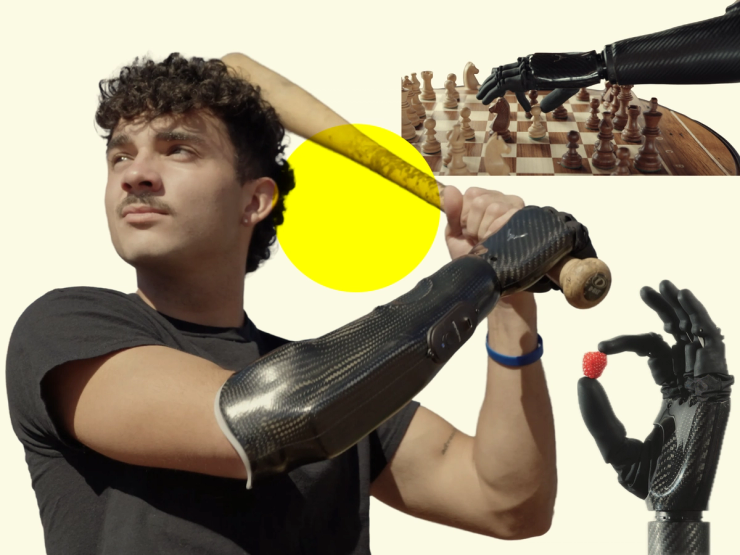
Psyonic, a San Diego startup, wants to give people its bionic hands — and pay them — so it can capture data on how they grip, lift, and fold, with the ultimate goal of perfecting the robotic hand, a longstanding challenge in physical AI.
Founded in 2015, the company initially focused on making prosthetic hands for humans, but CEO Aadeel Akhtar said robotics developers in recent years came knocking at his door, interested in using the hands for robots.
Psyonic is now in the early stages of an effort to deploy thousands of bionic hands globally — it is specifically eyeing Pakistan, where Akhtar’s parents are from, and India. Users would go about their everyday tasks; the data from every grip would then be used to train a robotics model, making the prosthetic wearers a data-collection workforce. That in turn, Akhtar hopes, can subsidize the cost of the hands for those who need them.
“Robotics has a data problem,” especially around hands, Akhtar told Semafor. Companies are scouring for new data sources that can be used to train robots: Some are offering free home cleanings in exchange for filming the work; others are strapping head-mounted cameras on factory workers in India.
Akhtar said Psyonic’s hands log the forces, torques, and finger positions of every grip, which can be synced to video from a wearable camera, so a robotics model learns both what the task looks like and what it feels like. Psyonic’s current plan is to sell the resulting models, rather than the data itself, to robotics companies, Akhtar said.
He also sees it as a way to provide an economic livelihood to people who are unemployed because they are missing limbs; millions of people worldwide have upper-limb amputations, most of them in developing countries. Psyonic is working with Koalaa, a London-based company, to deploy the hands using a soft fabric sleeve — replacing the custom-molded socket that would ordinarily take several clinician visits to set up.
In this article:

Know More
Hands are particularly puzzling for robotics engineers in part because of how compact and complex they are. Engineers count a hand’s complexity in “degrees of freedom” — the number of independent ways it can move. A human hand has around 27; some of the most advanced robotic hands have about 22. Hands are often the biggest single cost in building a humanoid, Barclays researcher Zornitsa Todorova said.
“It’s loaded with motors and rare earths and actuators,” she said. “It’s like an iPhone on steroids. Everything is really packed.”
On top of those engineering challenges, hands also have to interact with the physical world in a way that robotic legs often don’t. It doesn’t matter whether a robot doing a backflip, for example, lands hard or soft on a concrete floor. But a hand has to be skilled at “grabbing a raspberry without crushing it, but also lifting a 100-pound kettlebell and swinging it,” Akhtar said.
That kind of rich, tactile-based manipulation — essentially instilling a sense of touch and feeling in a robot hand — remains “generally unsolved,” said Kanishka Rao, a research director on Google DeepMind’s robotics team. The lab, whose models are built to run on other companies’ robot hardware, has made advances in dexterity: In rolling out Gemini Robotics 2 in July, DeepMind showed a video of a humanoid tying a trash bag — a task that even humans sometimes struggle with.
Rao likened future challenges to pulling keys out of a purse when you can’t see what’s inside: A person can deduce what’s plastic versus metal, soft versus sharp, but “this is a very difficult task that robots would have a lot of trouble doing today.”

Room for Disagreement
Some in the robotics industry argue a human-like hand isn’t needed. Some bots that are currently in use in hospitals, from companies like Cobot and Diligent Robotics, move on wheels and have simple grippers to transport supplies, lab samples, and carts through hospital corridors.
A study from German researchers published in July, which reviewed more than 100 scientific papers, found that “in-hand manipulation does not benefit from anthropomorphic hand design, as simpler mechanisms are sufficient.” Robot-makers should try to copy the function, rather than just the form, of the human hand, they wrote.

The View From China
A host of Chinese startups are also racing to solve the hand hurdle, and analysts say they have an advantage in cost and scale, given China’s hardware-manufacturing prowess. Leading Chinese firm Unitree Robotics last week announced a new human-sized robotic hand with 22 degrees of freedom.
“It was really impossible to do hardware in the United States because the supply chain problem is just so constraining,” the founder of a Shenzhen-based robo-hands company told The Guardian.
The superpowers’ physical AI sectors are becoming increasingly isolated, after Washington in July banned new models of foreign-made robots.