



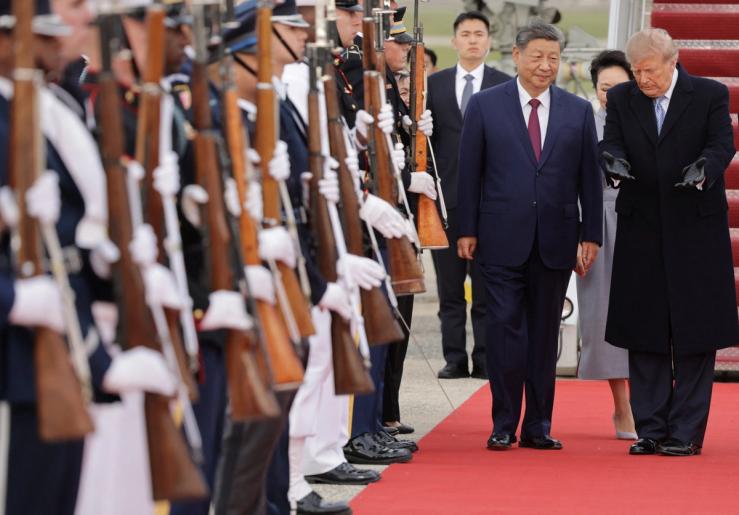
Before this week, the last time a US president greeted a foreign leader at Joint Base Andrews was when John F. Kennedy welcomed British Prime Minister Harold Macmillan in 1962.
But that’s not the reason the image of US President Donald Trump waiting at the foot of the stairs of an Air China Boeing-747 to personally greet Chinese leader Xi Jinping is historic. Macmillan led a close American ally; Xi leads America’s paramount adversary. In rolling out the red carpet, Trump underscored how rapidly the balance of power in the relationship has shifted.
The turning point came last year, when China made the ultimate power move, threatening to choke off rare earths — and turn US factories dark — after Trump ramped up tariffs on Chinese goods to more than 140%.
Trump backed down, and at the time, Rush Doshi, a Georgetown University professor and former Biden administration official, wrote that China had proved itself to be a “true peer” of the US, unafraid to push back. Doshi’s take on the arrival ceremony, which also included a 21-gun salute and a flyover by B-1B bombers — far exceeding courtesies extended to Trump in Beijing in May — has been that China believes “they’ve basically tamed the United States.”
“The tectonic plates have shifted beneath us,” he told me, “and both leaders are acting accordingly.”
The China scholar Orville Schell writes that the US’ epic diplomatic successes of the 20th century — securing the unconditional surrender of Japan and Germany after World War Two; defusing the Cuban missile crisis; securing arms-control agreements with Moscow to wind down the Cold War — set an unrealistic ceiling for Americans about what’s achievable today. This summit established a new, lower floor.
In classic diplomacy, protocol giveaways are supposed to be reciprocated by substantive concessions. Otherwise, why bother?
Xi offered two pandas — Ping Ping and Fu Shuang — for the Atlanta zoo, bromides on how the US and China must “coexist in peace” and, according to Trump, showed interest in the granite used to construct the new White House helipad.
Yet at the same time, China is supplying Russia with dual-use technology to pummel Ukraine, and as Xi landed, The Wall Street Journal was reporting details of how Beijing had supplied Iran with rocket propellant and electronic components used to make drones and missiles that Tehran is using to lash out at its neighbors — and reportedly kill US service personnel — in the Gulf.
As for actual results, there was talk of an AI hotline to notify each other of risks that rise to the national security level, and an agreement to extend a trade truce for two months. But again, reality belies the rhetoric: It’s far from clear that China and the US assess AI risks in the same way — and whether a hotline would actually work. Moreover, the short extension of the trade armistice only underscores its fragility; Beijing is still squeezing flows of rare earths to extract concessions from the US and coerce its allies, including Japan.
It’s worth remembering that, until quite recently, US and Chinese leaders aired their disagreements in front of TV cameras at joint news conferences on issues ranging from human rights to market access for foreign companies, with American presidents pressing for concessions.
This week, by contrast, has been an exercise in shallow bonhomie. Even a few Republican loyalists have recoiled at the extravagant pageantry, seemingly designed to flatter Xi and awe a domestic audience, although the absence of TV cameras at the Rose Garden ceremony undermined that low-ambition objective. Ahead of the summit, Roger Wicker, the Senate Armed Services Committee Chairman, questioned why Trump was offering such a “lavish welcome” to a “brutal, unelected, and oppressive dictator.”
After a state dinner featuring bok choy and sesame-crusted sea bass — and a clutch of tech moguls including Tim Cook, Elon Musk, and Jensen Huang — the puzzle remains: Why did Trump blow diplomatic capital for such meager results?
“Tremendous things will be happening,” Trump posted on Friday. That’s a diplomatic hope, not a deliverable.