



The News
The US State Department declared this week that neither of Sudan’s two warring factions is fit to govern, sharpening Washington’s pressure campaign as its push for a ceasefire stalls.
“Neither the Sudanese Armed Forces, the Rapid Support Forces, nor their respective leaders, represent legitimate, constitutional governance for Sudan — they rule through force of arms alone,” the State Department said in a statement Tuesday, vowing to raise the cost of fighting “on all belligerents and the networks which fuel the conflict.”
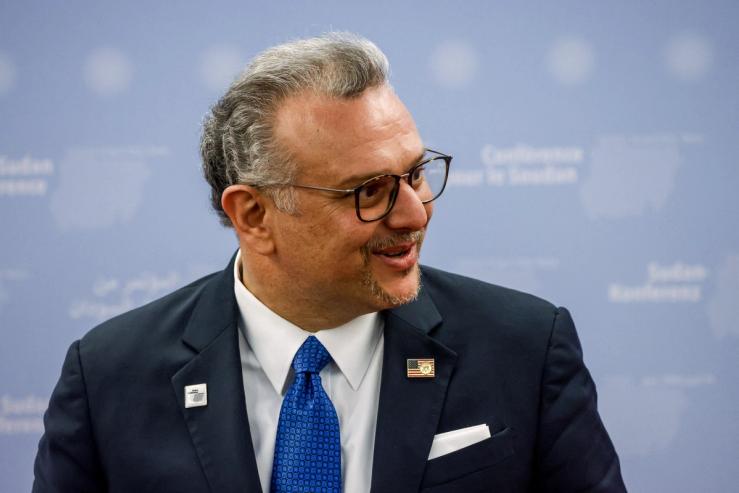
The statement comes after more than a year of US efforts, led by President Donald Trump’s Africa adviser Massad Boulos, to secure a temporary ceasefire in Sudan’s three-year-old war, in which both sides have been accused of widespread abuses against civilians.
The RSF has signaled it would accept a ceasefire, while the SAF — which has gained ground over the last year — has rejected a blanket truce.
Washington responded by imposing “punitive measures” on the army in recent months, said Cameron Hudson, a veteran US-Africa affairs analyst and a former White House official under US President George W. Bush, including by imposing sanctions over the alleged use of chemical weapons and pushing to extend a UN arms embargo from RSF-controlled Darfur to all of Sudan. This week, the US reportedly restricted a visa for SAF leader Gen. Abdel Fattah al-Burhan ahead of a planned appearance at the UN General Assembly.
“What the US has been doing is ratcheting up pressure very steadily on the army with the assumption that it could get the pressure high and severe enough that the army would relent and sign a deal,” said Hudson.

Know More
Experts question whether the Trump administration’s strategy will work.
EJ Hogendoorn, a senior fellow at the Atlantic Council and a former senior adviser to the US special envoy for Sudan, said that “the United States is expending a ton of political capital just to send a signal.” He warned that “temporary ceasefires tend to stay temporary,” pointing to dozens of past Sudanese truces that held only long enough for the combatants to regroup.
The State Department’s declaration could also make diplomacy harder, Hudson argued.
“The question that the Sudanese are asking themselves right now is how you engage in diplomacy with someone who you have now said very explicitly has no legitimacy to sit on the other side of the table from you,” he said.
Boulos, speaking at Semafor’s The Next 3 Billion event Tuesday, stressed that Washington opposes any attempt to divide Sudan.
“We are totally against any parallel governments,” he said.
Asked whether the US still recognizes Sudan’s army-led Transitional Sovereignty Council, Boulos demurred: “There’s a de facto government that we deal with. It doesn’t mean that you officially recognize [it].”

Step Back
Washington’s hardline approach is also creating distance between the US and its regional allies seeking to end the war.
After the State Department’s declaration on Tuesday, Saudi Arabia, Egypt, Pakistan, and Türkiye issued a joint statement affirming their support for Sudan’s “sovereignty, unity, independence and territorial integrity.” It stressed the importance of preserving Sudan’s “legitimate national institutions” and rejecting “parallel entities.”
“What this episode demonstrates is how isolated the United States has made itself,” Hudson said. The US is “moving in a very different direction from the rest of the countries that are engaging in diplomacy on Sudan.”
The break could be particularly significant with Saudi Arabia. Trump agreed to help end the war after Saudi Crown Prince Mohammed bin Salman asked him to get involved, but the two countries’ approaches have increasingly diverged, particularly as Riyadh grows closer to the SAF, Hogendoorn said.
“Because the SAF is resisting this ceasefire — and the US is obviously upset about that — that is driving a bit of difference between what the Saudis would like to see happen and what the administration is trying to achieve,” he said.

Notable
- The UN Security Council will revisit expanding the arms embargo in mid-October, after extending the Darfur-only measure for a month amid resistance from China, Russia, and others.