




The News
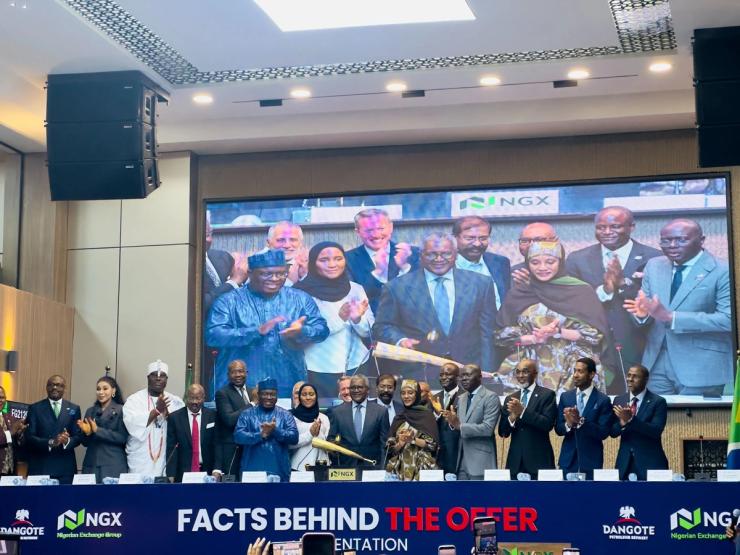
Africa’s richest man Aliko Dangote tapped the opening gong this morning on the floor of the Lagos exchange to open Africa’s largest initial public offer.
The $20 billion Dangote Refinery built on swamp land on the outskirts of Lagos becomes the fourth Dangote Industries subsidiary to go public in Nigeria. When the initial offer closes next month, the company will have raised more than $4 billion at about a $50 billion valuation, if demand matches the year-long buzz partly driven by the company’s pledge to pay dividends in US dollars. The refinery will likely account for up to 40% of the Lagos exchange’s capitalization when its shares start trading post IPO in November.
“We are going to fully, fully share all our prosperity with the people,” Dangote, 69, said in a packed and celebratory hall of bankers, investors and stock brokers for whom the multibillion-dollar Dangote Refinery IPO has been the most talked-about business event in Nigeria all year.
“We, as a group, will list every single company that we operate,” he said, flanked on either side by two of his three adult daughters. Each of them holds an executive role in the Dangote conglomerate and they are positioned to lead its future, but it is the grey-haired veteran magnate who turns the newest page of the empire’s 45-year-old history.
The capital raise and market lead are steps to a more expansive ambition: Dangote’s push to be the biggest fuel seller to Africa’s 1.5 billion people.
“We want to displace less competitive imports that are coming from far away into a market that we can better serve in closer proximity,” David Bird, an ex-Shell executive who has been the Dangote Refinery’s CEO for a year, told Semafor in an interview. Rather than seeing Europe or elsewhere as an export market to target, the refinery’s goal is to win over all of those regions’ fuel supply businesses in Africa, he said.
Central to its strategy of meeting Africa’s fuel demand is an ongoing $14 billion project to double the Nigerian refinery’s output to make it the world’s largest by the first quarter of 2029, Bird said. “We will have foundations and steel coming out of the ground by the end of the year,” Bird said of the Nigeria expansion. The Dangote group’s separate $16 billion Kenya plant is at the planning stage.
Bruce Tanner, the Nigerian refinery’s chief financial officer, told Semafor that “pretty much all” of the IPO proceeds will go towards funding the plans, with additional debt equity financing on the horizon. Executing the expansion would provide an impetus for a secondary listing on an international exchange, he said.
In this article:

Know More
Fuel consumption in Nigeria has risen by about 7.5% on average annually since the Dangote Refinery began transporting fuel to Nigerian pump stations two-and-a-half years ago, despite higher fuel prices after President Bola Tinubu ended a government subsidy. Higher demand and global events, such as the disruption to oil supply sparked by the Iran war since February, have worked in the company’s favor. It netted $1.8 billion in profit after tax on nearly $14 billion of revenue in the first half of this year, more than its total revenue for 2025.
FirstCap, a Nigerian investment bank that is one of two dozen co-issuers of the IPO, expects the refinery’s revenue at the end of this year to reach $28 billion, more than double last year’s earnings. Nigeria’s 220 million population makes it Africa’s largest fuel market. Its growing population and fast pace of urbanization will keep the demand trend for the refinery upwards, according to the bank and other equity analysts.
But serving other African markets — from Senegal to Namibia — that have historically depended on imports from Europe and the Middle East is the pillar of the Dangote refinery’s long-term growth, Bird said. A key part of the whole expansion push is to build out “structural distribution infrastructure” made up of regional tank farms and pipelines that will connect the group’s refineries to prospective markets on the continent, he said. Executing these plans would be very rewarding for the company. Revenue is projected to grow at an average of 45% per year between this year and 2030, according to FirstCap, with a three-fold increase in pre-tax profit to $13 billion within the period.
With expansion years away, solving current operational challenges is critical to the refinery’s pitch that the IPO will be a wealth creation platform for everyday Nigerians. One of those challenges is ensuring regular access to crude oil.

Step Back
On more than one occasion this year, Bird has publicly raised alarm concerning unreliable crude oil supply from Nigeria, particularly under a government scheme aimed to insulate the refinery’s crude purchase price from foreign exchange volatility (the refinery temporarily switched to pricing fuel sales in dollars in July). The company still sources up to 35% of feedstock under that scheme, but a similar share has also come from abroad.
“We’ve got to get everyone off this idea that we’re wedded to Nigerian crude. It’s not about Nigerian crude,” Bird said. The company has bought from several African countries, including Angola, Cameroon, Ghana, and Senegal. It bought two cargoes from the UAE in June, its first crude purchase from the Middle East. With the prospect of an expanded refining capacity in the near future, Bird plans to be even less reliant on Nigerian supply as the business expands and pursues exports to regional markets.
“Our sole business model is daily margin maximization. I’m completely agnostic to where the crude comes from,” he said.

Room for Disagreement
Feyi Fawehinmi, a UK-based accountant and author, and a long-time Dangote critic, said investors in the IPO “are being asked to pay a lot more for each dollar of Dangote Refinery’s earnings,” based on his comparison of the plant’s finances against those of four peer refiners in India, South Korea, Turkey, and the US.Fawehinmi argues that the IPO is the latest evidence of the Nigerian financial sector’s tendency to suspend rigorous scrutiny and diligence when assessing proposals by the billionaire industrialist and his companies, a pattern he says stretches back a decade when banks rushed to uncritically finance the refinery.
On one hand, the refinery’s IPO is a good opportunity for Nigerians to co-own an industry leader and will be a welcome window into the energy market’s inner workings. But the earnings data used by Dangote and its issuing houses make assumptions and calculations that are not clearly reconciled, Fawehinmi argued in an analysis published on Substack over the weekend.
He questions the refinery’s use of revenues in the first half this year that benefitted from high oil prices triggered by the Iran war to compute its valuation and future earning potential. “While the figures demonstrate improvement, they do not tell us how much of these should be carried into a normal year” without a war, Fawehinmi wrote.

Notable
- The Dangote Refinery IPO plans to reach 10 million African subscribers and includes an incentive program that will offer retail investors a free share if they buy and hold the minimum requirement of 10 shares for 12 consecutive months.