




The News
Juleanna Glover, a longtime adviser to CEOs navigating Washington, DC, and onetime adviser to Elon Musk, spent the summer of 2020 texting Musk’s phone number to everyone she knew in Joe Biden’s campaign. The Tesla CEO had started to grouse on X about the Democratic nominee, and she could see where it was going. Could the former vice president, perhaps, give the billionaire a call and show him a little love?
Biden’s team ignored her, and his administration ignored Musk. Now Glover, a former Dick Cheney aide who is now firmly anti-Trump, is making a different plea to the Democrats likely to take power in Washington in November: Leave the other tech giants alone. Her argument is that Democrats should direct their limited investigative bandwidth at the soft targets — crypto scammers, connected Kazakh mining companies, alleged Albanian mobsters, and insider traders — rather than at blue-chip American companies. And, she argues, the party should expose evidence that Democratic state attorneys general can bring to court.
Most Fortune 500 companies, Glover says, have largely operated inside the law in making payments to President Donald Trump’s favored causes, and their lawyers will tie Democrats into knots. Most of all, she thinks, remember what happened with Musk in 2024?
“These are some of the most powerful business leaders in the world, and we need them on our side,” said Glover, whose client roster doesn’t include the big tech CEOs who were pictured attending Trump’s 2025 inauguration. “We need their support in order to win the White House in 2028.”
In this article:

Know More
Glover’s plea comes as Democrats across a handful of House committees are deciding how to use their subpoenas and hearings if they retake the majority. The potential target list is expansive, including obscure felons, blue-chip companies, the Trump family, and the Cabinet. A handful of politically charged mergers, as my colleague Nicholas Wu has reported, are also in their sights.
And for now, they’re still working out their priorities.
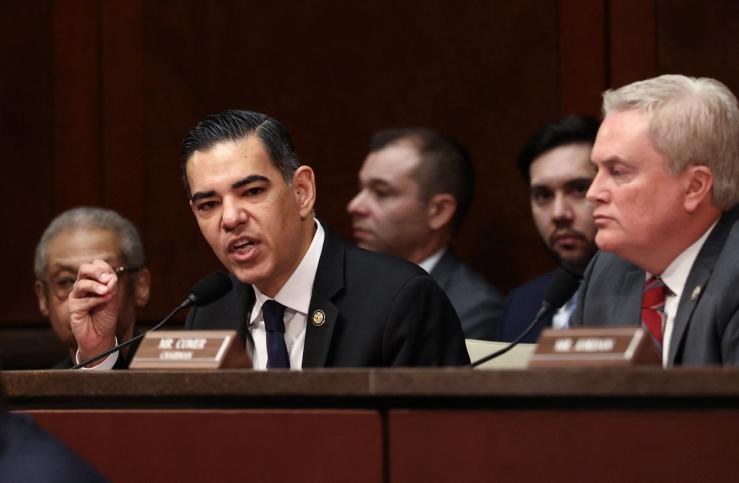
“We can’t do everything,” Rep. Robert Garcia, D-Calif., the top Democrat on the House Oversight Committee, told me of his committee and others. “We’re narrowing down right now what our lanes are going to be.”
Garcia didn’t rule out going after big tech. But he said Democrats want to probe Trump family corruption, as well as the Justice Department’s handling of the Jeffrey Epstein files, immigration enforcement, and Health and Human Services Secretary Robert F. Kennedy Jr.’s work.
“The big lane for us is going to be this corporate corruption and going after folks that are ripping off the public,” Garcia said.
The Oversight Democrats, whose website opens with a picture of Trump and Epstein, have very limited power in the minority. They have sent a series of stern letters to government officials and CEOs who aren’t obliged to respond. None of their public letters have targeted Big Tech’s payments to Trump causes.
Trump and his family deny all wrongdoing, and cast the unprecedented monetization of the presidency as an open extension of their thriving family business.
When it comes to those donations, “the American public has a right to know what they were expecting in return,” Garcia said.

Ben’s view
Glover’s argument to keep away from Big Tech is indicative of the reality in Washington that the US political system is buckling in the face of ascendant corporate and tech power. Early MAGA gestures toward reining in corporations quickly gave way quickly to dealmaking, and neither Republicans nor Democrats are immune to a sense that the balance has shifted.
Long before Trump entered the picture in DC, there has been the burning question of how to understand corporate money in Washington: Is it like bribery, a simple transaction for a concrete outcome? Or is it something a little closer to extortion, a payment to be left alone? For most of Big Tech, the Trump administration has looked a bit more like the latter.
Still, tech CEOs may want to keep their calendars free next spring. There’s a perception, at least in Washington. that beating up on Big Tech is good politics. (The victory of the pro-data-center candidate for governor of Wisconsin, as my colleague Dave Weigel noted, suggests it may not be quite that simple.) And that iconic photograph of Jeff Bezos, Mark Zuckerberg, Sundar Pichai, and Musk at Trump’s inauguration more or less guarantees Democrats will call them to testify in 2027.

Room for Disagreement
Rep. Ted Lieu, D-Calif., a Democrat on the House Judiciary Committee, said big American companies will be a top focus next year.
“It is sad that so many companies bent the knee to a corrupt president, and did not stand up to an authoritarian regime. You would have thought that American companies would have had more spine,” Lieu told me.
I asked if he thought they should pay a price for that.
“One thousand percent,” he responded. “Now, whether that’s a prosecution, I don’t know. That would require proof beyond a reasonable doubt. But definitely, congressional hearings can take place where they’re going to have to answer publicly in front of the American people.”

Notable
- Top tech companies whose CEOs have allied with Trump are staying quiet about a new Justice Department memo suggesting the White House will assert executive privilege over his communications with the private sector, our Nicholas Wu recently reported.