



The News
President Donald Trump’s plans to sell F-35 fighter jets to Türkiye remain stalled more than a month after he announced them, leaving Congress to navigate the resulting tension between a NATO ally and Israel.
At issue is the requirement in US sanctions law that Türkiye offload its S-400 Russian air defense system in order to get access to F-35s — six of which it has already paid for, jets that have remained in the US since its expulsion from the program in 2019.
Disabling the S-400 is one possible solution to facilitate the Trump-backed sale, but one that risks further stoking tension with lawmakers who view the statute as requiring full divestment of the system. Another option is selling the Russian system to the UAE; Türkiye reportedly entered into talks for that last month, but the conversations don’t appear to have advanced, according to people familiar with the talks.
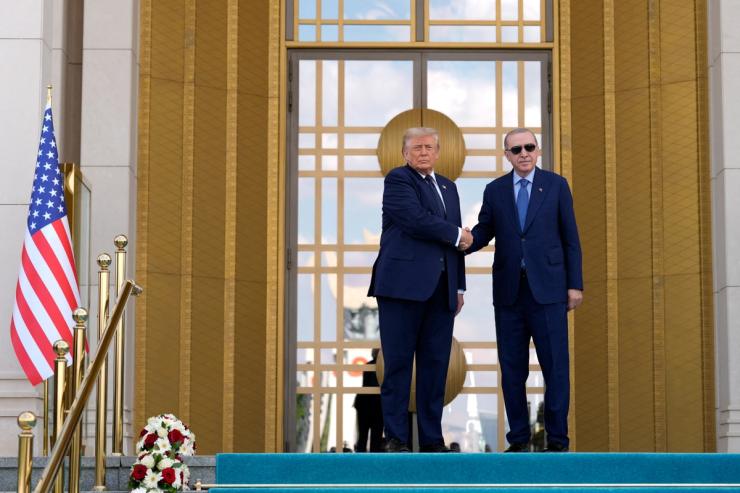
The result is a limbo state for the F-35 deal, which Trump previewed at last month’s NATO summit alongside Turkish President Recep Tayyip Erdoğan, who’s become a key ally. A few hours after that, Israeli Prime Minister Benjamin Netanyahu raised the stakes for the F-35 deal by warning that selling Türkiye the jets could “destroy the power balance in the Middle East.”
The GOP-controlled Congress has largely given Trump what he wants during his second term. Yet the F-35 sale could have a hard time surviving a congressional disapproval vote that would pit Israel’s interests against a NATO member — in part because many Trump allies are part of the camp insisting on Türkiye’s full divestment of the Russian system.
“I don’t think they should have F-35s unless they’re going to be a true partner … so if they have the S-400, they cannot have the F-35,” Sen. Rick Scott, R-Fla., told Semafor. He added that he hasn’t “heard anything” from the Trump administration about moving forward — “and I talk to the administration quite a bit, so.”
Senate Foreign Relations Chair Jim Risch, R-Idaho, who has a longstanding hold on the purchase, put it bluntly: “At this point, they have not removed the S-400s, so it’s at a standstill.”
One US official underscored to Semafor that a sale to the UAE is still possible, noting that it has “no problem buying sh*t from the Russians.” The official added that “I don’t think there’s been any firm decision” on an S-400 purchase from Türkiye yet.
The UAE and Türkiye did not respond to requests for comment. The White House did not comment for this story.
Meanwhile, Saudi Arabia is ramping up lobbying for its own F-35 purchase — one that’s seen no public progress since November, when Trump announced his plans to pursue it. Saudi Defense Minister Khalid bin Salman met with Trump administration officials last month as the country hopes to build on momentum from its recent nuclear deal.
Douglas Silliman, former US ambassador to Iraq and Kuwait and president of the Arab Gulf States Institute, described the Saudi sale as “a years-long process.” He added that “the Israelis may be concerned about lacking some sort of normalization” in relations with Riyadh as a condition for that sale.

Know More
It’s not clear why talks with the UAE may have stalled. One potential reason: The UAE’s possession of the S-400 would prevent it from purchasing its own F-35s.
“I’ve talked to the Emiratis about it, I talked to the Turks about it, but I’m not sure that I got some official position on it,” Sen. Chris Coons, D-Del., said. “I will make a general observation: Any country that purchased the S-400 and deployed it would face the same concerns, challenges, and restrictions … that the Turks did.”
The S-400 isn’t skeptics’ only concern over Türkiye getting access to F-35s, the most advanced fighter jets in use today. Sen. Chris Van Hollen, D-Md., pointed to Ankara’s “crackdown on democracy” as well as its occupation of Cyprus and previous intrusions into Greek airspace.
“I have a long history of being concerned about the sale of the F-35s to Türkiye, apart from any of the current crosscurrents,” Van Hollen said.
Israeli opposition to the F-35 deal is rooted in its pursuit of a regional military advantage, experts say.
“The Israelis have a significant problem with Türkiye acquiring advanced fighter jets such as the F-35 because that would essentially empower the Turkish military, which is already significantly bigger than the Israelis’,” said Sinan Ciddi, Türkiye Program Director at the Foundation for Defense of Democracies.
Israel is pressuring members of Congress to maintain the restrictions on Türkiye’s F-35 acquisition, Ciddi added. Its main lobbying group in DC isn’t hiding its skepticism of the sale.
“We share the concerns raised by some members of Congress about providing the F-35 to a country that welcomes Hamas, helps Iran evade sanctions, and has deepening ties with Russia and China,” AIPAC spokesperson Deryn Sousa told Semafor.
The Iran war has at times strained Trump’s relations with Netanyahu while tightening his ties to Türkiye. That may make it difficult for Israel to prevail in any political standoff in Washington over F-35 sales, whether with Ankara or Riyadh.
“Israel currently has a monopoly on F-35 use in the Middle East, but this will not last forever, as Saudi Arabia will begin taking deliveries by 2029,” Tim Chattell, an international security fellow at Chatham House, said.
Israel’s resistance to the F-35 sale at a time when its standing with Democrats has hit a nadir could also make some in the party reassess their own opposition to it.
“I have my own hesitations about selling F-35s to Türkiye, but I am not interested in advice from Benjamin Netanyahu,” Sen. Elizabeth Warren, D-Mass., told Semafor. She added that his “lobbying here may be having the opposite effect.”
There is still another potential obstacle to an F-35 sale that would materialize if a sale to UAE, or another country, pans out for Türkiye: Moscow. Russia must approve any transfer of the S-400s, giving it unique leverage over a move that it has a significant reason to reject.
The S-400’s continued presence in Türkiye, Ciddi said, “has really sort of undercut the cohesivity of NATO.”

Room for Disagreement
If Türkiye can’t sell its S-400 to the UAE or disable it, there is also the option of destroying the system.
“There’s several options to solve this problem, and I think the Turks want to solve it,” the US official told Semafor.

Eleanor, Lauren, and Shelby’s View
A stronger US-Türkiye relationship — and the F-35s that come along with it — undoubtedly threatens Israel’s regional control.
But even if Netanyahu’s political capital in Washington were strong (it isn’t), Ankara’s status in NATO changes the game here. As one Turkish journalist wrote in Responsible Statecraft this week, Türkiye’s “deterrent capacity is a European security question as much as a Middle Eastern one.”
We expect the F-35 sale to Türkiye to reach Congress eventually, despite the current problems it’s facing.

Notable
- Turkish officials told Middle East Eye that an Israeli intelligence report that warned Iran planned to assassinate Trump during last month’s NATO summit in Ankara may have been a ruse to undermine negotiations with Iran and Trump’s relationship with Erdoğan.
- The New York Times reported US intelligence detected a credible Iranian threat to Trump at the NATO summit, including a possible surface-to-air missile attack against Air Force One.