




The News
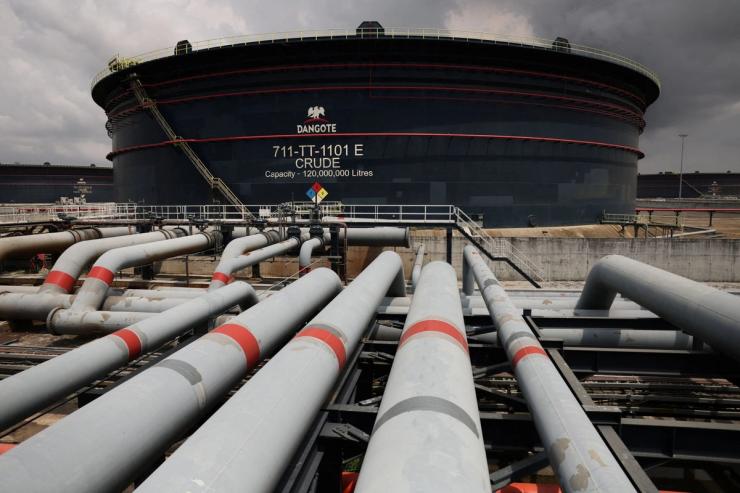
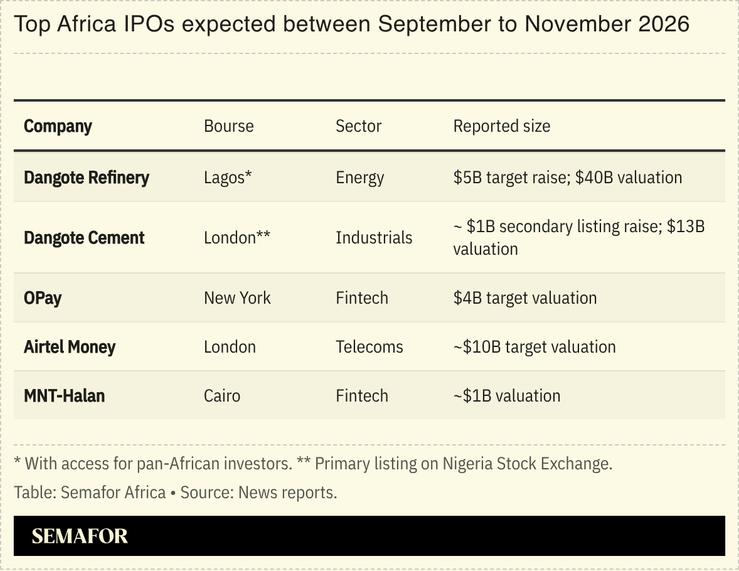
Africa’s dealmakers are betting that the continent’s capital markets are entering a new phase, with a burst of IPO and M&A activity kicking off with Aliko Dangote’s anticipated $5 billion listing of his refinery on the Nigerian Exchange.
“The Dangote IPO has got everyone very excited,” Yemisi Deji-Bejide, head of M&A for Africa at Standard Chartered, told Semafor. She said the deal showed the continent’s growing ability to build and finance large industrial businesses after years of sluggish activity.
The Dangote Petroleum Refinery IPO, which still needs regulatory approval, is expected to be Africa’s largest-ever listing. It is also being marketed to investors across the continent even though its primary listing will be in Lagos. A strong demand from retail and institutional investors could eventually broaden the pool of capital for other African companies, said Miguel Azevedo, head of investment banking for the Middle East and Africa at Citigroup. “One transaction won’t create a market, but this transaction by its size will change things.”
Other potential IPOs are emerging across the continent’s tech and telecom industries. The M&A market has also picked up, including Diageo’s $2.3 billion sale of its East African beer business to Japan’s Asahi, and South Africa lender Nedbank’s $855 million offer for a controlling stake in Kenya’s NCBA Group.
The deals are being helped by a more favorable economic backdrop — and by private-equity firms finally finding an exit window after years of currency volatility. “A good number of private-equity exits were delayed because of the impact of the currency devaluation on USD valuations,” said Funso Akere, Head of M&A Advisory for Standard Bank’s Africa Regions. “At the moment we’re running a good number of sell-side processes across Africa for PE firms.”
But the revival is not yet broad-based. Much of the recent activity is concentrated in a relatively small number of large transactions, and bankers caution that a busier deal calendar does not necessarily mean deeper or more liquid markets.

Know More
The capital-markets window is reopening because the economics of doing deals are improving. After the pandemic, sharp currency devaluations, high inflation, rising global interest rates, and heavier debt burdens made African assets even less attractive than usual. It pushed many private-equity and venture exits out of reach. Nigeria was among the hardest-hit major markets, as currency declines sharply reduced the dollar value of businesses funds had bought years earlier.
Now some of those pressures are easing. Akere points to Nigeria’s stabilizing exchange rate and recovering economic activity, while Angola, Ghana and Zambia have also made progress — including Zambia’s restructuring of roughly $12 billion in external debt.
Greater currency stability gives buyers and sellers more confidence that a valuation agreed today will still hold when a deal closes or an investor eventually exits.
It is also prompting multinationals to rethink their African portfolios. Diageo’s East Africa beer business was sold to Asahi for a higher price than expected, Akere said, encouraging other multinationals to explore sales of non-core African assets.
That can create a virtuous cycle: More transactions establish valuation benchmarks, successful exits put capital back to work, and healthier public markets give companies another way to raise money — and investors another exit.

Yinka’s view
The opportunity here is to turn an improved dealmaking environment into a more liquid capital market — one that can connect African companies with a larger pool of local and international investors, give private-equity and venture capital firms more credible exit options and make going public a realistic choice for a broader group of businesses.
That requires more than a handful of large transactions, exciting though they may be. African public markets remain fragmented and relatively shallow. The challenge is to create enough activity that each successful deal makes the next one easier: more transactions establish valuation benchmarks, more trading creates liquidity and a larger investor base gives companies greater confidence that there will be demand for their shares.
That is where Dangote’s refinery could be unusually important. Its scale could pull new investors into African equities, while the effort to make the offering accessible across the continent could test whether Africa can offer a larger pool of capital rather than a collection of fragmented national markets.
But there is a risk in placing too much weight in one deal. A $5 billion IPO can prove that investors will fund Africa’s most prominent industrialist; it cannot by itself offer the liquidity, analyst coverage, institutional participation and regulatory integration needed for deeper markets.
The more important signal will come afterward. If Dangote’s IPO is successful, it will help persuade other African entrepreneurs to list their businesses and give investors confidence that a pipeline will follow. That will, in turn, encourage exchanges to make cross-border investing easier and create something that, as enthusiastic bankers say, will be truly transformative.

Room for Disagreement
Not everyone reads this as broad-based momentum. Research by BCG shows that recent activity is increasingly about fewer, larger and more considered transactions rather than a deepening of the market. IPOs have made up only about 10% of African private-equity exits over the past two decades and it is estimated that share will slightly decline over time.

The View From Abuja
Nigeria is also preparing for another potential blockbuster IPO. President Bola Tinubu confirmed to Nigerian Stock Exchange executives on Aug. 6 that his government intends to follow through and eventually list the state’s Nigerian National Petroleum Company on the NGX, invoking Saudi Aramco as a model. The idea is not new and was first put into play in 2021. NNPC said in March 2025 that it was in the “final stages” of IPO preparations, while CEO Bayo Ojulari has since cited 2028 as a target. But coming as Dangote Refinery — effectively NNPC’s biggest domestic competitor — moves toward its own listing, Tinubu’s latest comments look more than a coincidence. If both deals materialize, Nigeria could be heading for an unusually consequential moment in public ownership and domestic capital formation.

Notable
- The UK wants more African companies to prioritize London when seeking to raise money from capital markets, a British government official told Semafor.