




The News
As President Donald Trump relies on special envoys to conduct diplomacy in the Middle East, ambassadorial posts in the region remain vacant — while the Iran war provides a real-time test of his approach.
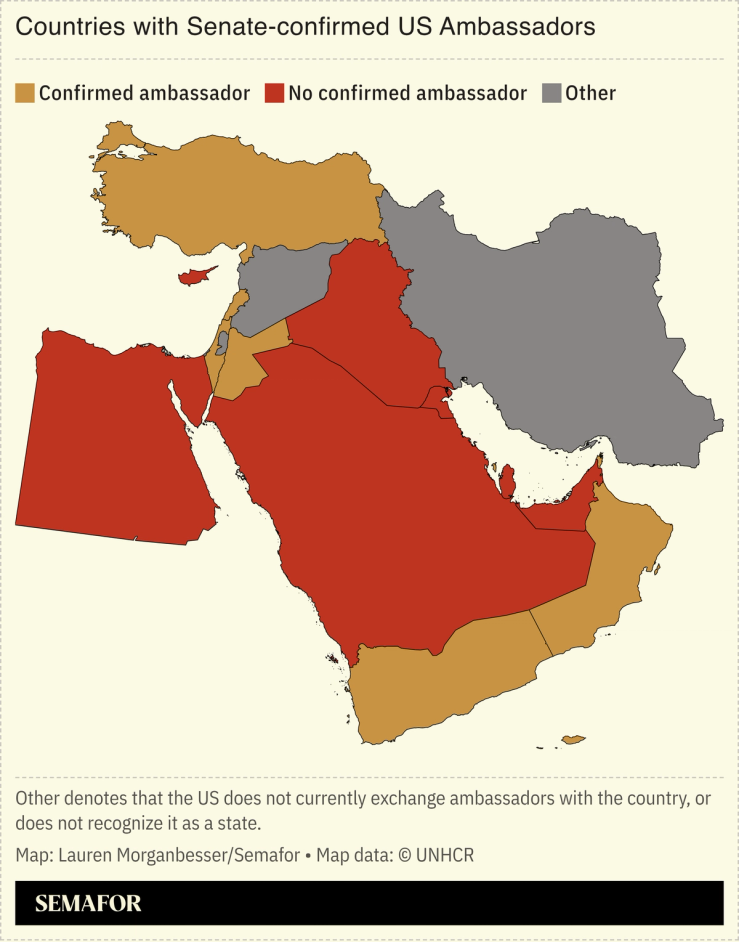
Excluding Israel, the conflict with Iran has ensnared a dozen Middle Eastern countries that have normalized relations with the US, and half of them lack a Senate-confirmed US ambassador; only one, Egypt, has an active nominee. The openings span close US regional partners that host critical US military assets, face the threat of Iranian attack, and play central roles in negotiations on the war.
Oman and Bahrain are the only two Gulf states with serving US ambassadors, and both are technically holdovers from President Joe Biden’s time in office.
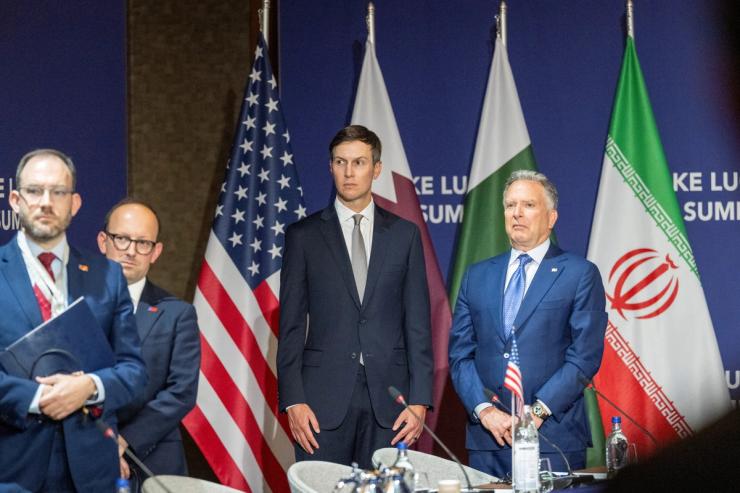
The current administration expresses confidence in its diplomatic framework, which relies on regional leaders’ direct dialogue with Trump, Cabinet members, and special envoys like his longtime friend Steve Witkoff and son-in-law Jared Kushner. But former ambassadors who have served in administrations of both parties told Semafor that they fear the vacancies have made it more difficult for the US to communicate with allies during a rapidly evolving war.
“If you take the countries most affected by the war,” said Barbara Leaf, who served as US ambassador to the UAE during the Obama and first Trump administrations, “I’ve heard this repeatedly from officials in all those governments: None of them have ever been confronted with a situation where there were so few people to reach in, both in Washington and certainly in the field, who could tell them what’s going on or through whom they might convey their concerns.”
The result, Leaf added, is that Middle Eastern governments often struggle to understand US intentions or find officials who can meaningfully respond to their concerns.
Nearly 19 months into Trump’s second term, the US lacks confirmed ambassadors in Saudi Arabia, the United Arab Emirates, Qatar, Kuwait, and Iraq. Trump has submitted one nominee to those countries this term, though his pick for ambassador to Kuwait failed in the Senate.
The Middle East vacancies are part of a much broader shortage of Senate-confirmed ambassadors across the world, with more than 100 unfilled ambassadorial posts. They’re also something of a return to form during Trump’s first term; at this point in 2018, he had one sitting ambassador and one nominee in those five Middle Eastern countries.
But the administration was working toward filling some of the positions: Trump floated names of possible candidates for four of the five countries by late 2018, and the Senate confirmed ambassadors to Saudi Arabia, the UAE, and Iraq within three years. By contrast, former President Joe Biden named nominees to all five Middle Eastern ambassadorial posts by his 20th month in office, with two of the five confirmed in two years or less.
A State Department spokesperson said that the lack of ambassadors had not hindered the administration’s progress. While the posts may be vacant, the department noted, experienced diplomats remain in charge of US embassies.
“Diplomatic efforts by the United States are by no means limited; they have been empowered under this Administration,” the spokesperson said in a statement. “We have seen sustained engagement from the highest levels of the Trump Administration with our partners in the Middle East, and our relationship with our allies in the region continues to get stronger.”
Former ambassadors countered that the risks of centralizing diplomatic relations among a small handful of senior officials become especially acute during a fast-moving crisis.
“When you’re dealing with something like the Iran conflict and you’ve got a dozen foreign ministers or heads of government who want to engage on a daily basis, how frequently can [Trump and his circle] update those people?” said Brian Nichols, a former US ambassador to Zimbabwe and Peru who served in senior State Department positions under the Obama, Biden, and Trump administrations.
“It’s really hard to keep all those people focused when your embassies are not able to offer their substantive engagement on those issues because they’re not inside the policy process the way that they were historically,” Nichols added.
After Democratic senators pressed Secretary of State Marco Rubio on the broader trend of vacancies in June, he acknowledged a preference for more confirmations. “I mean, I’d like to have more ambassadors, to be frank,” he said.
Democrats on the Foreign Relations Committee said in statements that the vacant posts in a region affected by war have left them particularly worried.
Sen. Tim Kaine, D-Va., said that “the absence of such ambassadors in the Middle East has made US diplomacy much more difficult during this war.” Sen. Chris Murphy, D-Conn., lamented the lack of “credible, Senate-confirmed US ambassadors.”
The embassies of Saudi Arabia, the UAE, Qatar, Kuwait, and Iraq in DC did not respond to a request for comment.
In this article:

Know More
In the absence of Senate-confirmed ambassadors, career government employees serve as chargé d’affaires and lead embassies. These officials allow American diplomatic missions to remain operational, according to the State Department.
But former diplomats and experts said there is a meaningful difference between managing the embassy and serving as the president’s representative abroad.
“The host-country knows immediately that the ambassador has that kind of stamp of approval from Senate confirmation,” said Liz Schrayer, president and CEO of the US Global Leadership Coalition. “They have that credibility of the weight of the White House in terms of the authority to coordinate all of America’s tools: diplomatic, military, international assistance, intelligence, economic — and they have the access.”
That authority matters not only in Washington, but overseas — where a lack of ambassadors can shape how foreign governments interpret US engagement.
“When a country does not have an American ambassador who has been confirmed, often, if you’re the Chargé,” Nichols said, “you’re answering questions like, why don’t they like us? Why are they not sending us an ambassador? What’s wrong?”
While ambassadorial vacancies are not unprecedented, former diplomats described them as far more significant during a regional war.
Days after the first US strikes on Iran, for example, the State Department urged Americans to “DEPART NOW” from 14 Middle Eastern countries. According to Leaf, embassies, lacking ambassadors at the helm, were left scrambling to respond to anxious citizens seeking guidance.
“What it meant was total chaos and panic in those countries among large communities of Americans, where the embassies, especially without ambassadors, were blindsided,” Leaf said.

Room for Disagreement
Supporters of the administration’s style of diplomacy contended that Trump’s reliance on envoys reflects his preference for direct diplomacy over existing government bureaucracy.
The Abraham Accords of his first term, establishing normalized relations between Israel and several Arab countries, also show that Trump’s use of diplomats outside traditional networks can bear fruit.
“If you look at his personal business style it’s always been very one-to-one, very personal,” Simon Hankinson, a senior research fellow at The Heritage Foundation, said. “It’s not through a convoluted chain of bureaucracy. And that is a real weakness at the State Department, is that there’s just so many different hoops you have to jump through.”

Notable
- Political nominees comprise 90% of ambassadorial nominations in Trump’s second term, a break from preceding administrations, The Washington Post reports.