




Andy’s view
The US lawyer Paul Reichler has made a career defending the underdog. When I first met him a decade ago, he was poring over antique navigation charts and hydrological surveys of the South China Sea, preparing to take on China in a case brought by the Philippines under the United Nations Convention on the Law of the Sea.
That led to one of his greatest triumphs: A panel of jurists in The Hague unanimously struck down China’s expansive claims to one of the world’s most strategically important waterways, upholding the core principles of the UN framework.
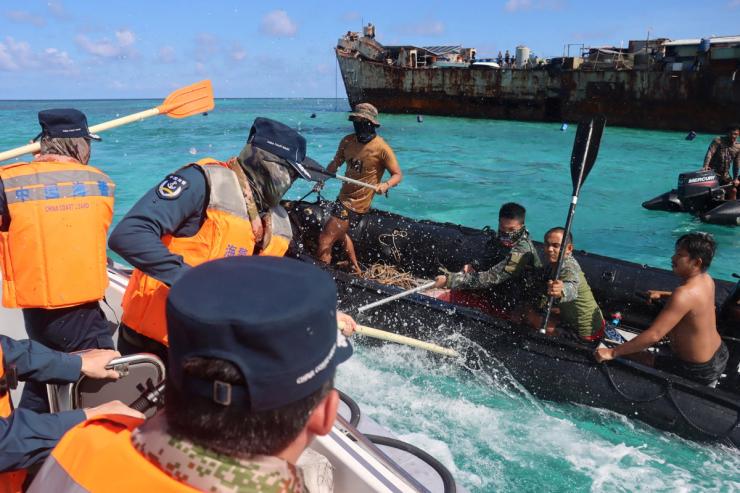
But for Manila, the ruling was something of a Pyrrhic victory. China rejected the verdict — the foreign ministry called it “nothing but a scrap of paper” — and stepped up its campaign of intimidation against smaller neighbors. Last month, a Chinese coast guard vessel blasted high-pressure water cannon at Philippine boats bringing fuel supplies to local fishermen in the country’s own waters; nearby, sailors from the two countries battled each other around a disputed reef, wielding batons and oars in yet another dangerous high-seas encounter. The China Daily posted an AI-generated video depicting the Philippines as a monkey controlled by the US and Japan — an insult that Manila condemned as “dehumanizing and racist.”
It’s deeply ironic, then, that just as China was bullying the Philippines, Chinese leader Xi Jinping was wooing developing nations at the World AI Conference in Shanghai as part of Beijing’s bid to establish its global AI leadership. Having sought to upend the global maritime order — the underpinning of the global goods trade, energy flows, food supplies, and internet communications — China now seeks the trust of smaller countries to shape the digital one.
Reichler told me he’s concerned that the world’s great powers — China and the US, but also regional hegemons like Israel and Russia — are acting with impunity and “the system is under as much stress as it’s been since World War II.”
Indeed, in retrospect, the ruling at The Hague a decade ago was the harbinger of a new global order — one based not on rules, norms, and conventions but, increasingly, raw power wielded by the strong against the weak. And that bears lessons for the AI race.
Today, it’s hard to take at face value the idea of China as a benign hegemon delivering AI to the world as “public goods” or, for that matter, its notion of common interest. China has shown little desire to share the rich resources of the South China Sea, blocking undersea oil and gas prospecting by neighboring states, enforcing seasonal fishing bans, and endangering the marine ecosystem by dredging vast artificial islands.
As in the maritime domain, AI governance is becoming the new frontier of a Cold War-style contest between China and the US, which both sides see as critical to their national security and prosperity. Beijing’s goal is to lead a coalition of emerging economies as a supplier of open-source AI models, locking them into its technological and industrial ecosystems, and generating dependencies. For its part, the US is forging “Pax Silica,” an alignment dominated by advanced economies to secure semiconductor, critical mineral, and AI supply chains.
That geopolitical reality will limit the success of US-China talks on AI next month ahead of a presidential summit in Washington, DC. There’s no prospect the two sides will agree to the equivalent of an arms control agreement on developing powerful AI models; China would view such an arrangement as a form of containment, which is how it sees US pushback to its maritime ambitions through so-called “freedom of navigation” exercises and military support for the Philippines and other Asian nations.
Reichler, though, sees grounds for optimism. A veteran of the multilateral legal system, including the International Court of Justice, he points to more and more cases brought by small and medium-sized countries defending themselves across a broader range of issues, from genocide, to environmental harm, and human rights.
Even as Beijing blatantly violates international law, Reichler notes that it generally seeks to justify its actions by reference to those same laws, which often means “twisting themselves into knots.” Why? “Because this is important to their soft power.”
That’s perhaps not much comfort to the Philippines and other rival claimants to the South China Sea who are on the receiving end of Chinese hard power — in a world where, increasingly, in both the physical and digital realms, might makes right.

Notable
- Washington’s global AI initiatives remain “largely supply-side policies,” Patrick M. Cronin and Pinshan Lai argued in The Diplomat. “They strengthen US technological competitiveness but do not yet amount to a comprehensive strategy of AI diplomacy.”