




The Scene
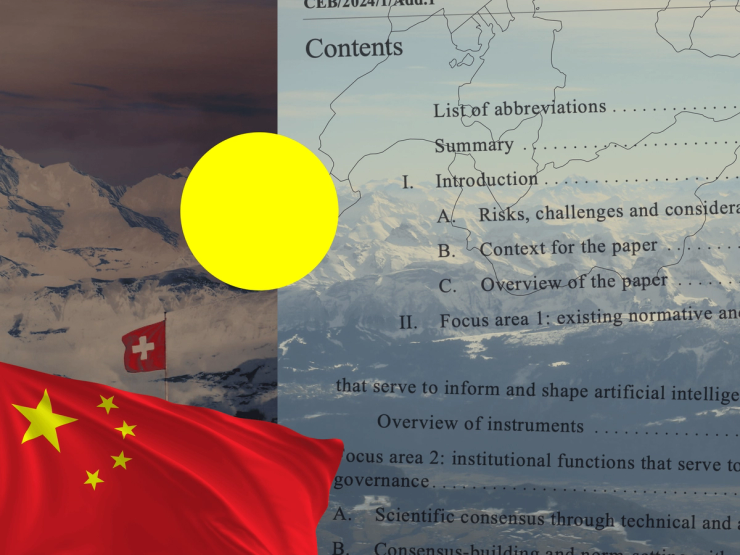
In the days before the American AI industry erupted in a bitter dispute over Kimi K3 and other Chinese open-weight models, thousands of world leaders, tech executives, and AI researchers converged at the sprawling Palexpo convention center in Geneva, Switzerland, for what the UN billed as a global dialogue on AI governance.
Hosted by the UN agency that sets international tech standards for everything from satellites to spectrum, the AI for Good summit featured all the usual tech-conference trappings: a massive expo hall of vendors hawking robotic dogs and networking equipment; circuit regulars like will.i.am and John Legend; and AI-generated, well, everything.
Notably absent, however, were the leaders of US frontier labs — the most prominent American CEO was Salesforce’s ubiquitous Marc Benioff — and Trump administration officials who’ve been thumping their chests over why the US needs to tighten its grip on AI. In their place was a massive delegation of Chinese government officials and executives who fanned out over the course of four days to make a largely undisputed case that for most of the world, free Chinese-made models are the future.
China’s AI can be a “resource” for other countries much like energy is, said prominent Chinese computer scientist Wang Jian, a former Microsoft Asia executive and the chief architect of Alibaba’s cloud business, which is now growing faster than Amazon’s, albeit from a smaller base. “Having a choice for the rest of the world is very important.”
Wang, who now runs a government-backed AI research institute, spoke to Semafor on the sidelines of the UN conference, where a floor below the flashy mainstage, a quieter, more significant conversation was happening in a windowless room bearing a blue banner in English and Chinese that read “Group of Friends of Global Governance.”
The Chinese-led alliance was formed last year as a counter to US and European influence, and Wang spoke along with dozens of other Chinese government officials and executives to pitch ministers from Pakistan, Russia, Zambia, and across the Global South on how open-source AI could help their countries’ economies. The unspoken message: As America pulls back from many of the world’s regulatory bodies, China can be the more reliable partner.
The moment offers a glimpse at the broader Chinese global strategy of a kind of “token diplomacy,” where efforts are centered around supplying AI tokens rather than ports, railways, telecom networks, and other infrastructure built across the developing world for more than a decade through the Belt and Road Initiative.
In the same way China flooded the world with cheaper solar panels and electric vehicles — setting de facto industry standards that would help the Chinese lock up global market dominance along the way — Beijing is now making its AI models widely available, offering its open-source models at cheaper costs than US rivals, and promising to train countries around the world on how to use it.
In this article:

Know More
It’s a familiar playbook. Chinese tech firms have already helped shape UN facial recognition and surveillance standards — policies that have been adopted by many developing nations. Beijing also led the drafting of new UN rules on automated driving systems, following a workshop in Shanghai; those regulations were adopted globally with the backing of all major auto powers.
China’s also benefitting by a shift in countries seeking technological independence from the US, which was exacerbated last month when the US’ abrupt export controls on Anthropic’s Mythos and Fable models created massive disruptions for non-US companies and governments using the frontier lab’s models.
A week after the UN conference, Chinese leader Xi Jinping put a finer point on the Chinese mission: “We should seize this rare, historic opportunity to encourage open source,” he said in a speech at the World AI Conference in Shanghai touting China as a benefactor to developing nations and as a global AI leader. “We should jointly oppose overstretching the national security concept in the field of AI and placing one country’s security over that of others.”
While Xi didn’t mention the US directly, he warned that “AI development should not be a solo performance by a single country” and pledged to help align global rules and technical standards through a new group of 29 countries called the World AI Cooperation Organization. (The US, which is not a member of the China-led group, has convened a similar group of countries working together on a different tech initiative called Pax Silica.)
For its part, the Trump administration has said it wants to promote American AI around the world, too, but more selectively, favoring sharing with whomever it deems trusted allies and partners. It also wants to protect American models from what Washington has called IP theft by Chinese AI labs through a process called distillation. “Open source is not open season on American IP,” Treasury Secretary Scott Bessent posted last week.
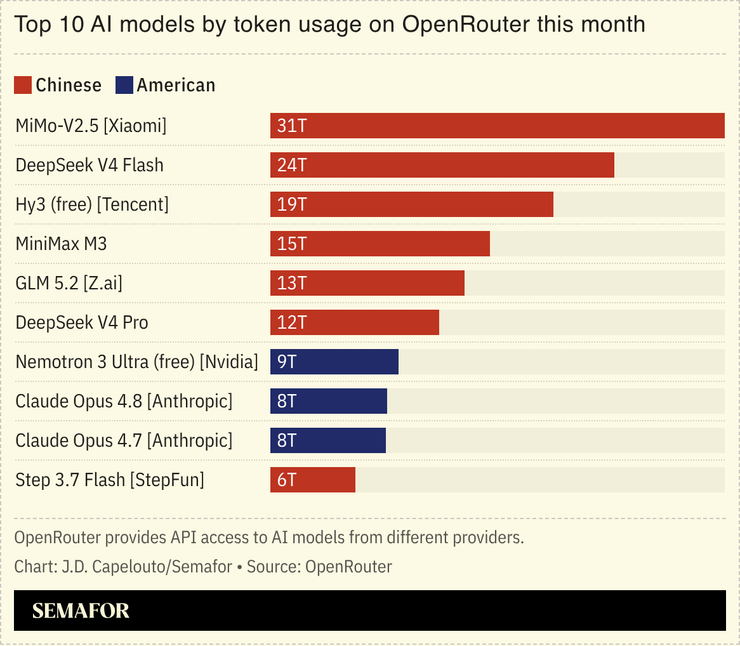
China’s token diplomacy, a US State Department spokesperson told Semafor, “follows a familiar pattern: initial promises of partnership that give way to dependency on Chinese infrastructure and adherence to substandard Chinese technical standards.”
Some officials from other countries, even those who have benefitted from China’s largesse in the past, remain skeptical about using Chinese models, which experts say remain opaque and could mean trading dependency on one superpower for another.
“America leads the pack,” said Nkundwe Mwasaga, director general of the ICT Commission in Tanzania, a country whose national fiber network was built by Chinese firms and financed by Chinese state loans. But China is “just catching up.”
When it comes to open source AI, Mwasaga is developing a sovereign AI model that local startups can build using either Chinese or American AI models.
Beijing “opposes drawing ideological lines or imposing technological barriers,” and “believes that artificial intelligence is not the exclusive domain of any single major country,” a spokesperson for China’s Washington embassy said.

J.D.’s view
After talking to experts and technology leaders from governments around the world, I got the sense in Geneva that many are wary of building on Chinese open-source models that haven’t disclosed their training data and carry a Beijing-aligned framing on sensitive topics, as studies have shown. An economic agency researching semiconductor policy through a DeepSeek-based assistant, for example, could understandably be worried about China’s views on Taiwan’s chip industry seeping into the answers — as one red team found.
The director of Cameroon’s IT agency told me the Central African country is piloting a small model for civil servants trained on its government data; the system lives on IBM’s mainframe, rather than a Chinese-built system.
Xi’s pitch to go after the world’s “AI iron curtain” is a compelling one, but the country’s tech firms will also have to address the trust and transparency question if they want to win in the AI era.
And I wouldn’t count out the US’ technological hold on the rest of the world. Even as the US steps back from multilateral bodies, many companies are still making an effort to work with governments and other companies around the world. Microsoft, Google, and Meta were all well-represented in Geneva, and Washington’s Pax Silica effort has managed to attract dozens of allies around the world to reduce their reliance on China.

Room for Disagreement
Some governments and institutions, including Singapore and Saudi Arabia’s Aramco, don’t seem as worried about embracing Chinese AI for their localized models. Many developers and governments around the world may be more skeptical of American tech than Chinese alternatives.
Noema Magazine also argued earlier this month that Western models carry embedded behaviors as well — and the open weights of China’s models at least let someone tweak them for their own needs and environment.

Notable
- China’s AI diplomacy is part of its larger effort to “build an alternative global order” to the US-led West, and inject its values into the world’s digital infrastructure, the Financial Times wrote.
- On AI, Beijing is trying to be the Android to the US’ Apple, but while the moves are symbolically significant, “China’s AI diplomacy efforts don’t have much substance,” tech expert Kyle Chan wrote in his newsletter High Capacity.
- Chinese open-source models don’t “uniformly censor information,” China analyst Samm Sacks argued. When used overseas, some models will answer questions that might be blocked inside China. “Since weights are open, users can change content restrictions.”