




David’s view
What’s the point of a political party? We’ve received a few answers to that question this month.
Maine Democrats threw together a mini-primary to replace their US Senate nominee. In Wisconsin, where the Democrat most party leaders were comfortable with blew up her campaign, Gov. Tony Evers yanked a former candidate off the bench and endorsed him. Officially neutral in the Aug. 11 primary, Wisconsin Democrats began asking the state if voters who’d wasted their mail ballots on the ex-candidate could get that ballot back.
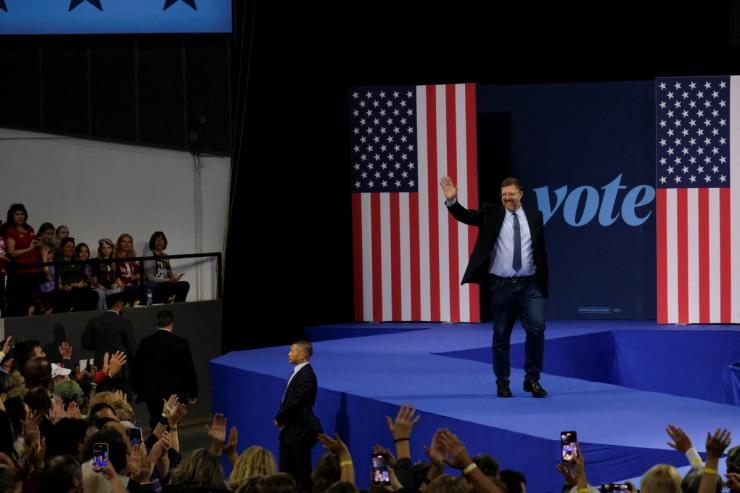
“There’s this saying that many of us hate, but it’s so true,” said David Crowley, the Milwaukee County executive who rebooted his campaign with the Evers endorsement. “Trust the process.”
Two summers after former President Joe Biden’s reluctant abdication, Democrats have discovered how handy it is to make a decision without asking voters first. But that’s forcing them to wrestle with the idea that any action taken by a party is illegitimate, anti-democratic rigging — something the other team can use to depress the base.
“Democrats are totally not rigging their primary, guys,” Wisconsin radio talker Dan O’Donnell said on Tuesday. “Nothing says you are not picking sides in a primary like having to say you’re not picking sides.”
In this article:

Know More
The new book from Ben Wikler, the media-savvy ex-chairman of the Wisconsin Democratic Party, is relevant to this conversation. On Tuesday, Wikler published This Is The Plan, a guide to the constant organizing that helped his party (mostly) win, starting with an April 2020 state supreme court victory that would prevent Donald Trump from overturning Biden’s electoral victory.
“We need not a 50-state strategy, but 50 state strategies,” Wikler told me on Monday, before heading to an appearance on The Daily Show. “What can be replicated from the experience of Wisconsin is a relentless focus on year-round organizing and communication, from the grassroots up, for power at every level of our democracy.”
In Wikler’s vision, Democrats need to out-work Republicans, win power across several cycles, and pass major, structural reforms, amounting to a new party system. Elections would be competitive, but there would be no Electoral College skewing the presidential race; electoral districts would be drawn for competitiveness; and the District of Columbia would become a state.
Step one would be making people want to join and organize with the Democratic Party — to make it, argued Wikler, “a home for people who want to throw themselves into building a country that works for everyone.” Unfortunately for Democrats, they have to do this at a moment of deep unpopularity for the party, during which even candidates running under the Democratic Party umbrella want people to know they’re not that into it.
In northeast Pennsylvania, the party’s star House recruit focused her first TV ad on how she “beat both parties” as an anti-machine independent. The new ad from Sen. Ed Markey, D-Mass., who joined Congress during the US Bicentennial, shows him power-walking alongside Sen. Bernie Sanders, I-Vt., to prove that he’s not a machine candidate. “I’ve been standing up to the bosses for a long time,” Markey says.
On the very basic question of whether the party should control its strategy and nomination process, Democrats are under constant attack from both the left and right. The left accuses the “establishment” of rigging elections. The right amplifies those concerns. The press then asks Democrats if all this criticism is fair.
Wikler isn’t immune to the scrutiny. After our interview, when he sat down with Jon Stewart, the liberal host asked him about the mess in Wisconsin from the premise that something sleazy was happening.
“The party is not backing any of the progressive candidates that have the plan,” Stewart said. “They want to stick with the establishment candidates that might not want to rock the boat. Why is that?”
But why shouldn’t a party want an “establishment”? The real trick, which Trump has pulled off, is becoming the establishment while convincing voters that you’re still an outsider. This has been tremendously successful for Republicans on the metric that matters for what a party can do: Money. Individual Democrats can raise it, but party committees and affiliated PACs are struggling. Republicans don’t have that problem.
The Democrats’ bad brand, and their willingness to hand influence to outside groups to paper over it, has increasingly become a problem for them this year. The Democratic National Committee, which Wikler wanted to run this cycle, is led instead by Ken Martin, who has struggled to make it a desirable place for Democrats to send money. Meanwhile, a donation to the Republican Party is a way to help Trump, and a donation to the president’s super PAC is even better.
The DNC experienced the same problem in 2018, the last Trump midterm, when it spent nearly two years re-writing party rules to convince people that it wasn’t “rigging” the next primary. At this point eight years ago, the DNC had $9 million in the bank, and the RNC had $51 million as it ramped up for Trump’s reelection bid.
The Republican advantage this year is much larger — $125 million piled up against Democrats, who have as much debt as money. Washington is entertaining itself with a JD Vance-Marco Rubio bake-off for the 2028 nomination, but Vance has served as the RNC’s finance chair since March 2025, helping it accumulate cash without intra-party complaints. For Republicans, there is no downside to representing the Republican Party and celebrating it as a force for good.
That’s a ludicrous idea for modern Democrats. And it’s not even Ben Wikler’s idea. It can’t just be Democrats who bring about the small-d democratic revolution.
“When people feel, often with great justification, that the system isn’t working for them, you don’t want to run as a defender or restorer of a system that doesn’t work,” Wikler told me. He wasn’t telling Democrats to “embrace party labels in their campaigns” everywhere, because in some places, that wouldn’t help them. “To ensure that we have a government by and for the people, to safeguard democracy and actually expand it, it’s going to take an alliance of Democrats and Independents and non-MAGA Republicans.”

Room for Disagreement
That’s not to say any one Republican candidate needs Trump to rake in cash. Sen. Susan Collins, R-Maine, who has notably kept her distance from Trump, maintains a tremendous money advantage over Democrats (and her eventual opponent).

Notable
- In Madison’s Capitol Times, Paul Fanlud detected some worry from Wikler that Democrats might fumble their project of governing Wisconsin long enough to reform it.
- On his Substack, Ken Martin defended the DNC’s fundraising and spending by saying it set them up to win long term. “We are replacing a boom-and-bust campaign model with permanent political infrastructure.”