




The News
New York Gov. Kathy Hochul’s Tuesday announcement of a data center moratorium signals that backlash against unchecked AI growth is moving closer to the Democratic mainstream — after months of progressives capitalizing on it in primaries.
In races across the country where left-leaning challengers are threatening Democratic establishment picks, they’re doing so by making the AI industry into a new bogeyman. As the implosion of Graham Platner in Maine stokes an intraparty debate over progressives’ campaign acumen, the left has sought to change the subject by digging in against data centers as energy-hungry behemoths that hurt communities.
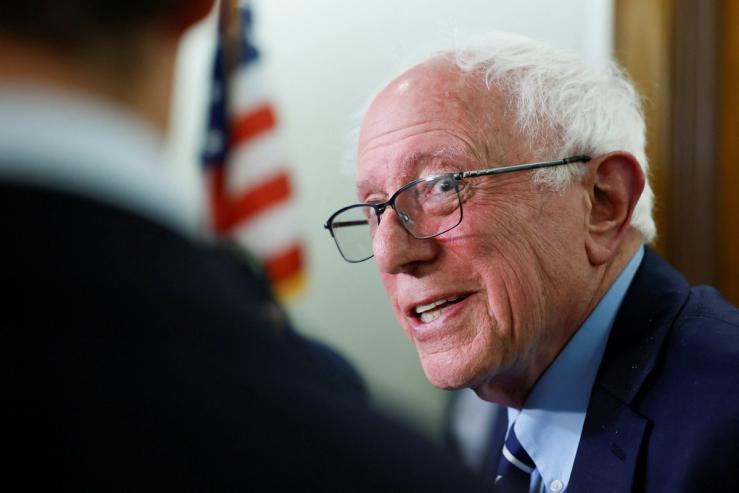
“Progressives have made the influence of big money a major divide in our politics this cycle,” said Faiz Shakir, an adviser to Sen. Bernie Sanders, I-Vt., who in March proposed a nationwide data center moratorium alongside New York Rep. Alexandria Ocasio-Cortez. “The centrist push has been so clearly ‘public-private partnerships,’ while we have been ‘fight oligarchy.’”
Progressives’ efforts to spotlight AI politics are most aggressive in Michigan, where Senate candidate Abdul El-Sayed rolled out restrictive “terms of engagement for data centers” in January, and where El-Sayed-endorsed House candidate William Lawrence made his first campaign ad about stopping data centers.
“Tech billionaires want to turn this whole field into a massive data center that’ll jack up our energy bills and ruin our home values,” said Lawrence in the ad, as a special effect turned the green field into a sickly shade of brown.
Before entering politics, Lawrence co-founded the left-wing climate activism group Sunrise Movement. The group released a video on Monday of a rival House candidate, former US ambassador to Ukraine Bridget Brink, refusing to endorse a “pause” on all data center development when pressed by a Sunrise activist.
Another rival of Lawrence and Brink, veteran Matt Maasdam, has endorsed data center regulation, but not a pause or moratorium, out of concern that “all those opportunities will go to other states.”
That position aligns Maasdam with the International Brotherhood of Electrical Workers, which has endorsed him, warning that “data center bans eliminate good-paying union construction jobs.”
Across the country in Arizona, Democratic Rep. Greg Stanton supports legislation that would force data center manufacturers to pay more costs for their energy use.
But in his 4th Congressional District, a collection of Democratic-trending cities and suburbs near Phoenix, residents of Ahwatukee had protested the construction of a 1-million-square-foot data center all year.
Kai Newkirk, an environmental activist challenging Stanton in next week’s Democratic primary, headed to the southwest corner of the district to protest with them.
“Residents are standing up against it, and I’m standing with them,” Newkirk said on social media. “Greg Stanton, my opponent, has been silent. He takes tons of corporate PAC money from the same big tech interests that are pushing the AI boom.”
And in Wisconsin, socialist state Rep. Francesca Hong has outflanked opponents with a clear position against new data center construction.
“I’m the only one in this race that supports a one-year moratorium on the construction of new hyperscale AI data centers,” Hong says in one short ad, which is running on Meta platforms.
Her highest-polling opponents, Lt. Gov. Sarah Rodriguez and former Lt. Gov. Mandela Barnes, have not gone as far, preferring to endorse limits on new data centers or studies of their impact.
In February, polling from Marquette Law School found 70% of all Wisconsinites agreeing that “the costs of the data centers outweigh the benefits.” Among Democrats, the number was 85%
In this article:

Know More
Progressive and environmental activists first saw blowback building to data center construction last year. In off-year elections, Virginia Republicans and Democrats both ran on limits to new centers in the DC exurbs, while Georgia Democrats won two seats on the state’s public service commission with campaigns that framed AI facilities as energy-sucking eyesores.
“The issue that we’re really seeing emerge this year is around data centers and AI spending,” Sunrise president Denae Ávila-Dickson told Semafor in March, pointing to strong progressive performances in some of the year’s first primaries. “There’s just such a clear tie-in: The people who want to put a data center in your community will give $2 million to a candidate who’s going to let them do that.”
That month, Nida Allam, a Democratic challenger in a North Carolina House race who’d lost a 2022 campaign for the same district, nearly unseated Rep. Valerie Foushee. Her race was seen as a mini-referendum on Gaza, as Allam campaigned against Foushee’s prior support from AIPAC.
Yet the challenger believed that the AI issue was cutting through, reaching voters who weren’t focused on foreign policy, as an AI industry PAC swooped in to help the incumbent.
“This is not just an economic issue,” Allam told Semafor. “This is an environmental issue. This is a social justice issue.”

David’s view
Centrist Democrats want to warn primary voters that left-wing candidates risk defeat for their party in general elections — with Platner as exhibit A. But the left has developed an effective strategy of mitigating centrist attacks, one that it’s deploying on anti-data center campaigns.
First, progressives try to define the groups they expect to attack them. Then, when the attack comes, they discredit it (or try to) by pointing out the source.
This is the story of AIPAC, which is now toxic in Democratic primaries. In New York, progressives benefited when their opponents got helped by groups with links to the Israel lobby. Now progressives want AI industry PACs to face the same fate.
They know that Democratic voters are now deeply critical of Israel and deeply skeptical of the AI industry. If their establishment primary opponents are backed by those interests, that can be easily turned into a liability.
What Hochul’s moratorium on Tuesday shows is that the rest of the party can’t afford to cede this territory to progressives. (Another example: Mallory McMorrow, before she quit her Senate campaign, released her own stringent AI regulatory framework.)
What other Democrats have not done, yet, is develop an AI and data centers position that matches what IBEW wants — a pro-construction position that’s at odds with voters who do not want battleship-sized AI centers in their backyards.
There is a lot of tension there, which one Democrat I talked to compared with the tension of the Keystone XL pipeline protests. Labor wanted construction. Environmentalists wanted to leave carbon in the ground. Democrats who wanted to win primaries took the environmentalist stance.

Room for Disagreement
Before Hochul even got there this week, an even more establishment figure in the party staked out stronger turf on data centers.
Rep. Frank Pallone, D-N.J., who would become the chair of the influential Energy and Commerce Committee if Democrats win back the House in November, last month proposed his own nationwide moratorium on data centers.

Notable
- In an interview with Politico’s Riley Rogerson and Kelsey Brugger, Rep. Greg Casar, R-Texas, worries that Democratic colleagues are too nervous about spending by AI industry PACs.
- In Signal, Andrew Tobias looked at how former Ohio Sen. Sherrod Brown, running for his state’s other Senate seat, is campaigning against data centers.
- In Publius, Reid Wilson lays out the polling on data centers in states where they’re being built, finding a surge of public opinion against them.
- In Wired, Caroline Haskins reported that some electricians disagree with the IBEW about the importance of building data centers.