




The News
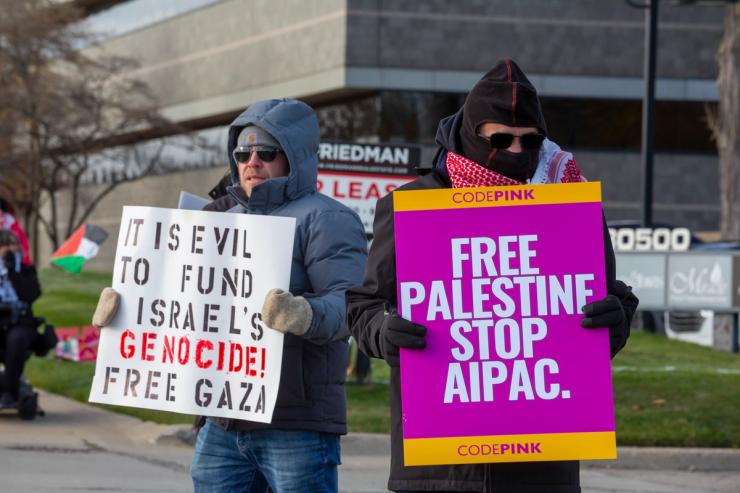
LANGLEY PARK, Md. — The toxicity of the American Israel Public Affairs Committee in Democratic primaries has officially grown beyond the war in Gaza. Just ask the two candidates challenging Rep. Steny Hoyer’s preferred successor.
Former Capitol Police officer Harry Dunn is denouncing Adrian Boafo, the retiring Hoyer’s preferred heir to his Maryland Democratic seat, for getting help from “the MAGA donors who fund AIPAC.” Another candidate for the 5th District nomination this fall, Prince George’s County legislator Wala Blegay, put it more directly: “People are tying the war in Iran to AIPAC.”
Democratic opposition to an Iran war that the US is conducting alongside Israel isn’t the only new factor driving the party base’s hostility toward AIPAC. Growing confusion about pop-up political action committees that use unfamiliar names is also playing a role by giving progressive candidates an opportunity to generate a speedy backlash.
Anti-AIPAC sentiment is helping to swing Democratic primaries across the country. In Michigan, the pro-Israel group’s support for Rep. Haley Stevens has become somewhat of an anchor weighing down her Senate bid. In Philadelphia, a liberal group that had received some support from AIPAC’s network just once found that the association was now toxic, hurting its ability to help a candidate.
And in the race to replace Hoyer, Boafo got condemned by other Democrats for his support from AIPAC’s best-known campaign committee.
The evolution of Democrats’ AIPAC problem comes nearly eight months after a ceasefire in Gaza that President Donald Trump touted as a meaningful resolution to two years of conflict, despite signs that progress on a long-term peace agreement has fizzled.
As progressive Democrats use weariness of war in Iran and skepticism of big money to keep driving voters away from AIPAC, however, other sectors of the party are getting dragged down. That new, messy reality unfolded for the 314 Action Fund, a group founded in 2016 to elect Democrats “with scientific or technical backgrounds.”
It received $1 million in 2024 from the United Democracy PAC, AIPAC’s first campaign committee, which went into aiding now-Rep. Maxine Dexter, D-Ore. She’s since voted to block military aid to Israel and renounced the group.
When a partially-inaccurate story in The Intercept highlighted the spending, the 314 Action Fund denied the UDP connection until after Dexter had won. But the murkiness of that story has made it hard for subsequent independent expenditure groups to convince voters that any money they’re spending did not start with AIPAC.
“Any time we make an endorsement or investment in a race, our opponents are branding our support as AIPAC money, and the truth is we haven’t accepted any contributions from AIPAC or affiliated entities in two years,” said Erik Polyak, 314 Action’s executive director.
“Every time we play in these races, our opponents are screaming ‘AIPAC,’ and they’re using it to take down our candidates,” he added.
In this article:

Know More
The AIPAC phenomenon affected another race that 314 Action Fund got involved in. The fund supported Ala Stanford, whose campaign for an open Philadelphia-area seat faltered for a number of reasons; among them was the perception of an AIPAC link.
In a poll conducted from April 15 through April 20, when primary voters in Pennsylvania’s 3rd District were asked about Stanford, none mentioned AIPAC.
In a poll taken between April 30 and May 2, 39% named either AIPAC or Israel as a negative association with her, and 38% of respondents identified her as the candidate supported by AIPAC.
Two developments were responsible. At a candidate forum, Stanford had refused to call Israel’s actions in Gaza “genocide,” comparing the use of the term to a racist insult against Black people.
Next, the left-leaning news site Drop Site reported on Stanford’s support from 314 Action Fund, which included $500,000 from a newly formed foundation which had also contributed to EDW Action Fund, an AIPAC-affiliated group that the site alleged had been used to “secretly funnel money to support Maxine Dexter.”
A strategist working with 314 Action found that the story was widely discussed on Philadelphia news forums and on social media, supplementing its coverage on local news. The negative AIPAC association had exploded in two weeks.
The fight in Michigan had built up more slowly. Stevens was one of the first beneficiaries of AIPAC’s expanded political strategy in 2021; the group continued to direct donors to candidates and supplemented that work with spending from UDP.
After Stevens defeated Rep. Andy Levin, a Jewish critic of Israel, AIPAC’s then-CEO called the race “proof of concept” for their new method of electing pro-Israel candidates.
Levin was unable to turn the race into a referendum on AIPAC, and Stevens embraced the organization, recording a post-primary video thanking it for corralling $5 million worth of help: “Our values spoke very loudly this evening.”
She’s been more circumspect this year. On Wednesday, the Detroit News detailed how AIPAC was intervening less visibly in the race, with donors moving through its own Democracy Engine portal.
Later that day, moderators of a Democratic primary debate asked Stevens what AIPAC’s support for her meant. Stevens responded with a non sequitur, that her campaign was a “love letter to Michigan” and that voters were “frustrated because we have not done comprehensive campaign finance reform.” Abdul El-Sayed, one of her more progressive primary opponents, said that the money “buys $3.5 billion sent to a foreign military that could be used here.”
Levin, who supports El-Sayed, said that AIPAC’s negative image had soared since he lost his House race to Stevens.
“I think they’re trailing an anchor through the water now,” he said of AIPAC. “When people see ads for Haley or against the others, I think they’re gonna take it with a grain of salt. Some of them, they’re just gonna dismiss it.”

Room for Disagreement
AIPAC did not comment when asked about how these primary debates had unfolded. Democratic Majority for Israel, which spends to help pro-Israel candidates in party primaries, redirected a question about what was happening to stand by the practice of pro-Israel groups messaging on issues that are entirely domestic.
“Ultimately, the most important thing is to win races and talk about the issues that voters care about, which is often affordability,” said Brian Romick, the president of DMFI Action PAC — and before that, a top staffer for Hoyer. “Different types of districts have different primary electorates, and we have to account for that in our strategies.”

David’s view
A few trends are converging to disconnect AIPAC’s problems from what’s happening in Gaza, which has faded from headlines in the US. First, the new progressive and far-left media — built up over the last half-decade as an alternative to corporate media — is getting in front of many Democratic voters who might have read more traditional outlets five years ago.
The power of a negative Drop Site story was more intense than I expected when I started calling around about these primaries.
Second, the cornucopia of “dark money” — let’s define that narrowly as spending that voters can’t easily trace to a source — is confounding more voters every year. Democrats are paranoid about progressive-sounding PACs that suddenly start telling them which candidate will “fight Trump,” only to find out after voting that the PAC was created by GOP operatives.
This is a major problem for AIPAC’s style of funding groups whose names and messaging have nothing to do with the group’s pro-Israel priorities. A candidate who disclaims “dark” or “corporate” money now faces risk if donors create a new group to help him or her.
Democratic voters are inclined to be skeptical, and to believe rumors that the group is funded by the same Israeli government that wanted the US to bomb Iran.

Notable
- Drop Site published another AIPAC/donor story that changed how local voters heard about their race — this time, the contest to replace Nancy Pelosi in San Francisco.
- HuffPost covered the success of Adam Hamawy, a Muslim physician whose New Jersey congressional campaign thrived with early support from pro-Palestinian groups.
- In late March, The Bulwark challenged the “vibes”-based research of AIPAC Tracker, which has applied different standards for “pro-Israel” ties depending on the specific politics and alliances of candidates.
Correction: An earlier version of this story incorrectly described the nature of the foundation’s contribution.