



The News
President Donald Trump’s administration is intensifying efforts to broker a deal to end Libya’s 15-year conflict. But critics warn the deal is an “elite bargain” that could backfire and undermine a UN road map to elections — and could cement the dominance of rival strongmen at the heart of the country’s political crisis.
The US initiative aims to end more than a decade of political division by striking a power-sharing agreement between Libya’s two rival leaders: military commander Khalifa Haftar in the east and Prime Minister Abdul Hamid al-Dbeibah in the west.
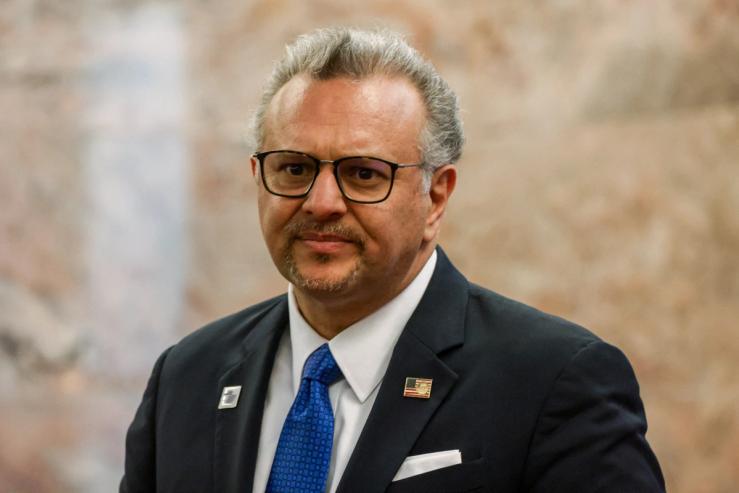
Massad Boulos, Trump’s senior adviser on Africa and Tiffany Trump’s father-in-law, is brokering the deal. Under the reported terms of the proposal, the Dbeibah family would retain the prime minister’s office while the Haftar family would head the Presidency Council, the three-member collective head of state.
“The United States supports a Libyan-led, consensus-based political process toward unified governance and stability, with a path to credible national elections,” a State Department official told Semafor.
Analysts, however, say the administration is prioritizing short-term stability over a long-term solution, particularly to pave the way for American oil companies to enter Libya.
“This has the hallmarks of a Trump transaction,” Cameron Hudson, a White House official on Africa during the George W. Bush administration.
“They’re not worried about the Libya that they pass off to the next administration,” he added. “They’re worried about beating the Europeans and the Turks to the oil market in Libya.”
In this article:

Know More
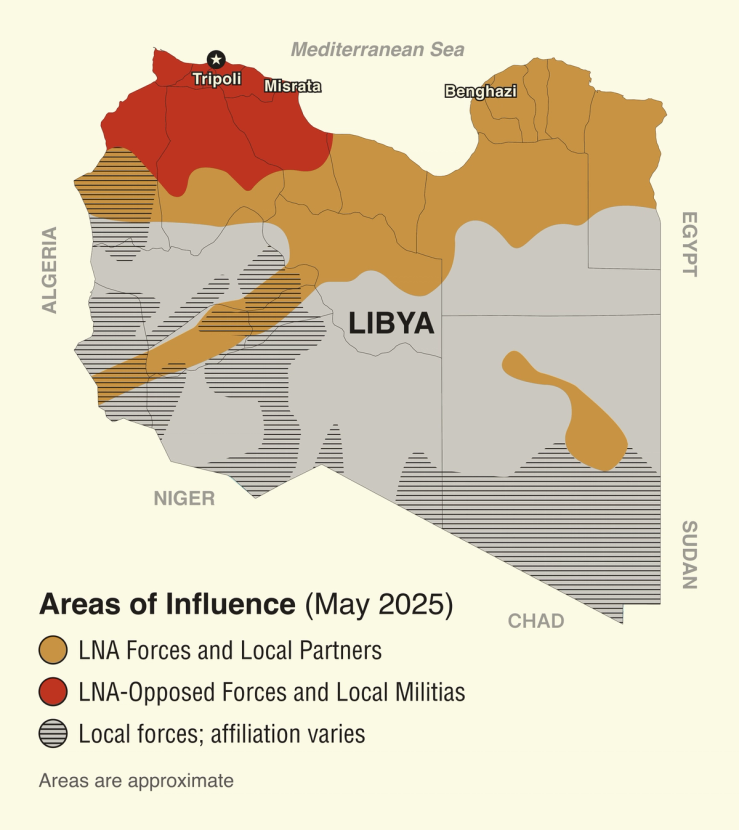
Since the 2011 overthrow of Muammar Gaddafi, Libya has remained de facto split between competing political and military centers of power. Although the UN-backed Government of National Unity, headed by Dbeibah, is internationally recognized, much of eastern Libya is controlled by the Haftar family and their Libyan Arab Armed Forces, leaving the country unable to function as a unified state.
Boulos has spent more than a year trying to broker an arrangement between the two factions, saying publicly that if the deal is successful, it could be signed in Washington in Trump’s presence.
Boulos’ latest trip last week illustrates how his shuttle diplomacy is driving the talks: He started Monday in Malta before traveling to Misrata, then to Tripoli, where he met Dbeibah and the technocrats overseeing Libya’s finances, and then to Benghazi, for a sit-down with Haftar. He ended the trip back in Tripoli, where he met with Libya’s interior minister and UN Special Representative Hanna Tetteh.
The tour followed a symbolically loaded moment the week before, when Secretary of State Marco Rubio met Saddam Haftar — Khalifa Haftar’s son, deputy, and presumed successor — in Washington, in a major status boost for a man with no official political title.
“It was quite a significant move for the secretary to welcome basically a military commander to the seventh floor of the State Department,” said Ben Fishman, former National Security Council director for Libya during the Obama administration and a senior fellow at the Washington Institute for Near East Policy.
Critics fear the proposed Boulos settlement could collapse into renewed fighting. Karim Mezran of the Atlantic Council warned that various factions could react badly to the deal, and “if one of the militias starts shooting at the others, then what happens?”
Others argue the deal guts a parallel UN process aimed at elections and long-term political resolution, sidelining ordinary Libyans from having a say in their political future.
“I think it basically kills the UN plan,” Fishman said. “These guys have no interest in giving up power. …The problem in Libya historically has been that once people have access to the money of the state, they fight like hell not to let it go or give away that access to power and wealth.”
The Trump administration refuted that notion. “The United States continues to support the [United Nations Support Mission in Libya] roadmap,” the State Department official said.

Step Back
Analysts say the Libya negotiations fit an emerging pattern in Trump’s foreign policy: pairing myopic diplomatic agreements with access to strategically valuable natural resources.
Hudson traces a pattern to Boulos’ DR Congo deal, which he negotiated “largely in secret, even in secret from his own government.” He warned that deals struck this way lack durability once disputes arise: “You go faster alone and further together. [Boulos] is going faster alone.”
Analysts add that Libya’s economic potential is a major driver of the deal. Libya holds Africa’s largest proven oil reserves, and US energy companies have been steadily expanding their footprint in the country. Over the past year, Libya’s National Oil Corporation has signed agreements with American energy companies Chevron, Halliburton, and ConocoPhillips.
Experts say that Boulos’ proposed agreement could further open the door to American energy companies interested in the country, mirroring other Trump administration strategies in conflict zones.
“If you want a unified Trump administration foreign policy field theory, it’s natural resource capture and exploitation,” former US Special Envoy for Libya Jonathan Winer during the Obama administration told Semafor. He cited Trump’s various proposals for Greenland, Venezuela, and Iran as among several recent examples.

Room for Disagreement
Some analysts push back, saying a Libya pact bolsters US diplomatic efforts in Africa. Zineb Riboua, research fellow with the Hudson Institute’s Center for Peace and Security in the Middle East, characterized the deal as a strategic opening, saying she believes “the United States sees [it] rightfully as a good opportunity.”
She argued that the Trump administration’s plan “is more valuable than doing absolutely nothing and leaving that void for a very long time while emerging threats are just accumulating.”
“It’s very important to have functioning states so that you can conduct counterterrorism operations properly or can rely on partners,” she added of the US’ strategy.

Notable
- Boulos’ portfolio across Africa has been defined by his relative freedom to blend diplomacy with dealmaking, as a profile from Tablet Magazine connecting him to an oil company operating in Libya lays out.
- Sources tell The National that Pakistan is seeking to help the US broker a deal in Libya with backing from Saudi Arabia.