




The News
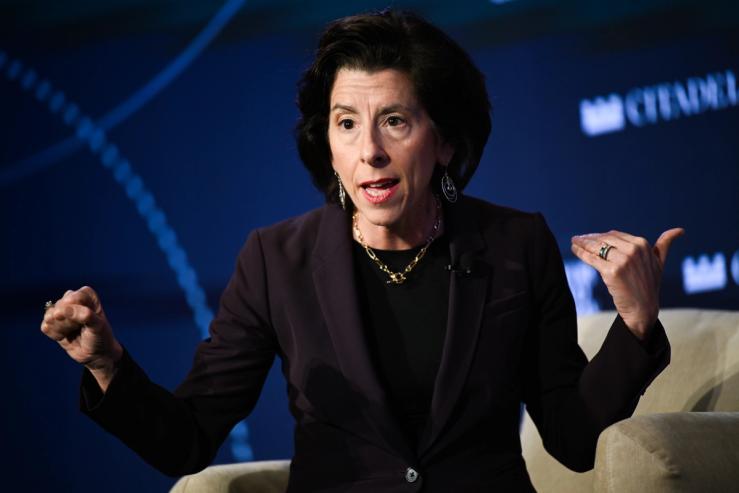
Former Commerce Secretary Gina Raimondo and Eric Holcomb, Indiana’s former Republican governor, are leading a new effort to help the US workforce adapt to the economy in the age of artificial intelligence.
The nonpartisan group, RAISE US, has backing from major AI firms like the OpenAI Foundation and Anthropic, as well as other prominent corporations like Bank of America and Amazon, according to details shared with Semafor. As a first step, the organization is teaming up with red and blue states — Arkansas, Connecticut, Maryland, and Utah — to test programs that support workers as the AI boom reshapes the US economy.
The project’s central goal is to use private capital — more than half a billion dollars from donors thus far — to encourage companies to retrain and redeploy workers; support people in job transition; and effectively train people for jobs in the AI economy, Raimondo, who served in the Biden administration and will be CEO of RAISE US, told Semafor in an interview,
Its leaders are talking to the Trump administration, too, Raimondo said, alluding to conversations with Acting Labor Secretary Keith Sonderling.
“I’m excited about AI and all that the technology can do, but I am worried that we have to be purposeful and intentional to have a plan for America’s workforce,” she said.
Raimondo described near-constant outreach “from senators of both parties, congresspeople of both parties, governors of both parties, CEOs of all industries calling me saying, ‘How do you think about this? What are we going to do?’”
In this article:

The View From gina raimondo
This interview has been edited for length and clarity.
Morgan Chalfant: Where did the idea come from for this?
Gina Raimondo: When I was commerce secretary, I spent so much time thinking about AI and chips — the CHIPS Act was really an AI industrial strategy — and became obsessed with making sure America leads the global AI race. That being said, I as governor and throughout my career have always wanted to make sure that workers don’t get left behind.
I’m excited about AI and all that the technology can do, but I am worried that we have to be purposeful and intentional to have a plan for America’s workforce.
Have you had any conversations with the Trump administration about this, or do you plan to?
Yes. By the way, we want to work with everyone who wants to work with us in good faith and hard work. Because this is hard stuff. But yes, we’ve been meeting with Secretary Sonderling, who I think is doing a good job and who we are very aligned with his approach on much of this. I should also say — I am constantly — if not constantly, regularly — hearing from senators of both parties, congresspeople of both parties, governors of both parties, CEOs of all industries, calling me, saying, ‘How do you think about this? What are we going to do?’ There is a high level of anxiety, not a lot of certainty, super fast-changing situation — which is why I decided to do this.
Do you think there is time to develop and implement what you call a “people strategy,” given the pace at which the technology is evolving and being deployed?
It’s a worrying issue because, as you said, the technology is being implemented fast. That being said, it’s going to take time — a little bit of time — for companies to so fully implement AI in a way that they start changing the structures of their organizations and the way they do work before you start to see any potential labor market disruption at a big level. So it’s going to be hard, definitely, and we can’t solve everything, but I think we have a bit of time.
Does the public concern about AI and public opposition to things like data centers affect your work?
Of course it affects our work. Opposition to AI seems to be growing by the day, opposition to data centers is growing by the day, fear related to AI is growing by the day.
That’s just a reality, and you know what’s interesting — America is an outlier. If you look at public sentiment towards AI in Europe, Africa, China, Asia, it’s not nearly as negative. So, to me, that means we have to really listen to where people are coming from and I personally think much of the anxiety comes from people’s concerns about job security. And so, if anything, it should make us so much more urgent about the work that we’re doing.
What do you think about this idea of the US government taking a stake in big AI companies?
In this regard, I am speaking as a former governor and Cabinet official, not so much for RAISE US, because at this point we’re not planning to wade into the national tax debate. In general, I get queasy when we start to talk about government ownership of companies.
I didn’t like, for example, when the government took an ownership stake in Intel that converted the grant that we had given into an equity ownership. The things that have made our economy the best, most dynamic, most resilient, most amazing in the world is actually private capital funding private enterprise with limited interference from government.
And I worry a lot that, when you go down the slippery slope of government owning a means of production — I mean, what does that sound like to you? To me, it sounds like socialism. To me, it sounds like an invitation for corruption. To me, I don’t know a state-owned enterprise that is as efficient and well-run as it could be if it weren’t a state-owned enterprise.
Have you thought any more about 2028? Have you closed the door to a run, or are you still open to it?
I’m doing this. I’m excited to do this. I’m the CEO of this. I’m full-time doing this. I loved my time in government, but I think that this, which is out of government but working with government, I’m excited by being able to do something that is bipartisan, that embraces compromise, and that’s just practical — all things that I have found to be increasingly hard to do in politics.

Notable
- Treasury Secretary Scott Bessent and Commerce Secretary Howard Lutnick have discussed different ways to structure potential government equity stakes in major AI companies, Semafor’s Eleanor Mueller reported.
- Companies like Oracle are already blaming AI for layoffs, Bloomberg reported.