




David’s view
It used to be so much easier to sell a war of choice.
Bill Clinton mobilized troops for NATO’s mission to bomb Yugoslavia, and around three in five Americans approved. George W. Bush announced Operation Iraqi Freedom; more than 70% of adults went along with it. Americans were war-wearier in 2011, after electing the only presidential candidate who’d promised to get out of Iraq. But half of them heard Barack Obama endorse a no-fly zone over Libya and said: Why not?
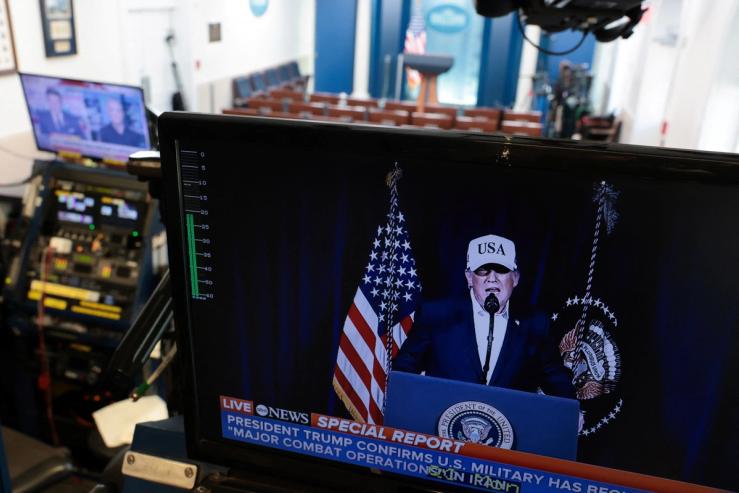
Operation Epic Fury doesn’t get that benefit of the doubt. If you’re old enough to remember the Iraq War build-up, a year-long sales job that it became “unpatriotic” to question, the lack of any real presidential persuasion effort has been surreal.
The administration and supportive media outlets are making that case now. Their pitch : The president is ending, not starting, a “forever war” started by Iran and left behind by weaker, less decisive presidents.
It’s an unusually tortured argument, but it had to be. The voters who joined Trump’s coalition in 2024, after staying far away from it in 2016 and 2020, were told that Trump wouldn’t do something like this – but that it would definitely happen if he lost.
“Our interest, I think, very much, is in not going to war with Iran,” JD Vance told Tim Dillon, as part of Trump-Vance campaign’s phenomenally successful podcast tour back in 2024. “It would be a huge distraction of resources; it would be massively expensive to our country.”
Saying things into microphones is risky, because people might remember what you say. At the end of the Trump campaign, especially after Liz Cheney and her father endorsed Kamala Harris, the candidate and his team warned that this team-up of neocons and social justice warriors would “invade the whole Middle East.” Director of National Intelligence Tulsi Gabbard, who as a 2020 presidential candidate promised to “stop Donald Trump from starting a war with Iran,” is suddenly more interested in finding out who won the 2020 presidential election in Georgia. (The surprising answer: Joe Biden.)
It’s easy to find candidates reversing their promises once they win power. Republicans can play this game, too, tunneling through the C-Span archives to find Chuck Schumer and Nancy Pelosi endorsing the sort of action that they can’t, inside their party, endorse right now.
But Trump is operating in a political theater he rebuilt over a decade, by denouncing the Iraq War, and deriding Hillary Clinton’s “judgment” in voting for it. The victory of the “America First” conservatives, led by Trump, gave Republicans the zero-sum argument that Bush and Cheney left to Democrats. Every dollar spent in a foreign war was a dollar stolen from a bridge in Steubenville or a school lunch program in Dubuque. Even the deployment of the National Guard to the border and American cities was previewed, during the 2024 campaign, as a smart alternative to foreign adventurism.
“Our country is being destroyed by a radical political class that sends our guardsmen and women to defend the borders of distant foreign nations while they surrender our own borders to an invasion right here at home,” Trump said in a campaign speech to the National Guard Association.
This was a powerful, easily understandable populist argument. Democrats want it back. They have no fear, whatsoever, that the war will go so well that voters will punish the people who opposed it. The downside risk of supporting a war, even one that goes better than anybody expected, is higher than the risk of opposing it.
This was one lesson I took away from the centrist Democratic think tank Third Way’s conference in South Carolina this week. Put together to make the moderate wing of the party as robust as possible, ahead of the midterms and the 2028 primary, it started with a moment of silence for service members killed in OEF and Third Way President Jonathan Cowan urging Democrats to oppose the war.
“I do not see a scenario by which, in 2028, what Trump has done here is popular,” Cowan told me after his speech. I heard the lessons of 2008 and 2016 when he said that. Had Clinton voted against the 2002 war resolution, she would have negated Barack Obama’s best issue and very likely become president; had she lost that race, she’d have knocked away one of the weapons Trump used in 2016 to convince disgruntled Bernie Sanders voters to stay home, vote Green, or give him a shot.
The Iraq War’s unpopularity smoothed over many of the Democrats’ divisions in the Clinton-Obama race. Something similar could happen with the U.S.-Israeli strikes on Iran. Support for military aid to Israel has collapsed inside the party, and it’s much easier to oppose Trump’s war – the bad polls help – than to sort this out. Yesterday, in North Carolina, Rep. Valerie Foushee survived a challenger who called Israel’s Gaza war a “genocide” by renouncing her past support from AIPAC and co-sponsoring a bill to cut aid, and then, crucially, denouncing the new war.
Foushee’s not going to run for president. The Democrats who do will have to answer questions about when they would and wouldn’t risk American lives. But they generally agree that the Obama-era nuclear deal would have prevented this. And they’re all in the basic position that Trump was when he re-shuffled the electorate 10 years ago.

Notable
- In the American Conservative, Hunter DeRensis urged Gabbard to resign from the administration, perhaps to run for office later as a credible anti-war candidate. “There is nothing more of value that Gabbard can render to this administration without sacrificing her own credibility.”
- In Politico, Ian Ward looked at how Vance’s born-again belief in regime change had alienated some of his America First supporters.
- In the New York Times, Michelle Goldberg chided the people who ever claimed that Trump’s post-facto criticism of the Iraq War made him an “anti-war” candidate.