




The News
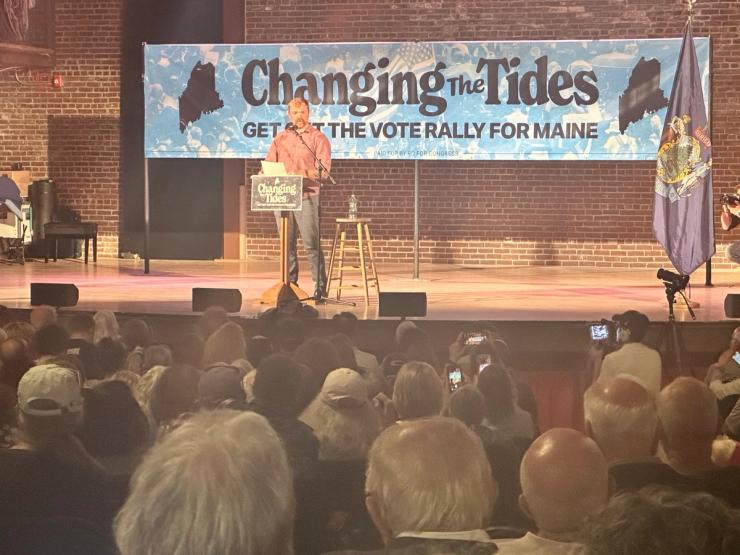
BAR HARBOR, Maine — Outside the Criterion Theatre, Graham Platner’s Senate campaign was in shambles, chastised by some Democrats and abandoned by others. Inside the building, 500 Mainers greeted him as a flawed, relatable hero.
The crowd even chanted his wife Amy’s name when he acknowledged their nearly three-year-old marriage had its stumbles, exposed last week in newspapers of record that documented his sexual messages to other women.
“When hurtful things I said on the internet a decade ago came out into the public, as I shared my personal journey through PTSD and darkness of recovery and accountability and growth — Maine had my back,” Platner said.
He then alluded to the second hit of negative coverage, a New York Times report on three former girlfriends who recalled occasionally volatile and intimidating behavior that he has denied: “And when politically motivated, serious, and false accusations are made against me: Maine, you have my back.”
Pulled from obscurity last year by labor unions and progressive strategists, Platner has become the kind of candidate both parties dread: one whose words and messy personal life keep throwing them off-message. What started as a drive to find working-class candidates outside the party’s usual bench is now a potential problem for Democrats everywhere, not least because Platner has no intention of heeding pressure to step aside.
Maine Democrats will decide on Tuesday whether to nominate him to face Sen. Susan Collins, a Republican seeking her sixth term. Gov. Janet Mills, who suspended her bid when Platner built an overwhelming poll lead, is reminding voters that she’s still on the ballot. David Costello, a Democratic activist, warned that Platner is “starting to bleed support.”
“All of us are fairly nervous about his chances, and what information Republicans might be holding back about him until the primary’s over,” added Costello, who said more people had been showing up to his meet-and-greets.
The Platner team is projecting confidence that it understands Maine voters much better than the DC professionals. Morris Katz, Platner’s lead strategist, told Semafor that the campaign’s message was always built on “redemption,” and that the candidate spoke to the kind of man who didn’t vote for Democrats anymore.
“He was ashamed of some of the things he said and did. Unlike others, he took accountability for it,” said Rep. Ro Khanna, D-Calif., in Bar Harbor. Khanna added that Platner had made mistakes, but they weren’t all his fault; he described the candidate as an avatar for “thousands of young men” whose lives were broken by “dumb wars.”
Encapsulating the fine line the Platner campaign has to walk, Khanna also said Platner should apologize to the ex-girlfriends who described his mistreatment of them.
In this article:

Know More
Platner’s run began as a challenge to the Democratic “establishment,” a loosely defined but well-understood term. The candidate had acknowledged that he’d done things ripe for use in campaign attack ads, from his years of off-color and occasionally offensive Reddit posts to the Nazi tattoo he claimed he’d gotten with fellow Marines before learning its meaning.
Jordan Wood, a former Hill staffer who had sought the Senate seat before leaving to run for the open 2nd Congressional District, said the Democratic Senatorial Campaign Committee made a strategic error by trying to undermine all of Mills’ rivals.
“Thank you to the DSCC for trying to f*ck us over,” said Wood. “They didn’t even know Graham enough to f*ck him over. … Because the other part of his message was that the establishment was trying to stop him.”
Mills quit the race on April 30. The next day, Republicans began pounding him over the same opposition research that she’d tried to use against him.
“He’ll no longer be able to live in the state after we thoroughly beat the sh*t out of him,” Alex Latcham, the executive director of the Senate Leadership Fund, told Semafor.
But Platner’s ability to withstand early attacks became a point of pride for the progressives who’d recruited him. Until last week, when Democratic patience with Platner ebbed amid the dual reports of his behavior toward women.
Not only has his campaign’s strategy not changed since then, but Katz went after “incompetent, opportunistic operatives” who’d betrayed Platner rather than offering any contrition. When the Times published an interview with a Platner ex who recalled arguments where he’d “grabbed her by the shoulders,” the candidate gave MSNOW an interview where he called the worst allegations “politically motivated” and “simply not true.“Only in Maine could Platner manage to replicate what helped him rise by telling voters that he wanted to throw out the old Democratic order. What if everyone in Maine had the universal health care he got as a veteran? What if they had “the freedom to take risks, start a business, make art, make music, fall in love, and raise a family?” What if they replaced Collins, whose husband used to be a defense lobbyist?
“You don’t see as many articles about that,” he said.

David’s view
The Democrats’ crisis in Maine is a factional battle in which one faction, the progressives, got the high ground early. It seized a moment when primary voters were maximally skeptical of anything they heard from party leaders in DC.
His campaign is now greeting the type of headlines that might derail other candidates by digging in on the message that got him this far: Because of his potential to disrupt the status quo, Republicans and Democrats have tag-teamed a push to destroy him with details about his pre-campaign life.
How does Platner want to meet that challenge? Not by encouraging the entire Democratic Party to unify around him. That won’t happen.
Instead he’s attacked the faction that opposes him, responding to a week of attacks from Sen. John Fetterman, D-Pa., by calling him “a stooge for AIPAC and the Republican Party.” (Fetterman, incidentally, got elected with a progressive brand using some of the same strategists as Platner.)

The View From Voters
Platner’s supporters entered the Friday rally through a phalanx of cameramen asking what they thought of their candidate now. They were a little tense when the candidate started talking about his scandals. But many later insisted that all of it was a test from DC.
“I think it’s going to get worse before it gets better,” said Safiya Khalid, 30. “I think he is getting a taste of what’s to come, and it’s really helping him grow that thick skin that he needs on the campaign trail, and when he’s a senator.”

Notable
- In The Nation, Joan Walsh credited Platner’s rise and resilience to “white male identity politics,” ignored by Democrats at their peril.
- In New York, David Freedlander assessed how Platner’s troubles were affecting Katz, a bright star in left-wing Democratic politics. “There was fear, of course, about dreams of a Democratic majority in the U.S. Senate slipping away but also something that, if not quite glee, has a suitable German equivalent.”
- In conversation with fellow New York Times columnists, Jamelle Bouie argued that Platner is “representative of the median voter.”
- In The Bulwark, Lauren Egan talked to Democratic strategists who think that Fight Agency, the firm that works with Platner, hurt the party.